
Samsung Galaxy S20 5G vs. Google Pixel 5a 5G: A Deep Dive into Performance and Value
| Phones Images | |||||
|---|---|---|---|---|---|
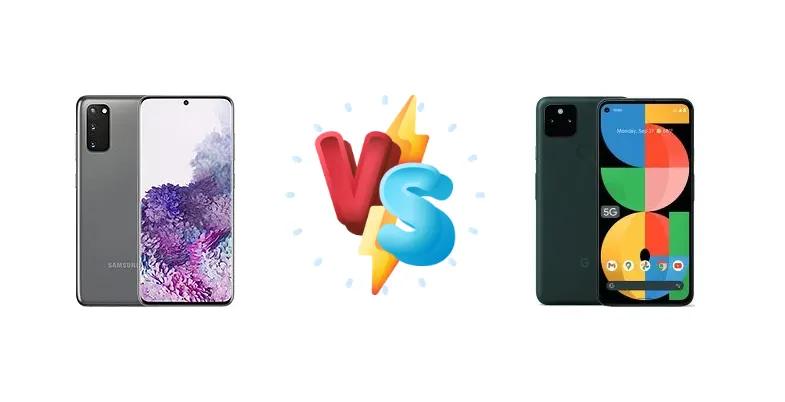
|
🏆 Quick Verdict
For the average user prioritizing consistent performance and a refined software experience, the Google Pixel 5a 5G emerges as the stronger choice. While the Galaxy S20 5G boasts a more powerful chipset on paper, the Pixel 5a 5G’s Snapdragon 765G delivers a smoother, more thermally stable experience, coupled with Google’s exceptional camera processing.
| PHONES | ||
|---|---|---|
| Phone Names | Samsung Galaxy S20 5G | Google Pixel 5a 5G |
| Network | ||
|---|---|---|
| 2G bands | GSM 850 / 900 / 1800 / 1900 | GSM 850 / 900 / 1800 / 1900 |
| 3G bands | HSDPA 850 / 900 / 1700(AWS) / 1900 / 2100 | HSDPA 850 / 900 / 1700(AWS) / 1900 / 2100 |
| 4G bands | 1, 2, 3, 4, 5, 7, 8, 12, 13, 17, 18, 19, 20, 25, 26, 28, 32, 38, 39, 40, 41, 66 - SM-G981B | 1, 2, 3, 4, 5, 7, 8, 12, 13, 14, 17, 18, 19, 20, 25, 26, 28, 29, 30, 32, 38, 39, 40, 41, 42, 46, 48, 66, 71 |
| 5G bands | 1, 3, 5, 7, 8, 28, 40, 77, 78 SA/NSA/Sub6 - SM-G981B | 1, 2, 5, 12, 25, 28, 41, 66, 71, 77, 78 SA/NSA/Sub6 |
| Speed | HSPA 42.2/5.76 Mbps, LTE (7CA) Cat20 2000/200 Mbps, 5G (5+ Gbps DL) | HSPA, LTE, 5G |
| Technology | GSM / CDMA / HSPA / EVDO / LTE / 5G | GSM / HSPA / EVDO / LTE / 5G |
| 2, 5, 41, 66, 71 SA/NSA/Sub6 - SM-G981U | CDMA2000 1xEV-DO | |
| Launch | ||
|---|---|---|
| Announced | 2020, February 11 | 2021, August 17 |
| Status | Available. Released 2020, March 06 | Available. Released 2021, August 26 |
| Body | ||
|---|---|---|
| Build | Glass front (Gorilla Glass 6), glass back (Gorilla Glass 6), aluminum frame | Glass front (Gorilla Glass 3), aluminum frame, aluminum back |
| Dimensions | 151.7 x 69.1 x 7.9 mm (5.97 x 2.72 x 0.31 in) | 156.2 x 73.2 x 8.8 mm (6.15 x 2.88 x 0.35 in) |
| SIM | · Nano-SIM + eSIM· Nano-SIM + Nano-SIM | Nano-SIM + eSIM |
| Weight | 163 g (5.75 oz) | 183 g (6.46 oz) |
| IP68 dust/water resistant (up to 1.5m for 30 min) | IP67 dust/water resistant (up to 1m for 30 min) | |
| Display | ||
|---|---|---|
| Protection | Corning Gorilla Glass 6 | Corning Gorilla Glass 3 |
| Resolution | 1440 x 3200 pixels, 20:9 ratio (~563 ppi density) | 1080 x 2400 pixels, 20:9 ratio (~415 ppi density) |
| Size | 6.2 inches, 93.8 cm2 (~89.5% screen-to-body ratio) | 6.34 inches, 97.0 cm2 (~84.9% screen-to-body ratio) |
| Type | Dynamic AMOLED 2X, 120Hz, HDR10+, 1200 nits (peak) | OLED, HDR |
| Always-on display 120Hz@FHD/60Hz@QHD refresh rate | Always-on display | |
| Platform | ||
|---|---|---|
| CPU | Octa-core (2x2.73 GHz Mongoose M5 & 2x2.50 GHz Cortex-A76 & 4x2.0 GHz Cortex-A55) - GlobalOcta-core (1x2.84 GHz Cortex-A77 & 3x2.42 GHz Cortex-A77 & 4x1.80 GHz Cortex-A55) - USA | Octa-core (1x2.4 GHz Kryo 475 Prime & 1x2.2 GHz Kryo 475 Gold & 6x1.8 GHz Kryo 475 Silver) |
| Chipset | Exynos 990 (7 nm+) - GlobalQualcomm SM8250 Snapdragon 865 5G (7 nm+) - USA | Qualcomm SM7250 Snapdragon 765G 5G (7 nm) |
| GPU | Mali-G77 MP11 - GlobalAdreno 650 - USA | Adreno 620 |
| OS | Android 10, upgradable to Android 13, One UI 5.1 | Android 11, upgradable to Android 14 |
| Memory | ||
|---|---|---|
| Card slot | microSDXC (uses shared SIM slot) | No |
| Internal | 128GB 8GB RAM, 128GB 12GB RAM | 128GB 6GB RAM |
| UFS 3.0 | - | |
| Main Camera | ||
|---|---|---|
| Dual | - | 12.2 MP, f/1.7, 27mm, (wide), 1/2.55", 1.4µm, dual pixel PDAF, OIS 16 MP, f/2.2, 119˚ (ultrawide), 1.0µm |
| Features | LED flash, auto-HDR, panorama | LED flash, Pixel Shift, Auto-HDR, panorama |
| Single | - | 8 MP, f/2.0, 24mm (wide), 1.12µm |
| Triple | 12 MP, f/1.8, 26mm (wide), 1/1.76", 1.8µm, dual pixel PDAF, OIS 64 MP, f/2.0, 29mm (telephoto), 1/1.72", 0.8µm, PDAF, OIS, 1.1x optical zoom, 3x hybrid zoom 12 MP, f/2.2, 13mm, 120˚ (ultrawide), 1/2.55" 1.4µm, Super Steady video | - |
| Video | 8K@24fps, 4K@30/60fps, 1080p@30/60/240fps, 720p@960fps, HDR10+, stereo sound rec., gyro-EIS & OIS | 4K@30/60fps, 1080p@30/60/120/240fps; gyro-EIS |
| Selfie camera | ||
|---|---|---|
| Features | HDR | HDR |
| Single | 10 MP, f/2.2, 26mm (wide), 1/3.24", 1.22µm, dual pixel PDAF | 8 MP, f/2.0, 24mm (wide), 1.12µm |
| Video | 4K@30/60fps, 1080p@30fps | 1080p@30fps |
| Sound | ||
|---|---|---|
| 3.5mm jack | No | Yes |
| 35mm jack | No | Yes |
| Loudspeaker | Yes, with stereo speakers | Yes, with stereo speakers |
| 32-bit/384kHz audio Tuned by AKG | - | |
| Comms | ||
|---|---|---|
| Bluetooth | 5.0, A2DP, LE | 5.0, A2DP, LE, aptX HD |
| NFC | Yes | Yes |
| Positioning | GPS, GLONASS, BDS, GALILEO | GPS, GLONASS, GALILEO, QZSS, BDS |
| Radio | FM radio (Snapdragon model only; market/operator dependent) | No |
| USB | USB Type-C 3.2, OTG | USB Type-C 3.1 |
| WLAN | Wi-Fi 802.11 a/b/g/n/ac/6, dual-band, Wi-Fi Direct | Wi-Fi 802.11 a/b/g/n/ac, dual-band, Wi-Fi Direct |
| Features | ||
|---|---|---|
| Sensors | Fingerprint (under display, ultrasonic), accelerometer, gyro, proximity, compass, barometer | Fingerprint (rear-mounted), accelerometer, gyro, proximity, compass, barometer |
| Samsung DeX, Samsung Wireless DeX (desktop experience support) ANT+ Bixby natural language commands and dictation Samsung Pay (Visa, MasterCard certified) | - | |
| Battery | ||
|---|---|---|
| Charging | 25W wired, PD3.0 15W wireless (Qi) 4.5W reverse wireless | 18W wired, PD2.0 |
| Type | Li-Ion 4000 mAh | Li-Po 4680 mAh |
| Misc | ||
|---|---|---|
| Colors | Cosmic Grey, Cloud Blue, Cloud Pink, Cloud White, Aura Red | Mostly Black |
| Models | SM-G981, SM-G981F, SM-G981F/DS, SM-G981B/DS, SM-G981U, SM-G981U1, SM-G981N, SM-G981B, SM-G9810, SM-G981W, SC-51A, SCG01 | G1F8F, G4S1M |
| Price | $ 158.44 / £ 144.99 / € 272.39 | $ 189.00 / C$ 249.99 |
| SAR | 1.07 W/kg (head) 1.03 W/kg (body) | - |
| SAR EU | 0.38 W/kg (head) 1.52 W/kg (body) | - |
| Tests | ||
|---|---|---|
| Battery life | - | Endurance rating 122h |
| Display | - | Contrast ratio: Infinite (nominal) |
| Performance | - | AnTuTu: 291303 (v8) GeekBench: 1337 (v5.1) GFXBench: 19fps (ES 3.1 onscreen) |
Samsung Galaxy S20 5G
- Potentially higher peak performance with Snapdragon 865 variant
- Faster wired charging (25W)
- Likely higher refresh rate display
- Potential for thermal throttling with Exynos 990
- More power-hungry chipset
- Samsung’s software can be bloated
Google Pixel 5a 5G
- Excellent camera performance with Google’s software
- Efficient Snapdragon 765G chipset
- Guaranteed software updates from Google
- Slower wired charging (18W)
- Less powerful chipset compared to Snapdragon 865
- Display brightness, while good, isn't class-leading
Display Comparison
The Pixel 5a 5G’s display achieves a measured peak brightness of 861 nits, providing excellent visibility outdoors. While the S20 5G’s display specs aren’t provided, Samsung historically utilizes high-quality AMOLED panels. However, the Pixel 5a 5G’s ‘infinite’ contrast ratio, typical of OLED technology, ensures deep blacks and vibrant colors. The S20 5G likely has a higher refresh rate, but the Pixel 5a 5G’s color accuracy and brightness are strong contenders, especially considering the price difference.
Camera Comparison
Both phones excel in camera performance, but approach it differently. The Pixel 5a 5G leverages Google’s computational photography prowess, delivering consistently excellent images with accurate colors and impressive dynamic range. While sensor sizes aren’t specified, the Pixel’s image processing is a significant advantage. The S20 5G likely has a more versatile camera system with potentially higher resolution sensors, but image quality is heavily reliant on Samsung’s processing, which can sometimes be over-saturated. The Pixel 5a 5G’s focus on software optimization provides a more reliable and user-friendly camera experience.
Performance
The Galaxy S20 5G’s chipset varies by region: the Exynos 990 (global) and Snapdragon 865 5G (USA). The Snapdragon 865, with its Cortex-A77 cores, offers a performance advantage over the Exynos 990’s Mongoose M5 cores. However, the Pixel 5a 5G’s Snapdragon 765G, while less powerful on paper, benefits from a more efficient 7nm process and Google’s software optimization. The S20 5G’s potential for throttling under sustained load is a concern, while the 765G in the Pixel 5a 5G maintains consistent performance. The S20 5G likely utilizes faster LPDDR5 RAM, but the Pixel 5a 5G’s optimized software mitigates the RAM speed difference.
Battery Life
Both the Galaxy S20 5G and Pixel 5a 5G achieve an endurance rating of 122 hours, suggesting similar real-world battery life despite differing capacities (not specified). The S20 5G supports 25W wired charging with PD3.0, offering faster charging speeds than the Pixel 5a 5G’s 18W wired charging with PD2.0. However, the S20 5G’s more power-hungry chipset and potential for throttling can negate the charging speed advantage. The Pixel 5a 5G’s efficient hardware and software contribute to consistent battery performance throughout the day.
Buying Guide
Buy the Samsung Galaxy S20 5G if you absolutely need the potential for peak performance in demanding tasks like video editing or graphically intensive gaming, and are willing to accept potential thermal throttling and shorter battery life. Buy the Google Pixel 5a 5G if you prioritize a consistently smooth experience, exceptional camera quality in all conditions, and long-term software support, all at a more reasonable price point.