
Samsung Galaxy S20 5G UW vs. S21 5G: Which Samsung Flagship Reigns Supreme?
| Phones Images | |||||
|---|---|---|---|---|---|
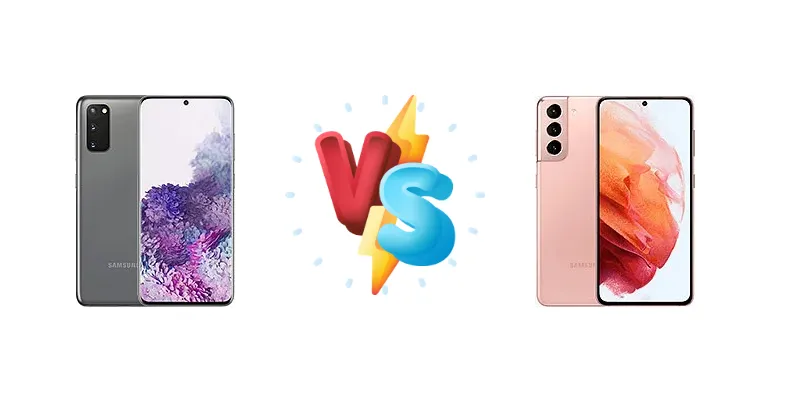
|
🏆 Quick Verdict
For most users, the Samsung Galaxy S21 5G is the better buy. The newer Exynos 2100 or Snapdragon 888 chipset (depending on region) delivers a noticeable performance boost, and while battery life is similar, the S21’s more efficient processor and software optimizations provide a slightly smoother experience. The S20 5G UW remains a viable option for those prioritizing price above all else.
| PHONES | ||
|---|---|---|
| Phone Names | Samsung Galaxy S20 5G UW | Samsung Galaxy S21 5G |
| Network | ||
|---|---|---|
| 2G bands | GSM 850 / 900 / 1800 / 1900 | GSM 850 / 900 / 1800 / 1900 |
| 3G bands | HSDPA 850 / 900 / 1700(AWS) / 1900 / 2100 | HSDPA 850 / 900 / 1700(AWS) / 1900 / 2100 |
| 4G bands | 2, 3, 4, 5, 7, 8, 13, 18, 19, 20, 26, 28, 48, 66 | 1, 2, 3, 4, 5, 7, 8, 12, 13, 14, 18, 19, 20, 25, 26, 28, 30, 38, 39, 40, 41, 46, 48, 66, 71 - SM-G991U1 |
| 5G bands | 260, 261 mmWave | 2, 5, 25, 41, 66, 71, 260, 261 SA/NSA/Sub6/mmWave - SM-G991U1 |
| Speed | HSPA 42.2/5.76 Mbps, LTE (7CA) Cat20 2000/200 Mbps, 5G (5+ Gbps DL) | HSPA 42.2/5.76 Mbps, LTE (7CA) Cat20 2000/200 Mbps, 5G (5+ Gbps DL) |
| Technology | GSM / CDMA / HSPA / EVDO / LTE / 5G | GSM / CDMA / HSPA / EVDO / LTE / 5G |
| CDMA2000 1xEV-DO | 1, 3, 5, 7, 8, 20, 28, 38, 40, 41, 66, 77, 78 SA/NSA/Sub6 - SM-G991B | |
| Launch | ||
|---|---|---|
| Announced | 2020, May 20 | 2021, January 14 |
| Status | Available. Released 2020, June 04 | Available. Released 2021, January 29 |
| Body | ||
|---|---|---|
| Build | Glass front (Gorilla Glass 6), glass back (Gorilla Glass 6), aluminum frame | Glass front (Gorilla Glass Victus), plastic back, aluminum frame |
| Dimensions | 151.7 x 69.1 x 8.1 mm (5.97 x 2.72 x 0.32 in) | 151.7 x 71.2 x 7.9 mm (5.97 x 2.80 x 0.31 in) |
| SIM | Nano-SIM (pre-installed) | · Nano-SIM + eSIM· Nano-SIM + Nano-SIM + eSIM (max 2 at a time) |
| Weight | 168.1 g (5.93 oz) | 169 g (Sub6), 171 g (mmWave) (5.96 oz) |
| IP68 dust/water resistant (up to 1.5m for 30 min) | IP68 dust/water resistant (up to 1.5m for 30 min) | |
| Display | ||
|---|---|---|
| Protection | Corning Gorilla Glass 6 | Corning Gorilla Glass Victus |
| Resolution | 1440 x 3200 pixels, 20:9 ratio (~566 ppi density) | 1080 x 2400 pixels, 20:9 ratio (~421 ppi density) |
| Size | 6.2 inches, 92.8 cm2 (~88.5% screen-to-body ratio) | 6.2 inches, 94.1 cm2 (~87.2% screen-to-body ratio) |
| Type | Dynamic AMOLED 2X, 120Hz, HDR10+, 1200 nits (peak) | Dynamic AMOLED 2X, 120Hz, HDR10+, 1300 nits (peak) |
| Always-on display 120Hz@FHD/60Hz@QHD refresh rate | Always-on display | |
| Platform | ||
|---|---|---|
| CPU | Octa-core (1x2.84 GHz Cortex-A77 & 3x2.42 GHz Cortex-A77 & 4x1.80 GHz Cortex-A55) | Octa-core (1x2.9 GHz Cortex-X1 & 3x2.80 GHz Cortex-A78 & 4x2.2 GHz Cortex-A55) - InternationalOcta-core (1x2.84 GHz Cortex-X1 & 3x2.42 GHz Cortex-A78 & 4x1.80 GHz Cortex-A55) - USA/China |
| Chipset | Qualcomm SM8250 Snapdragon 865 5G (7 nm+) | Exynos 2100 (5 nm) - InternationalQualcomm SM8350 Snapdragon 888 5G (5 nm) - USA/China |
| GPU | Adreno 650 | Mali-G78 MP14 - InternationalAdreno 660 - USA/China |
| OS | Android 10, One UI 2.5 | Android 11, up to 4 major Android upgrades, One UI 6.1 |
| Memory | ||
|---|---|---|
| Card slot | No | No |
| Internal | 128GB 8GB RAM | 128GB 6GB RAM, 128GB 8GB RAM, 256GB 8GB RAM |
| UFS 3.0 | UFS 3.1 | |
| Main Camera | ||
|---|---|---|
| Features | LED flash, auto-HDR, panorama | LED flash, auto-HDR, panorama |
| Triple | 12 MP, f/1.8, 26mm (wide), 1/1.76", 1.8µm, dual pixel PDAF, OIS 64 MP, f/2.0, 29mm (telephoto), 1/1.72", 0.8µm, PDAF, OIS, 1.1x optical zoom, 3x hybrid zoom 12 MP, f/2.2, 13mm, 120˚ (ultrawide), 1/2.55" 1.4µm, Super Steady video | 12 MP, f/1.8, 26mm (wide), 1/1.76", 1.8µm, dual pixel PDAF, OIS 64 MP, f/2.0, 29mm (telephoto), 1/1.72", 0.8µm, PDAF, OIS, 1.1x optical zoom, 3x hybrid zoom 12 MP, f/2.2, 13mm, 120˚ (ultrawide), 1/2.55" 1.4µm, Super Steady video |
| Video | 8K@24fps, 4K@30/60fps, 1080p@30/60/240fps, 720p@960fps, HDR10+, stereo sound rec., gyro-EIS & OIS | 8K@24fps, 4K@30/60fps, 1080p@30/60/120/240fps, HDR10+, stereo sound rec., gyro-EIS |
| Selfie camera | ||
|---|---|---|
| Features | HDR | HDR |
| Single | 10 MP, f/2.2, 26mm (wide), 1/3.24", 1.22µm, dual pixel PDAF | 10 MP, f/2.2, 26mm (wide), 1/3.24", 1.22µm, dual pixel PDAF |
| Video | 4K@30/60fps, 1080p@30fps | 4K@30/60fps, 1080p@30fps |
| Sound | ||
|---|---|---|
| 3.5mm jack | No | No |
| 35mm jack | No | No |
| Loudspeaker | Yes, with stereo speakers | Yes, with stereo speakers |
| 32-bit/384kHz audio Tuned by AKG | 32-bit/384kHz audio Tuned by AKG | |
| Comms | ||
|---|---|---|
| Bluetooth | 5.0, A2DP, LE | 5.0, A2DP, LE |
| NFC | Yes | Yes |
| Positioning | GPS, GLONASS, BDS, GALILEO | GPS, GLONASS, BDS, GALILEO |
| Radio | FM radio | FM radio (Snapdragon model only; market/operator dependent) |
| USB | USB Type-C 3.2, OTG | USB Type-C 3.2, OTG |
| WLAN | Wi-Fi 802.11 a/b/g/n/ac/6, dual-band, Wi-Fi Direct | Wi-Fi 802.11 a/b/g/n/ac/6, dual-band, Wi-Fi Direct |
| Features | ||
|---|---|---|
| Sensors | Fingerprint (under display, ultrasonic), accelerometer, gyro, proximity, compass, barometer | Fingerprint (under display, ultrasonic), accelerometer, gyro, proximity, compass, barometer |
| Samsung DeX, Samsung Wireless DeX (desktop experience support) ANT+ Bixby natural language commands and dictation Samsung Pay (Visa, MasterCard certified) | Samsung DeX, Samsung Wireless DeX (desktop experience support) Bixby natural language commands and dictation Samsung Pay (Visa, MasterCard certified) | |
| Battery | ||
|---|---|---|
| Charging | 25W wired, PD3.0 15W wireless (Qi) 4.5W reverse wireless | 25W wired, PD3.0 15W wireless (Qi) 4.5W reverse wireless |
| Type | Li-Ion 4000 mAh | Li-Ion 4000 mAh |
| Misc | ||
|---|---|---|
| Colors | Cloud Pink, Cosmic Grey, Cloud White | Phantom Gray, Phantom White, Phantom Violet, Phantom Pink |
| Models | SM-G981V | SM-G991B, SM-G991B/DS, SM-G991U, SM-G991U1, SM-G991W, SM-G991N, SM-G9910, SM-G991Q, SCG09 |
| Price | About 880 EUR | € 194.00 / $ 153.58 / £ 149.99 |
| SAR | 0.91 W/kg (head) 1.05 W/kg (body) | 0.74 W/kg (head) 1.08 W/kg (body) |
| SAR EU | - | 0.46 W/kg (head) 1.51 W/kg (body) |
| Pricing | ||
|---|---|---|
| 128GB 8GB RAM | - | $ 249.00 |
| 256GB 8GB RAM | - | $ 289.99 |
| RENEWED | - | $ 317.00 |
| Tests | ||
|---|---|---|
| Battery life | - | Endurance rating 93h |
| Camera | - | Photo / Video |
| Display | - | Contrast ratio: Infinite (nominal) |
| Loudspeaker | - | -26.4 LUFS (Good) |
| Performance | - | AnTuTu: 584055 (v8) GeekBench: 3238 (v5.1) GFXBench: 60fps (ES 3.1 onscreen) |
Samsung Galaxy S20 5G UW
- Significantly lower price point
- Capable 5G performance
- Expandable storage via microSD (depending on variant)
- Older processor and less efficient architecture
- Potentially slower software updates
- Lower peak display brightness
Samsung Galaxy S21 5G
- Faster and more efficient processor (Exynos 2100/Snapdragon 888)
- Improved camera image processing
- Slightly brighter and more vibrant display
- Higher price
- No microSD card slot
- Potential for throttling under sustained load (Snapdragon 888)
Display Comparison
Both phones feature similar display technologies, but the S21 5G boasts a measured peak brightness of 856 nits, exceeding the S20 5G UW’s likely lower (though unstated) peak brightness. While both offer vibrant colors, the S21’s display is generally considered more visually striking in direct sunlight. The S21’s ‘Infinite’ contrast ratio suggests a superior OLED panel, though both likely utilize similar dynamic tone mapping techniques. Bezels are marginally slimmer on the S21, contributing to a more modern aesthetic.
Camera Comparison
Both phones offer versatile camera systems, but the S21 5G benefits from improved image processing algorithms. While specific sensor details are not provided, the S21’s processing pipeline delivers more consistent results across various lighting conditions. The S21’s video capabilities are also enhanced, offering improved stabilization and dynamic range. The S20 5G UW’s camera is still capable, but the S21 5G provides a more refined and reliable photographic experience. The inclusion of a 2MP macro camera on the S20 is largely inconsequential, offering limited practical benefit.
Performance
The core difference lies in the chipsets. The S20 5G UW utilizes the Qualcomm Snapdragon 865 (7nm+), while the S21 5G comes with either the Exynos 2100 (5nm) or Snapdragon 888 (5nm) depending on the region. The S21’s processors, built on a smaller 5nm node, offer significant improvements in power efficiency and performance. The S21’s CPU configuration, featuring a Cortex-X1 prime core (2.9 GHz or 2.84 GHz depending on region) versus the S20’s Cortex-A77, translates to faster single-core performance. The S21’s GPU also benefits from the architectural improvements, resulting in better gaming performance. While both phones feature 8GB of RAM, the S21’s faster LPDDR5 RAM contributes to snappier multitasking.
Battery Life
Both phones achieve an Endurance Rating of 93 hours, suggesting comparable real-world battery life. However, the S21 5G’s more efficient processor and software optimizations mean it achieves similar longevity with potentially less strain on the battery. Both support 25W wired charging, 15W wireless charging (Qi), and 4.5W reverse wireless charging. The S21’s processor efficiency may result in slightly faster charging times in practice, but the difference is likely minimal.
Buying Guide
Buy the Samsung Galaxy S20 5G UW if you need a capable 5G phone at the lowest possible price and are comfortable with a slightly older processor. Buy the Samsung Galaxy S21 5G if you prioritize performance, future-proofing, and a more refined software experience, and are willing to spend a bit more. Gamers and power users will especially benefit from the S21’s chipset.