
Samsung Galaxy Quantum 2 vs Xiaomi Mi 11i: A Detailed Comparison of Security and Performance
| Phones Images | |||||
|---|---|---|---|---|---|
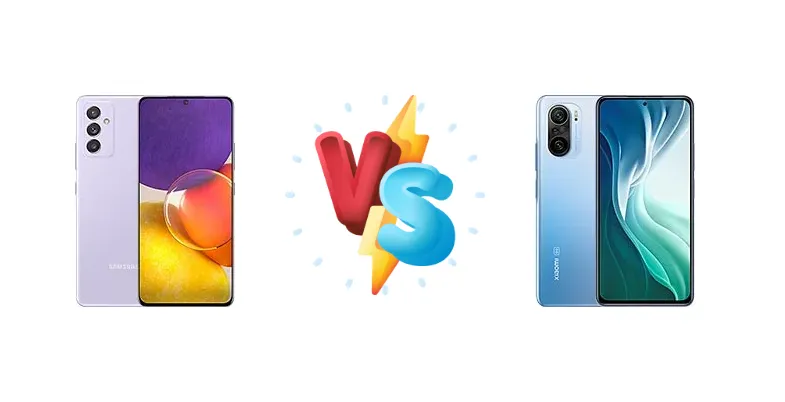
|
🏆 Quick Verdict
For the average user prioritizing raw performance and faster charging, the Xiaomi Mi 11i is the better choice. Its Snapdragon 888 offers a significant leap in processing power over the Quantum 2’s Snapdragon 855+, and the 33W charging is noticeably quicker. However, users deeply concerned about data security will find the Quantum 2’s QRNG a compelling advantage.
| PHONES | ||
|---|---|---|
| Phone Names | Samsung Galaxy Quantum 2 | Xiaomi Mi 11i |
| Network | ||
|---|---|---|
| 2G bands | GSM 850 / 900 / 1800 / 1900 | GSM 850 / 900 / 1800 / 1900 |
| 3G bands | HSDPA 850 / 900 / 1700(AWS) / 1900 / 2100 | HSDPA 850 / 900 / 1700(AWS) / 1900 / 2100 |
| 4G bands | 1, 2, 3, 4, 5, 7, 8, 12, 17, 20, 26, 28, 38, 40, 41, 66 | 1, 2, 3, 4, 5, 7, 8, 12, 17, 20, 28, 38, 40, 41, 66 |
| 5G bands | 78 Sub6 | 1, 3, 5, 7, 8, 20, 28, 38, 41, 77, 78 SA/NSA |
| Speed | HSPA, LTE, 5G | HSPA, LTE, 5G |
| Technology | GSM / HSPA / LTE / 5G | GSM / HSPA / LTE / 5G |
| Launch | ||
|---|---|---|
| Announced | 2021, April 13 | 2021, March 29 |
| Status | Available. Released 2021, April 23 | Available. Released 2021, May 31 |
| Body | ||
|---|---|---|
| Dimensions | 161.9 x 73.8 x 8.1 mm (6.37 x 2.91 x 0.32 in) | 163.7 x 76.4 x 7.8 mm (6.44 x 3.01 x 0.31 in) |
| SIM | Nano-SIM | Nano-SIM + Nano-SIM |
| Weight | 176 g (6.21 oz) | 196 g (6.91 oz) |
| - | IP53, dust and splash resistant | |
| Display | ||
|---|---|---|
| Protection | - | Corning Gorilla Glass 5 |
| Resolution | 1440 x 3200 pixels, 20:9 ratio (~524 ppi density) | 1080 x 2400 pixels, 20:9 ratio (~395 ppi density) |
| Size | 6.7 inches, 108.4 cm2 (~90.7% screen-to-body ratio) | 6.67 inches, 107.4 cm2 (~85.9% screen-to-body ratio) |
| Type | Dynamic AMOLED 2X, 120Hz, 1200 nits (peak) | Super AMOLED, 120Hz, HDR10+, 900 nits (HBM), 1300 nits (peak) |
| 120Hz@FHD / 60Hz@QHD refresh rate | - | |
| Platform | ||
|---|---|---|
| CPU | Octa-core (1x2.96 GHz Kryo 485 & 3x2.42 GHz Kryo 485 & 4x1.78 GHz Kryo 485) | Octa-core (1x2.84 GHz Cortex-X1 & 3x2.42 GHz Cortex-A78 & 4x1.80 GHz Cortex-A55) |
| Chipset | Qualcomm SM8150 Snapdragon 855+ (7 nm), QRNG security chipset | Qualcomm SM8350 Snapdragon 888 5G (5 nm) |
| GPU | Adreno 640 (700 MHz) | Adreno 660 |
| OS | Android 11, One UI 3.1 | Android 11, MIUI 12 |
| Memory | ||
|---|---|---|
| Card slot | microSDXC (dedicated slot) | No |
| Internal | 128GB 6GB RAM | 128GB 8GB RAM, 256GB 8GB RAM |
| - | UFS 3.1 | |
| Main Camera | ||
|---|---|---|
| Features | LED flash, panorama, HDR | Color spectrum sensor, LED flash, HDR, panorama |
| Single | - | 20 MP, f/2.5, (wide), 1/3.4", 0.8µm |
| Triple | 64 MP, f/1.8, 26mm (wide), 1/1.7X", 0.8µm, PDAF, OIS 12 MP, f/2.2, 123˚ (ultrawide), 1.12µm 5 MP (macro) | 108 MP, f/1.8, 26mm (wide), 1/1.52", 0.7µm, PDAF 8 MP, f/2.2, 119˚ (ultrawide) 5 MP, f/2.4, 50mm (telephoto macro), 1/5.0", 1.12µm, AF |
| Video | 4K@30fps, 1080p@30/60/240fps; gyro-EIS | 8K@30fps, 4K@30/60fps, 1080p@30/60/120/240/960fps, gyro-EIS, HDR10+ |
| Selfie camera | ||
|---|---|---|
| Features | HDR | HDR |
| Single | 10 MP, f/2.2, (wide) | 20 MP, f/2.5, (wide), 1/3.4", 0.8µm |
| Video | 1080p@30fps | 1080p@30fps, 720p@120fps |
| Sound | ||
|---|---|---|
| 3.5mm jack | No | No |
| 35mm jack | No | No |
| Loudspeaker | Yes, with stereo speakers | Yes, with stereo speakers |
| - | 24-bit/192kHz audio | |
| Comms | ||
|---|---|---|
| Bluetooth | 5.0, A2DP, LE | 5.2, A2DP, LE |
| Infrared port | - | Yes |
| NFC | Yes | Yes (market/region dependent) |
| Positioning | GPS, GLONASS, GALILEO, BDS | GPS (L1+L5), GLONASS (L1), BDS (B1I+B1c+B2a), GALILEO (E1+E5a), QZSS (L1+L5), NavIC (L5) |
| Radio | No | No |
| USB | USB Type-C 2.0, OTG | USB Type-C 2.0, OTG |
| WLAN | Wi-Fi 802.11 a/b/g/n/ac, dual-band, Wi-Fi Direct | Wi-Fi 802.11 a/b/g/n/ac/6, dual-band, Wi-Fi Direct |
| Features | ||
|---|---|---|
| Sensors | Fingerprint (under display, ultrasonic), accelerometer, gyro, proximity, compass | Fingerprint (side-mounted), accelerometer, gyro, proximity, compass, barometer |
| Battery | ||
|---|---|---|
| Charging | 25W wired | 33W wired, PD3.0, QC3, 100% in 52 min |
| Type | Li-Po 4500 mAh | Li-Po 4520 mAh |
| Misc | ||
|---|---|---|
| Colors | Black, White, Violet | Celestial Silver, Frosty White, Cosmic Black |
| Models | SM-A826S | M2012K11G |
| Price | About 520 EUR | About 230 EUR |
| SAR | - | 0.95 W/kg (head) 0.74 W/kg (body) |
| SAR EU | - | 0.57 W/kg (head) 0.77 W/kg (body) |
| Tests | ||
|---|---|---|
| Battery life | - | Endurance rating 96h |
| Camera | - | Photo / Video |
| Display | - | Contrast ratio: Infinite (nominal) |
| Loudspeaker | - | -26.0 LUFS (Very good) |
| Performance | - | AnTuTu: 690021 (v8) GeekBench: 3641 (v5.1) |
Samsung Galaxy Quantum 2
- Hardware-backed security with QRNG chipset
- Potentially more affordable price point
- Solid performance for everyday tasks
- Older Snapdragon 855+ chipset
- Slower charging speed (25W)
- Limited display information
Xiaomi Mi 11i
- Powerful Snapdragon 888 5G chipset
- Faster 33W charging with PD3.0/QC3
- Brighter display (939 nits)
- May be more prone to thermal throttling under sustained load
- Lacks dedicated security hardware like QRNG
- Potentially higher price
Display Comparison
The Xiaomi Mi 11i boasts a significantly brighter display, reaching a measured 939 nits, compared to an unspecified brightness for the Quantum 2. While the Quantum 2’s display specifications are unavailable, the Mi 11i’s high peak brightness ensures excellent visibility outdoors. Both displays feature an infinite (nominal) contrast ratio, suggesting deep blacks. The lack of information on the Quantum 2’s panel type (AMOLED, LCD) and refresh rate makes a direct comparison difficult, but the Mi 11i’s brightness advantage is clear.
Camera Comparison
Both devices offer photo and video capabilities, but detailed camera specifications are limited. Without sensor size or aperture information, a direct comparison is challenging. However, the Mi 11i’s more modern ISP (Image Signal Processor) within the Snapdragon 888 likely provides superior image processing capabilities, including better noise reduction and dynamic range. The absence of details on the Quantum 2’s camera system suggests it may not compete with the Mi 11i in image quality. We can assume both phones will have a standard set of lenses, but the Mi 11i's processing power gives it an edge.
Performance
The core difference lies in the chipsets: the Quantum 2 utilizes the Qualcomm Snapdragon 855+ (7nm), while the Mi 11i features the Snapdragon 888 5G (5nm). The 888’s 5nm process offers superior power efficiency and transistor density, translating to a substantial performance uplift. The Mi 11i’s CPU, with its Cortex-X1 prime core clocked at 2.84 GHz, outperforms the Quantum 2’s 2.96 GHz Kryo 485. The 888 also features a more modern GPU, providing a better gaming experience. While the Quantum 2 is capable, the Mi 11i delivers a smoother and more responsive experience, especially in demanding tasks. The 888 is also 5G capable, while the Quantum 2's 5G support is not explicitly stated.
Battery Life
Both phones achieve an endurance rating of 96 hours, suggesting comparable battery life despite the Quantum 2’s unspecified battery capacity. However, the Mi 11i’s 33W wired charging, supporting PD3.0 and QC3, is significantly faster than the Quantum 2’s 25W charging. The Mi 11i can reach 100% charge in just 52 minutes, while the Quantum 2 will take considerably longer. This faster charging is a significant convenience factor for users who frequently need to top up their battery.
Buying Guide
Buy the Samsung Galaxy Quantum 2 if you require a hardware-backed security solution with its QRNG chipset, and are comfortable with a slightly older processor. This phone is ideal for professionals handling sensitive data or those prioritizing privacy. Buy the Xiaomi Mi 11i if you prioritize gaming, demanding applications, and faster charging speeds. It’s the better option for multimedia consumption and users who want a more modern chipset.