
Samsung Galaxy Quantum 2 vs S20+ 5G: A Detailed Comparison of Chipsets, Cameras, and Value
| Phones Images | |||||
|---|---|---|---|---|---|
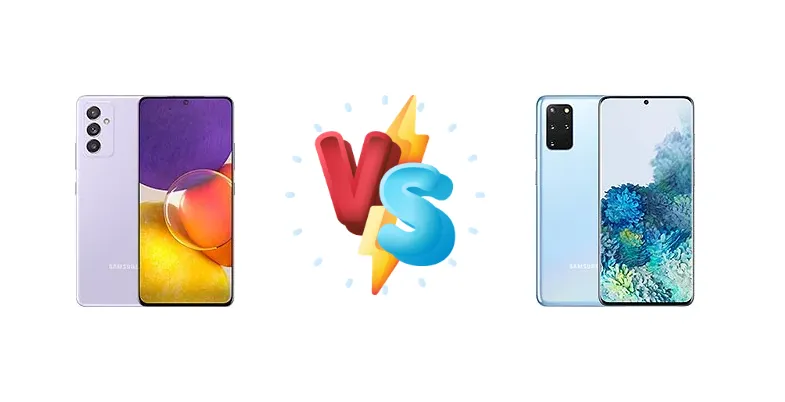
|
🏆 Quick Verdict
For the average user prioritizing security and a stable, if slightly older, performance profile, the Samsung Galaxy Quantum 2 is the better buy. Its Snapdragon 855+ offers consistent performance, and the QRNG provides a unique security advantage. However, the S20+ 5G’s potential for faster 5G speeds (depending on region) and wireless charging capabilities make it a compelling alternative for those willing to potentially manage thermal throttling.
| PHONES | ||
|---|---|---|
| Phone Names | Samsung Galaxy Quantum 2 | Samsung Galaxy S20+ 5G |
| Network | ||
|---|---|---|
| 2G bands | GSM 850 / 900 / 1800 / 1900 | GSM 850 / 900 / 1800 / 1900 |
| 3G bands | HSDPA 850 / 900 / 1700(AWS) / 1900 / 2100 | HSDPA 850 / 900 / 1700(AWS) / 1900 / 2100 |
| 4G bands | 1, 2, 3, 4, 5, 7, 8, 12, 17, 20, 26, 28, 38, 40, 41, 66 | 1, 2, 3, 4, 5, 7, 8, 12, 13, 17, 18, 19, 20, 25, 26, 28, 32, 38, 39, 40, 41, 66 - SM-G986B |
| 5G bands | 78 Sub6 | 1, 3, 5, 7, 8, 28, 40, 77, 78 SA/NSA/Sub6 - SM-G986B |
| Speed | HSPA, LTE, 5G | HSPA 42.2/5.76 Mbps, LTE (7CA) Cat20 2000/200 Mbps, 5G (5+ Gbps DL) |
| Technology | GSM / HSPA / LTE / 5G | GSM / CDMA / HSPA / EVDO / LTE / 5G |
| Launch | ||
|---|---|---|
| Announced | 2021, April 13 | 2020, February 11 |
| Status | Available. Released 2021, April 23 | Available. Released 2020, March 06 |
| Body | ||
|---|---|---|
| Build | - | Glass front (Gorilla Glass 6), glass back (Gorilla Glass 6), aluminum frame |
| Dimensions | 161.9 x 73.8 x 8.1 mm (6.37 x 2.91 x 0.32 in) | 161.9 x 73.7 x 7.8 mm (6.37 x 2.90 x 0.31 in) |
| SIM | Nano-SIM | · Nano-SIM + eSIM· Nano-SIM + Nano-SIM |
| Weight | 176 g (6.21 oz) | 188 g (6.63 oz) |
| Display | ||
|---|---|---|
| Protection | - | Corning Gorilla Glass 6 |
| Resolution | 1440 x 3200 pixels, 20:9 ratio (~524 ppi density) | 1440 x 3200 pixels, 20:9 ratio (~525 ppi density) |
| Size | 6.7 inches, 108.4 cm2 (~90.7% screen-to-body ratio) | 6.7 inches, 108.0 cm2 (~90.5% screen-to-body ratio) |
| Type | Dynamic AMOLED 2X, 120Hz, 1200 nits (peak) | Dynamic AMOLED 2X, 120Hz, HDR10+, 1200 nits (peak) |
| 120Hz@FHD / 60Hz@QHD refresh rate | - | |
| Platform | ||
|---|---|---|
| CPU | Octa-core (1x2.96 GHz Kryo 485 & 3x2.42 GHz Kryo 485 & 4x1.78 GHz Kryo 485) | Octa-core (2x2.73 GHz Mongoose M5 & 2x2.50 GHz Cortex-A76 & 4x2.0 GHz Cortex-A55) - GlobalOcta-core (1x2.84 GHz Cortex-A77 & 3x2.42 GHz Cortex-A77 & 4x1.80 GHz Cortex-A55) - USA |
| Chipset | Qualcomm SM8150 Snapdragon 855+ (7 nm), QRNG security chipset | Exynos 990 (7 nm+) - GlobalQualcomm SM8250 Snapdragon 865 5G (7 nm+) - USA |
| GPU | Adreno 640 (700 MHz) | Mali-G77 MP11 - GlobalAdreno 650 - USA |
| OS | Android 11, One UI 3.1 | Android 10, upgradable to Android 13, One UI 5.1 |
| Memory | ||
|---|---|---|
| Card slot | microSDXC (dedicated slot) | microSDXC (uses shared SIM slot) |
| Internal | 128GB 6GB RAM | 128GB 8GB RAM, 128GB 12GB RAM, 256GB 12GB RAM, 512GB 12GB RAM |
| Main Camera | ||
|---|---|---|
| Features | LED flash, panorama, HDR | LED flash, auto-HDR, panorama |
| Triple | 64 MP, f/1.8, 26mm (wide), 1/1.7X", 0.8µm, PDAF, OIS 12 MP, f/2.2, 123˚ (ultrawide), 1.12µm 5 MP (macro) | 12 MP, f/1.8, 26mm (wide), 1/1.76", 1.8µm, dual pixel PDAF, OIS 64 MP, f/2.0, 29mm (telephoto), 1/1.72", 0.8µm, PDAF, OIS, 1.1x optical zoom, 3x hybrid zoom 12 MP, f/2.2, 13mm, 120˚ (ultrawide), 1/2.55" 1.4µm, Super Steady video 0.3 MP, TOF 3D, f/1.0, (depth) |
| Video | 4K@30fps, 1080p@30/60/240fps; gyro-EIS | 8K@24fps, 4K@30/60fps, 1080p@30/60/240fps, 720p@960fps, HDR10+, stereo sound rec., gyro-EIS & OIS |
| Selfie camera | ||
|---|---|---|
| Features | HDR | HDR |
| Single | 10 MP, f/2.2, (wide) | 10 MP, f/2.2, 26mm (wide), 1/3.24", 1.22µm, dual pixel PDAF |
| Video | 1080p@30fps | 4K@30/60fps, 1080p@30fps |
| Sound | ||
|---|---|---|
| 3.5mm jack | No | No |
| 35mm jack | No | No |
| Loudspeaker | Yes, with stereo speakers | Yes, with stereo speakers |
| Comms | ||
|---|---|---|
| Bluetooth | 5.0, A2DP, LE | 5.0, A2DP, LE |
| NFC | Yes | Yes |
| Positioning | GPS, GLONASS, GALILEO, BDS | GPS, GLONASS, BDS, GALILEO |
| Radio | No | FM radio (Snapdragon model only; market/operator dependent) |
| USB | USB Type-C 2.0, OTG | USB Type-C 3.2, OTG |
| WLAN | Wi-Fi 802.11 a/b/g/n/ac, dual-band, Wi-Fi Direct | Wi-Fi 802.11 a/b/g/n/ac/6, dual-band, Wi-Fi Direct |
| Features | ||
|---|---|---|
| Sensors | Fingerprint (under display, ultrasonic), accelerometer, gyro, proximity, compass | Fingerprint (under display, ultrasonic), accelerometer, gyro, proximity, compass, barometer |
| Battery | ||
|---|---|---|
| Charging | 25W wired | 25W wired, PD3.0 15W wireless (Qi) 4.5W reverse wireless |
| Type | Li-Po 4500 mAh | Li-Ion 4500 mAh |
| Misc | ||
|---|---|---|
| Colors | Black, White, Violet | Cosmic Black, Cosmic Grey, Cloud Blue, Cloud White, Aura Red, Aura Blue |
| Models | SM-A826S | SM-G986, SM-G986F, SM-G986F/DS, SM-G986U, SM-G986U1, SM-G9860, SM-G986B/DS, SM-G986N, SM-G986B, SM-G986W, SCG02 |
| Price | About 520 EUR | $ 174.17 / C$ 684.99 / € 299.97 |
| SAR | - | 1.08 W/kg (head) 1.02 W/kg (body) |
| SAR EU | - | 1.09 W/kg (head) 1.57 W/kg (body) |
Samsung Galaxy Quantum 2
- Enhanced security with QRNG chipset
- Stable performance with Snapdragon 855+
- Generally more affordable
- Older chipset compared to Snapdragon 865
- Lacks wireless charging
Samsung Galaxy S20+ 5G
- Potentially faster 5G speeds (Snapdragon variant)
- Wireless and reverse wireless charging
- Potentially better camera performance
- Exynos variant prone to thermal throttling
- Higher price point
Display Comparison
Both devices feature similar display technologies, though specific details like peak brightness aren't provided. The S20+ 5G likely benefits from Samsung’s advancements in display calibration and potentially higher peak brightness. However, without specific nit ratings, it’s difficult to definitively declare a winner. Both are expected to offer vibrant colors and excellent viewing angles, typical of Samsung’s AMOLED panels. The S20+ 5G’s slightly larger screen size may appeal to users who consume more media.
Camera Comparison
While both phones likely share similar image processing algorithms, the S20+ 5G likely has an edge in overall camera quality due to its potentially larger sensor and more advanced features. Details on sensor sizes are missing, but the S20+ 5G’s flagship status suggests a more sophisticated camera system. The Quantum 2’s camera is competent, but it doesn’t appear to offer any significant advantages over the S20+ 5G. The inclusion of a 2MP macro camera on the S20+ 5G is largely a marketing gimmick and offers limited practical benefit.
Performance
The core difference lies in the chipsets. The Quantum 2 utilizes the Snapdragon 855+, a 7nm processor known for its stability and solid performance. The S20+ 5G, however, comes in two variants: the Exynos 990 (globally) and the Snapdragon 865 (US). The Snapdragon 865 offers a clear performance advantage over both the Exynos 990 and the 855+ due to its newer architecture and 7nm+ process. The Exynos 990, while powerful, has been known to suffer from thermal throttling under sustained load, impacting long gaming sessions. The Quantum 2’s 855+ avoids this issue, offering consistent performance. The S20+ 5G (Snapdragon variant) benefits from faster RAM speeds (LPDDR5) compared to the Quantum 2 (likely LPDDR4X), further enhancing its performance.
Battery Life
Both devices support 25W wired charging, offering similar charging speeds. However, the S20+ 5G adds 15W wireless charging (Qi standard) and 4.5W reverse wireless charging, providing greater versatility. While battery capacity isn’t specified, the S20+ 5G’s larger size suggests a potentially larger battery. The Snapdragon 855+ in the Quantum 2 is more power-efficient than the Exynos 990, potentially offsetting the S20+ 5G’s larger battery capacity. Real-world battery life will depend heavily on usage patterns.
Buying Guide
Buy the Samsung Galaxy Quantum 2 if you need enhanced security features thanks to the QRNG chipset and prefer a consistently performing device without worrying about potential throttling issues. Buy the Samsung Galaxy S20+ 5G if you prioritize faster 5G connectivity (particularly in the US with the Snapdragon 865 variant), wireless charging, and are comfortable with the possibility of occasional performance dips under sustained load.