
Samsung Galaxy Quantum 2 vs. Galaxy S20+: Which Samsung Flagship Reigns Supreme?
| Phones Images | |||||
|---|---|---|---|---|---|
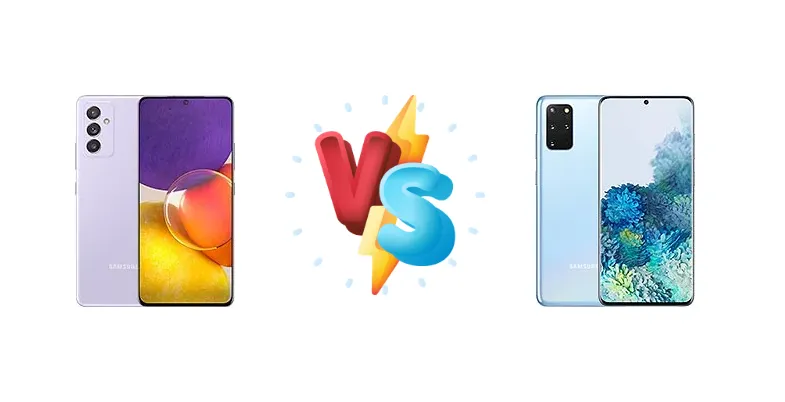
|
🏆 Quick Verdict
For the average user prioritizing all-around capability and a more refined software experience, the Samsung Galaxy S20+ is the better choice. However, the Quantum 2 presents a compelling value proposition for security-conscious users, offering a capable Snapdragon 855+ experience at a potentially lower price point.
| PHONES | ||
|---|---|---|
| Phone Names | Samsung Galaxy Quantum 2 | Samsung Galaxy S20+ |
| Network | ||
|---|---|---|
| 2G bands | GSM 850 / 900 / 1800 / 1900 | GSM 850 / 900 / 1800 / 1900 |
| 3G bands | HSDPA 850 / 900 / 1700(AWS) / 1900 / 2100 | HSDPA 850 / 900 / 1700(AWS) / 1900 / 2100 |
| 4G bands | 1, 2, 3, 4, 5, 7, 8, 12, 17, 20, 26, 28, 38, 40, 41, 66 | 1, 2, 3, 4, 5, 7, 8, 12, 13, 17, 18, 19, 20, 25, 26, 28, 32, 38, 39, 40, 41, 66 |
| 5G bands | 78 Sub6 | - |
| Speed | HSPA, LTE, 5G | HSPA 42.2/5.76 Mbps, LTE (7CA) Cat20 2000/200 Mbps |
| Technology | GSM / HSPA / LTE / 5G | GSM / CDMA / HSPA / EVDO / LTE |
| - | CDMA2000 1xEV-DO | |
| Launch | ||
|---|---|---|
| Announced | 2021, April 13 | 2020, February 11 |
| Status | Available. Released 2021, April 23 | Available. Released 2020, March 06 |
| Body | ||
|---|---|---|
| Build | - | Glass front (Gorilla Glass 6), glass back (Gorilla Glass 6), aluminum frame |
| Dimensions | 161.9 x 73.8 x 8.1 mm (6.37 x 2.91 x 0.32 in) | 161.9 x 73.7 x 7.8 mm (6.37 x 2.90 x 0.31 in) |
| SIM | Nano-SIM | · Nano-SIM + eSIM· Nano-SIM + Nano-SIM |
| Weight | 176 g (6.21 oz) | 186 g (6.56 oz) |
| - | IP68 dust/water resistant (up to 1.5m for 30 min) | |
| Display | ||
|---|---|---|
| Protection | - | Corning Gorilla Glass 6 |
| Resolution | 1440 x 3200 pixels, 20:9 ratio (~524 ppi density) | 1440 x 3200 pixels, 20:9 ratio (~525 ppi density) |
| Size | 6.7 inches, 108.4 cm2 (~90.7% screen-to-body ratio) | 6.7 inches, 108.0 cm2 (~90.5% screen-to-body ratio) |
| Type | Dynamic AMOLED 2X, 120Hz, 1200 nits (peak) | Dynamic AMOLED 2X, 120Hz, HDR10+, 1200 nits (peak) |
| 120Hz@FHD / 60Hz@QHD refresh rate | Always-on display 120Hz@FHD/60Hz@QHD refresh rate | |
| Platform | ||
|---|---|---|
| CPU | Octa-core (1x2.96 GHz Kryo 485 & 3x2.42 GHz Kryo 485 & 4x1.78 GHz Kryo 485) | Octa-core (2x2.73 GHz Mongoose M5 & 2x2.50 GHz Cortex-A76 & 4x2.0 GHz Cortex-A55) - GlobalOcta-core (1x2.84 GHz Cortex-A77 & 3x2.42 GHz Cortex-A77 & 4x1.80 GHz Cortex-A55) - USA |
| Chipset | Qualcomm SM8150 Snapdragon 855+ (7 nm), QRNG security chipset | Exynos 990 (7 nm+) - GlobalQualcomm SM8250 Snapdragon 865 5G (7 nm+) - USA |
| GPU | Adreno 640 (700 MHz) | Mali-G77 MP11 - GlobalAdreno 650 - USA |
| OS | Android 11, One UI 3.1 | Android 10, upgradable to Android 13, One UI 5 |
| Memory | ||
|---|---|---|
| Card slot | microSDXC (dedicated slot) | microSDXC (uses shared SIM slot) |
| Internal | 128GB 6GB RAM | 128GB 8GB RAM |
| - | UFS 3.0 | |
| Main Camera | ||
|---|---|---|
| Features | LED flash, panorama, HDR | LED flash, auto-HDR, panorama |
| Triple | 64 MP, f/1.8, 26mm (wide), 1/1.7X", 0.8µm, PDAF, OIS 12 MP, f/2.2, 123˚ (ultrawide), 1.12µm 5 MP (macro) | 12 MP, f/1.8, 26mm (wide), 1/1.76", 1.8µm, dual pixel PDAF, OIS 64 MP, f/2.0, 29mm (telephoto), 1/1.72", 0.8µm, PDAF, OIS, 1.1x optical zoom, 3x hybrid zoom 12 MP, f/2.2, 13mm, 120˚ (ultrawide), 1/2.55" 1.4µm, Super Steady video 0.3 MP, TOF 3D, f/1.0, (depth) |
| Video | 4K@30fps, 1080p@30/60/240fps; gyro-EIS | 8K@24fps, 4K@30/60fps, 1080p@30/60/240fps, 720p@960fps, HDR10+, stereo sound rec., gyro-EIS & OIS |
| Selfie camera | ||
|---|---|---|
| Features | HDR | HDR |
| Single | 10 MP, f/2.2, (wide) | 10 MP, f/2.2, 26mm (wide), 1/3.24", 1.22µm, dual pixel PDAF |
| Video | 1080p@30fps | 4K@30/60fps, 1080p@30fps |
| Sound | ||
|---|---|---|
| 3.5mm jack | No | No |
| 35mm jack | No | No |
| Loudspeaker | Yes, with stereo speakers | Yes, with stereo speakers |
| - | 32-bit/384kHz audio Tuned by AKG | |
| Comms | ||
|---|---|---|
| Bluetooth | 5.0, A2DP, LE | 5.0, A2DP, LE |
| NFC | Yes | Yes |
| Positioning | GPS, GLONASS, GALILEO, BDS | GPS, GLONASS, BDS, GALILEO |
| Radio | No | FM radio (Snapdragon model only; market/operator dependent) |
| USB | USB Type-C 2.0, OTG | USB Type-C 3.2, OTG |
| WLAN | Wi-Fi 802.11 a/b/g/n/ac, dual-band, Wi-Fi Direct | Wi-Fi 802.11 a/b/g/n/ac/6, dual-band, Wi-Fi Direct |
| Features | ||
|---|---|---|
| Sensors | Fingerprint (under display, ultrasonic), accelerometer, gyro, proximity, compass | Fingerprint (under display, ultrasonic), accelerometer, gyro, proximity, compass, barometer |
| - | Samsung DeX, Samsung Wireless DeX (desktop experience support) ANT+ Bixby natural language commands and dictation Samsung Pay (Visa, MasterCard certified) | |
| Battery | ||
|---|---|---|
| Charging | 25W wired | 25W wired, PD3.0 15W wireless (Qi) 4.5W reverse wireless |
| Type | Li-Po 4500 mAh | Li-Ion 4500 mAh |
| Misc | ||
|---|---|---|
| Colors | Black, White, Violet | Cosmic Black, Cosmic Grey, Cloud Blue, Cloud White, Aura Red, Aura Blue |
| Models | SM-A826S | SM-G985, SM-G985F, SM-G985F/DS |
| Price | About 520 EUR | € 299.97 / $ 189.60 / £ 234.21 |
| SAR | - | 0.72 W/kg (head) 1.03 W/kg (body) |
| SAR EU | - | 0.38 W/kg (head) 1.57 W/kg (body) |
| Pricing | ||
|---|---|---|
| 128GB 8GB RAM | - | $ 400.90 |
| RENEWED | - | $ 288.00 |
| Tests | ||
|---|---|---|
| Battery life | - | Endurance rating 87h |
| Camera | - | Photo / Video |
| Display | - | Contrast ratio: Infinite (nominal) |
| Loudspeaker | - | -24.4 LUFS (Very good) |
| Performance | - | AnTuTu: 500114 (v8) GeekBench: 2703 (v5.1) GFXBench: 42fps (ES 3.1 onscreen) |
Samsung Galaxy Quantum 2
- Enhanced security with QRNG chipset
- Potentially lower price point
- Capable Snapdragon 855+ performance
- Older chipset compared to S20+
- Lacks wireless charging
- Limited camera details
Samsung Galaxy S20+
- More powerful chipset (Snapdragon 865 or Exynos 990)
- Wireless and reverse wireless charging
- Superior battery endurance
- Exynos variant may suffer from thermal throttling
- Higher price point
- Potential for software bloat
Display Comparison
The Galaxy S20+ boasts a brighter display, reaching a measured 797 nits, compared to an unspecified peak brightness for the Quantum 2. While both likely utilize AMOLED technology, the S20+'s higher peak brightness translates to better visibility in direct sunlight. The S20+'s 'Infinite' contrast ratio suggests a well-tuned panel, though without detailed color accuracy data, a definitive advantage is difficult to claim. Both share a similar 120Hz refresh rate, but the Quantum 2's PWM dimming rate is unknown, potentially impacting users sensitive to flicker.
Camera Comparison
Both phones feature capable camera systems, but details are limited to 'Photo / Video' for both. The S20+ likely benefits from Samsung's more advanced image processing algorithms and potentially larger sensor sizes. The Quantum 2's inclusion of a QRNG chip doesn't directly impact image quality but could enhance the security of stored photos and videos. Without specific sensor details (megapixel count, aperture), it's difficult to assess a clear winner, but the S20+'s flagship positioning suggests a more refined and versatile camera experience.
Performance
The core difference lies in the chipsets. The Quantum 2 utilizes the Qualcomm Snapdragon 855+, while the S20+ shipped with either the Exynos 990 (globally) or Snapdragon 865 (USA). The Snapdragon 865 represents a generational leap over the 855+, offering improvements in CPU and GPU performance, and 5G connectivity. The Exynos 990, while competitive, has historically faced criticism for thermal throttling under sustained load. The Quantum 2's 855+ benefits from a slightly larger 7nm process node, potentially offering better efficiency, but the S20+'s 7nm+ node and architectural improvements in the 865/990 provide a performance edge. Both devices feature 8GB of RAM, but the type (LPDDR4x vs. potentially LPDDR5 in the S20+) isn't specified, impacting memory bandwidth.
Battery Life
The Galaxy S20+ achieves an impressive 87-hour endurance rating, despite sharing the same 25W wired charging speed as the Quantum 2. This suggests a more efficient combination of battery capacity and power management. The S20+ further adds 15W wireless charging (Qi) and 4.5W reverse wireless charging, features absent in the Quantum 2. While the Quantum 2's battery capacity is unknown, the S20+'s endurance rating indicates a significant advantage in real-world battery life.
Buying Guide
Buy the Samsung Galaxy Quantum 2 if you prioritize on-device security with its QRNG chipset and are comfortable with a slightly older, but still capable, Snapdragon 855+ processor. Buy the Samsung Galaxy S20+ if you value a more versatile camera system, faster charging with PD3.0, wireless charging capabilities, and a broader feature set including potentially a more powerful Snapdragon 865 (US variant).