
Samsung Galaxy Quantum 2 vs. Note20: A Detailed Comparison of Performance and Security
| Phones Images | |||||
|---|---|---|---|---|---|
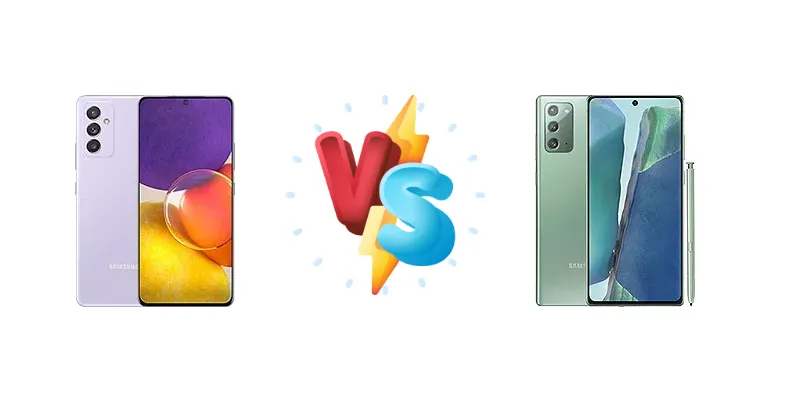
|
🏆 Quick Verdict
For the average user prioritizing security and consistent performance, the Samsung Galaxy Quantum 2 emerges as the better value. While the Note20 offers wireless charging and a more refined software experience at launch, the Quantum 2’s Snapdragon 855+ provides a stable platform, and the QRNG adds a layer of hardware-level security not found in the Note20.
| PHONES | ||
|---|---|---|
| Phone Names | Samsung Galaxy Quantum 2 | Samsung Galaxy Note20 |
| Network | ||
|---|---|---|
| 2G bands | GSM 850 / 900 / 1800 / 1900 | GSM 850 / 900 / 1800 / 1900 |
| 3G bands | HSDPA 850 / 900 / 1700(AWS) / 1900 / 2100 | HSDPA 850 / 900 / 1700(AWS) / 1900 / 2100 |
| 4G bands | 1, 2, 3, 4, 5, 7, 8, 12, 17, 20, 26, 28, 38, 40, 41, 66 | 1, 2, 3, 4, 5, 7, 8, 12, 13, 17, 18, 19, 20, 25, 26, 28, 32, 38, 39, 40, 41, 66 |
| 5G bands | 78 Sub6 | - |
| Speed | HSPA, LTE, 5G | HSPA 42.2/5.76 Mbps, LTE (7CA) Cat20 2000/200 Mbps |
| Technology | GSM / HSPA / LTE / 5G | GSM / CDMA / HSPA / EVDO / LTE |
| - | CDMA2000 1xEV-DO | |
| Launch | ||
|---|---|---|
| Announced | 2021, April 13 | 2020, August 05 |
| Status | Available. Released 2021, April 23 | Available. Released 2020, August 21 |
| Body | ||
|---|---|---|
| Build | - | Glass front (Gorilla Glass 5), plastic back |
| Dimensions | 161.9 x 73.8 x 8.1 mm (6.37 x 2.91 x 0.32 in) | 161.6 x 75.2 x 8.3 mm (6.36 x 2.96 x 0.33 in) |
| SIM | Nano-SIM | · Nano-SIM + eSIM· Nano-SIM + Nano-SIM |
| Weight | 176 g (6.21 oz) | 192 g (6.77 oz) |
| - | IP68 dust/water resistant (up to 1.5m for 30 min) Stylus, 26ms latency (Bluetooth integration, accelerometer, gyro) | |
| Display | ||
|---|---|---|
| Protection | - | Corning Gorilla Glass 5 |
| Resolution | 1440 x 3200 pixels, 20:9 ratio (~524 ppi density) | 1080 x 2400 pixels, 20:9 ratio (~393 ppi density) |
| Size | 6.7 inches, 108.4 cm2 (~90.7% screen-to-body ratio) | 6.7 inches, 108.4 cm2 (~89.2% screen-to-body ratio) |
| Type | Dynamic AMOLED 2X, 120Hz, 1200 nits (peak) | Super AMOLED Plus, HDR10+ |
| 120Hz@FHD / 60Hz@QHD refresh rate | Always-on display | |
| Platform | ||
|---|---|---|
| CPU | Octa-core (1x2.96 GHz Kryo 485 & 3x2.42 GHz Kryo 485 & 4x1.78 GHz Kryo 485) | Octa-core (2x2.73 GHz Mongoose M5 & 2x2.50 GHz Cortex-A76 & 4x2.0 GHz Cortex-A55) - GlobalOcta-core (1x3.0 GHz Kryo 585 & 3x2.42 GHz Cortex-A77 & 4x1.80 GHz Cortex-A55) - USA |
| Chipset | Qualcomm SM8150 Snapdragon 855+ (7 nm), QRNG security chipset | Exynos 990 (7 nm+) - GlobalQualcomm SM8250 Snapdragon 865 5G+ (7 nm+) - USA |
| GPU | Adreno 640 (700 MHz) | Mali-G77 MP11 - GlobalAdreno 650 - USA |
| OS | Android 11, One UI 3.1 | Android 10, upgradable to Android 13, One UI 5 |
| Memory | ||
|---|---|---|
| Card slot | microSDXC (dedicated slot) | No |
| Internal | 128GB 6GB RAM | 256GB 8GB RAM |
| - | UFS 3.0 | |
| Main Camera | ||
|---|---|---|
| Features | LED flash, panorama, HDR | LED flash, auto-HDR, panorama |
| Triple | 64 MP, f/1.8, 26mm (wide), 1/1.7X", 0.8µm, PDAF, OIS 12 MP, f/2.2, 123˚ (ultrawide), 1.12µm 5 MP (macro) | 12 MP, f/1.8, 26mm (wide), 1/1.76", 1.8µm, dual pixel PDAF, OIS 64 MP, f/2.0, 27mm (telephoto), 1/1.72", 0.8µm, PDAF, OIS, 3x hybrid zoom 12 MP, f/2.2, 120˚, 13mm (ultrawide), 1/2.55", 1.4µm |
| Video | 4K@30fps, 1080p@30/60/240fps; gyro-EIS | 8K@24fps, 4K@30/60fps, 1080p@30/60/240fps, 720p@960fps, HDR10+, stereo sound rec., gyro-EIS & OIS |
| Selfie camera | ||
|---|---|---|
| Features | HDR | HDR |
| Single | 10 MP, f/2.2, (wide) | 10 MP, f/2.2, 26mm (wide), 1/3.2", 1.22µm, dual pixel PDAF |
| Video | 1080p@30fps | 4K@30/60fps, 1080p@30fps |
| Sound | ||
|---|---|---|
| 3.5mm jack | No | No |
| 35mm jack | No | No |
| Loudspeaker | Yes, with stereo speakers | Yes, with stereo speakers |
| - | 32-bit/384kHz audio Tuned by AKG | |
| Comms | ||
|---|---|---|
| Bluetooth | 5.0, A2DP, LE | 5.0, A2DP, LE, aptX |
| NFC | Yes | Yes |
| Positioning | GPS, GLONASS, GALILEO, BDS | GPS, GLONASS, BDS, GALILEO |
| Radio | No | FM radio (Snapdragon model only; market/operator dependent) |
| USB | USB Type-C 2.0, OTG | USB Type-C 3.2, OTG |
| WLAN | Wi-Fi 802.11 a/b/g/n/ac, dual-band, Wi-Fi Direct | Wi-Fi 802.11 a/b/g/n/ac/6, dual-band, Wi-Fi Direct |
| Features | ||
|---|---|---|
| Sensors | Fingerprint (under display, ultrasonic), accelerometer, gyro, proximity, compass | Fingerprint (under display, ultrasonic), accelerometer, gyro, proximity, compass, barometer |
| - | Samsung Wireless DeX (desktop experience support) ANT+ Bixby natural language commands and dictation Samsung Pay (Visa, MasterCard certified) | |
| Battery | ||
|---|---|---|
| Charging | 25W wired | 25W wired, PD3.0 15W wireless (Qi) 4.5W reverse wireless |
| Type | Li-Po 4500 mAh | Li-Ion 4300 mAh |
| Misc | ||
|---|---|---|
| Colors | Black, White, Violet | Mystic Green, Mystic Bronze, Mystic Gray, Mystic Red, Mystic Blue |
| Models | SM-A826S | SM-N980F, SM-N980F/DS |
| Price | About 520 EUR | $ 202.82 / € 280.00 |
| SAR | - | 1.11 W/kg (head) 1.14 W/kg (body) |
| SAR EU | - | 0.36 W/kg (head) 1.37 W/kg (body) |
Samsung Galaxy Quantum 2
- Enhanced security with QRNG chipset
- Stable and consistent performance with Snapdragon 855+
- Potentially better value for money
- Lacks wireless charging
- May have a less refined software experience compared to the Note20 at launch
Samsung Galaxy Note20
- S Pen functionality for productivity
- Wireless and reverse wireless charging
- Potentially superior camera system (depending on variant)
- Exynos 990 variant prone to thermal throttling
- Higher price point (originally)
- May exhibit performance dips under sustained load
Display Comparison
Both devices feature Super AMOLED displays, but detailed specifications like resolution and refresh rate are missing from the provided data. However, given the Note20’s positioning as a flagship, it likely boasts a higher peak brightness and potentially a more color-accurate panel. The Quantum 2, while still excellent, likely prioritizes efficiency. The Note20’s larger display size, typical of the Note series, offers a more immersive viewing experience, while the Quantum 2 may be more manageable for one-handed use. Bezels are expected to be minimal on both, reflecting the design trends of their respective release years.
Camera Comparison
Detailed camera specs are limited, but both phones are expected to offer capable camera systems. The Note20, as a flagship, likely features a more advanced primary sensor and potentially a more versatile zoom lens. The Quantum 2’s camera performance will be solid, but it likely doesn’t match the Note20’s in terms of overall image quality and features. The presence of a 2MP macro camera on either device is largely a marketing gimmick, offering minimal practical benefit. Image processing styles will differ, with Samsung typically favoring vibrant, saturated colors.
Performance
The core difference lies in the chipset. The Galaxy Quantum 2 utilizes the Qualcomm Snapdragon 855+, a 7nm processor known for its stable performance. Its octa-core configuration (1x2.96 GHz Kryo 485, 3x2.42 GHz Kryo 485, 4x1.78 GHz Kryo 485) provides a balanced approach to power and efficiency. The Note20, however, features either the Exynos 990 (globally) or the Snapdragon 865 5G+ (USA). The Exynos 990, built on a 7nm+ process, initially showed promise but was plagued by thermal throttling issues under sustained load, particularly in graphically intensive tasks. The Snapdragon 865 5G+ variant in the US Note20 offers superior performance and thermal management. The Quantum 2’s Snapdragon 855+ will likely provide more consistent performance over extended periods, while the Note20 (Exynos) may exhibit performance dips during prolonged gaming sessions. Both devices likely utilize LPDDR5 RAM, but the speed and configuration could vary.
Battery Life
Both devices support 25W wired charging, offering similar charging speeds. However, the Note20 adds 15W wireless charging (Qi) and 4.5W reverse wireless charging, providing greater convenience. The actual battery capacity is not specified, but the Note20’s larger size suggests a potentially larger battery. The Quantum 2’s efficiency with the Snapdragon 855+ could offset a smaller battery capacity, resulting in comparable real-world battery life. The Note20’s wireless charging capabilities are a significant advantage for users who prefer cable-free charging.
Buying Guide
Buy the Samsung Galaxy Quantum 2 if you prioritize on-device security and a stable, reliable performance profile for everyday tasks and moderate gaming. Its QRNG chipset offers a unique advantage for privacy-conscious users. Buy the Samsung Galaxy Note20 if you absolutely require wireless charging, the S Pen functionality is essential to your workflow, and you can find a unit at a significantly discounted price, accepting the potential for thermal throttling under sustained load due to the Exynos 990.