
Samsung Galaxy Quantum 2 vs A73 5G: Which Samsung Phone Delivers More?
| Phones Images | |||||
|---|---|---|---|---|---|
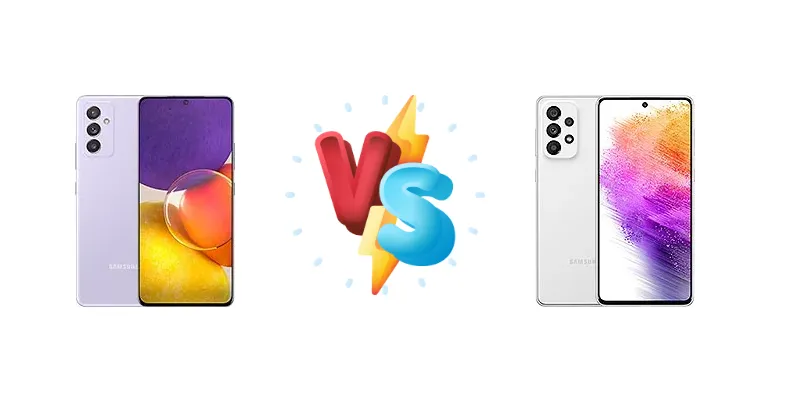
|
🏆 Quick Verdict
For users prioritizing raw performance and security, the Samsung Galaxy Quantum 2 is the better choice, despite its age. The Snapdragon 855+ provides a noticeable performance edge, and the QRNG offers a unique security benefit. However, the A73 5G’s more modern chipset offers better efficiency and potentially longer software support.
| PHONES | ||
|---|---|---|
| Phone Names | Samsung Galaxy Quantum 2 | Samsung Galaxy A73 5G |
| Network | ||
|---|---|---|
| 2G bands | GSM 850 / 900 / 1800 / 1900 | GSM 850 / 900 / 1800 / 1900 |
| 3G bands | HSDPA 850 / 900 / 1700(AWS) / 1900 / 2100 | HSDPA 850 / 900 / 1700(AWS) / 1900 / 2100 |
| 4G bands | 1, 2, 3, 4, 5, 7, 8, 12, 17, 20, 26, 28, 38, 40, 41, 66 | 1, 2, 3, 4, 5, 7, 8, 12, 13, 17, 20, 26, 28, 32, 38, 40, 41, 66 |
| 5G bands | 78 Sub6 | 1, 3, 5, 7, 28, 40, 41, 66, 78 SA/NSA/Sub6 |
| Speed | HSPA, LTE, 5G | HSPA, LTE, 5G |
| Technology | GSM / HSPA / LTE / 5G | GSM / HSPA / LTE / 5G |
| Launch | ||
|---|---|---|
| Announced | 2021, April 13 | 2022, March 17 |
| Status | Available. Released 2021, April 23 | Available. Released 2022, April 22 |
| Body | ||
|---|---|---|
| Dimensions | 161.9 x 73.8 x 8.1 mm (6.37 x 2.91 x 0.32 in) | 163.7 x 76.1 x 7.6 mm (6.44 x 3.00 x 0.30 in) |
| SIM | Nano-SIM | · Nano-SIM· Nano-SIM + Nano-SIM |
| Weight | 176 g (6.21 oz) | 181 g (6.38 oz) |
| - | IP67 dust/water resistant (up to 1m for 30 min) | |
| Display | ||
|---|---|---|
| Protection | - | Corning Gorilla Glass 5 |
| Resolution | 1440 x 3200 pixels, 20:9 ratio (~524 ppi density) | 1080 x 2400 pixels, 20:9 ratio (~393 ppi density) |
| Size | 6.7 inches, 108.4 cm2 (~90.7% screen-to-body ratio) | 6.7 inches, 108.4 cm2 (~87.0% screen-to-body ratio) |
| Type | Dynamic AMOLED 2X, 120Hz, 1200 nits (peak) | Super AMOLED Plus, 120Hz, 800 nits (HBM) |
| 120Hz@FHD / 60Hz@QHD refresh rate | - | |
| Platform | ||
|---|---|---|
| CPU | Octa-core (1x2.96 GHz Kryo 485 & 3x2.42 GHz Kryo 485 & 4x1.78 GHz Kryo 485) | Octa-core (1x2.4 GHz Cortex-A78 & 3x2.2 GHz Cortex-A78 & 4x1.9 GHz Cortex-A55) |
| Chipset | Qualcomm SM8150 Snapdragon 855+ (7 nm), QRNG security chipset | Qualcomm SM7325 Snapdragon 778G 5G (6 nm) |
| GPU | Adreno 640 (700 MHz) | Adreno 642L |
| OS | Android 11, One UI 3.1 | Android 12, up to 4 major Android upgrades, One UI 6.1 |
| Memory | ||
|---|---|---|
| Card slot | microSDXC (dedicated slot) | microSDXC (uses shared SIM slot) |
| Internal | 128GB 6GB RAM | 128GB 6GB RAM, 128GB 8GB RAM, 256GB 8GB RAM |
| Main Camera | ||
|---|---|---|
| Features | LED flash, panorama, HDR | LED flash, panorama, HDR |
| Quad | - | 108 MP, f/1.8, (wide), PDAF, OIS 12 MP, f/2.2, (ultrawide) 5 MP (macro) Auxiliary lens |
| Single | - | 32 MP, f/2.2, 26mm (wide), 1/2.8", 0.8µm |
| Triple | 64 MP, f/1.8, 26mm (wide), 1/1.7X", 0.8µm, PDAF, OIS 12 MP, f/2.2, 123˚ (ultrawide), 1.12µm 5 MP (macro) | - |
| Video | 4K@30fps, 1080p@30/60/240fps; gyro-EIS | 4K@30fps, 1080p@30/60fps; gyro-EIS |
| Selfie camera | ||
|---|---|---|
| Features | HDR | HDR |
| Single | 10 MP, f/2.2, (wide) | 32 MP, f/2.2, 26mm (wide), 1/2.8", 0.8µm |
| Video | 1080p@30fps | 4K@30fps, 1080p@30fps |
| Sound | ||
|---|---|---|
| 3.5mm jack | No | No |
| 35mm jack | No | No |
| Loudspeaker | Yes, with stereo speakers | Yes, with stereo speakers |
| Comms | ||
|---|---|---|
| Bluetooth | 5.0, A2DP, LE | 5.0, A2DP, LE |
| NFC | Yes | Yes (market/region dependent) |
| Positioning | GPS, GLONASS, GALILEO, BDS | GPS, GLONASS, GALILEO, BDS, QZSS |
| Radio | No | Unspecified |
| USB | USB Type-C 2.0, OTG | USB Type-C 2.0, OTG |
| WLAN | Wi-Fi 802.11 a/b/g/n/ac, dual-band, Wi-Fi Direct | Wi-Fi 802.11 a/b/g/n/ac/6, dual-band, Wi-Fi Direct |
| Features | ||
|---|---|---|
| Sensors | Fingerprint (under display, ultrasonic), accelerometer, gyro, proximity, compass | Fingerprint (under display, optical), accelerometer, gyro, proximity, compass |
| Battery | ||
|---|---|---|
| Charging | 25W wired | 25W wired |
| Type | Li-Po 4500 mAh | Li-Po 5000 mAh |
| Misc | ||
|---|---|---|
| Colors | Black, White, Violet | Gray, Mint, White |
| Models | SM-A826S | SM-A736B, SM-A736B/DS |
| Price | About 520 EUR | About 600 EUR |
| SAR | - | 1.14 W/kg (head) |
| SAR EU | - | 1.28 W/kg (head) 1.42 W/kg (body) |
Samsung Galaxy Quantum 2
- More powerful Snapdragon 855+ processor
- Unique QRNG security feature
- Potentially lower price due to age
- Older chipset with potentially shorter software support
- Less efficient processor leading to shorter battery life
- May experience more thermal throttling
Samsung Galaxy A73 5G
- More efficient Snapdragon 778G 5G processor
- Potentially longer software support
- Better thermal management
- Less powerful processor compared to the 855+
- May not perform as well in demanding games
- Potentially higher price
Display Comparison
Both devices likely feature similar AMOLED panels, typical of Samsung’s mid-range offerings. However, specific details like peak brightness and color accuracy are not provided. The A73 5G, being newer, *may* benefit from improved panel technology, but without concrete data, it’s difficult to assess. The Quantum 2’s display is likely adequate, but the A73 5G’s newer manufacturing process could translate to slightly better viewing angles and color reproduction.
Camera Comparison
Without detailed camera specs, a direct comparison is challenging. However, the chipset plays a role in image processing. The 855+’s ISP is capable, but the 778G’s ISP is newer and benefits from advancements in computational photography. The A73 5G likely has a more refined image processing pipeline, potentially resulting in better dynamic range and low-light performance. The absence of sensor details makes it difficult to definitively declare a winner, but the A73 5G’s newer image signal processor gives it an edge.
Performance
The core difference lies in the chipsets. The Quantum 2’s Snapdragon 855+ (7nm) was a flagship processor, featuring an octa-core configuration with a peak clock speed of 2.96 GHz. The A73 5G’s Snapdragon 778G 5G (6nm) is a mid-range chip, but its more efficient 6nm process and Cortex-A78 cores offer strong performance. While the 855+ has a higher peak clock speed, the 778G’s architecture is more modern, potentially leading to better sustained performance under load. The 6nm process also means the A73 5G will likely run cooler and more efficiently, reducing thermal throttling during extended gaming sessions. Users prioritizing demanding tasks will see a benefit from the Quantum 2, while everyday users will find the A73 5G more than capable.
Battery Life
Both phones offer 25W wired charging, suggesting similar charging speeds. The actual battery capacity isn’t specified, but the Snapdragon 778G’s 6nm process in the A73 5G will contribute to better battery life. The Quantum 2’s more power-hungry 855+ will likely drain the battery faster under similar usage. While the Quantum 2 might reach 100% slightly faster due to potential differences in battery size, the A73 5G will likely provide longer overall usage time on a single charge.
Buying Guide
Buy the Samsung Galaxy Quantum 2 if you need a phone capable of handling demanding games and applications, and if the added security of a QRNG is important to you. This phone is ideal for users who value performance over the latest features. Buy the Samsung Galaxy A73 5G if you prefer a more modern chipset with potentially better long-term software support, and if battery efficiency is a higher priority than peak performance. It’s a solid all-rounder for everyday tasks and moderate gaming.