
Samsung Galaxy Quantum 2 vs OnePlus 9RT 5G: A Detailed Performance and Security Showdown
| Phones Images | |||||
|---|---|---|---|---|---|
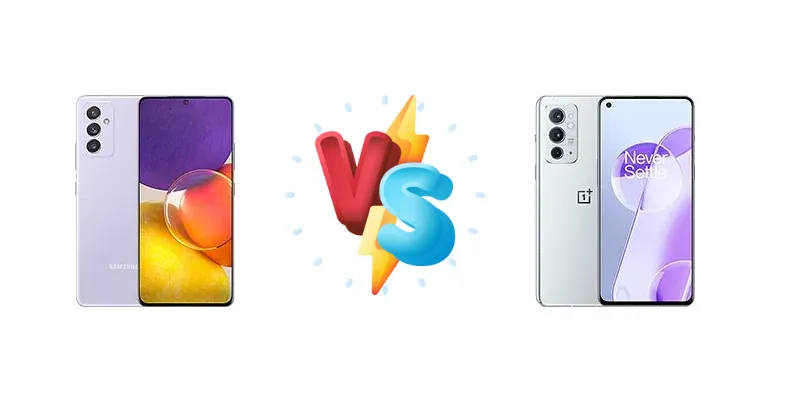
|
🏆 Quick Verdict
For the average user prioritizing speed and convenience, the OnePlus 9RT 5G is the clear winner. Its Snapdragon 888 offers a substantial performance uplift, and the 65W charging is a game-changer. However, users deeply concerned with hardware-level security and potentially seeking a lower price point may find the Quantum 2 compelling.
| PHONES | ||
|---|---|---|
| Phone Names | Samsung Galaxy Quantum 2 | OnePlus 9RT 5G |
| Network | ||
|---|---|---|
| 2G bands | GSM 850 / 900 / 1800 / 1900 | GSM 850 / 900 / 1800 / 1900 |
| 3G bands | HSDPA 850 / 900 / 1700(AWS) / 1900 / 2100 | HSDPA 800 / 850 / 900 / 1700(AWS) / 1800 / 1900 / 2100 |
| 4G bands | 1, 2, 3, 4, 5, 7, 8, 12, 17, 20, 26, 28, 38, 40, 41, 66 | 1, 2, 3, 4, 5, 7, 8, 12, 17, 18, 19, 20, 26, 28, 34, 38, 39, 40, 41 - Global |
| 5G bands | 78 Sub6 | 1, 3, 5, 8, 28, 40, 41, 78 SA/NSA - Global |
| Speed | HSPA, LTE, 5G | HSPA 42.2/5.76 Mbps, LTE Cat18 1200/200 Mbps, 5G |
| Technology | GSM / HSPA / LTE / 5G | GSM / CDMA / HSPA / EVDO / LTE / 5G |
| - | CDMA2000 1xEV-DO | |
| Launch | ||
|---|---|---|
| Announced | 2021, April 13 | 2021, October 13 |
| Status | Available. Released 2021, April 23 | Available. Released 2021, October 19 |
| Body | ||
|---|---|---|
| Build | - | Glass front (Gorilla Glass 5), glass back (Gorilla Glass 5), aluminum frame |
| Dimensions | 161.9 x 73.8 x 8.1 mm (6.37 x 2.91 x 0.32 in) | 162.2 x 74.6 x 8.3 mm (6.39 x 2.94 x 0.33 in) |
| SIM | Nano-SIM | Nano-SIM + Nano-SIM |
| Weight | 176 g (6.21 oz) | 198.5 g (7.02 oz) |
| Display | ||
|---|---|---|
| Protection | - | Corning Gorilla Glass 5 |
| Resolution | 1440 x 3200 pixels, 20:9 ratio (~524 ppi density) | 1080 x 2400 pixels, 20:9 ratio (~397 ppi density) |
| Size | 6.7 inches, 108.4 cm2 (~90.7% screen-to-body ratio) | 6.62 inches, 106.3 cm2 (~87.9% screen-to-body ratio) |
| Type | Dynamic AMOLED 2X, 120Hz, 1200 nits (peak) | AMOLED, 120Hz, HDR10+ |
| 120Hz@FHD / 60Hz@QHD refresh rate | Always-on display | |
| Platform | ||
|---|---|---|
| CPU | Octa-core (1x2.96 GHz Kryo 485 & 3x2.42 GHz Kryo 485 & 4x1.78 GHz Kryo 485) | Octa-core (1x2.84 GHz Cortex-X1 & 3x2.42 GHz Cortex-A78 & 4x1.80 GHz Cortex-A55) |
| Chipset | Qualcomm SM8150 Snapdragon 855+ (7 nm), QRNG security chipset | Qualcomm SM8350 Snapdragon 888 5G (5 nm) |
| GPU | Adreno 640 (700 MHz) | Adreno 660 |
| OS | Android 11, One UI 3.1 | Android 11, upgradable to Android 13, OxygenOS 13 |
| Memory | ||
|---|---|---|
| Card slot | microSDXC (dedicated slot) | No |
| Internal | 128GB 6GB RAM | 128GB 8GB RAM, 256GB 8GB RAM, 256GB 12GB RAM |
| - | UFS 3.1 | |
| Main Camera | ||
|---|---|---|
| Features | LED flash, panorama, HDR | Dual-LED flash, HDR, panorama |
| Quad | - | 50 MP, f/1.8, 24mm (wide), 1/1.56”, 1.0µm, PDAF, OIS 16 MP, f/2.2, 14mm, 123˚ (ultrawide), 1/3.6", 1.0µm 2 MP (macro) |
| Single | - | 16 MP, f/2.4, (wide), 1/3.06", 1.0µm |
| Triple | 64 MP, f/1.8, 26mm (wide), 1/1.7X", 0.8µm, PDAF, OIS 12 MP, f/2.2, 123˚ (ultrawide), 1.12µm 5 MP (macro) | - |
| Video | 4K@30fps, 1080p@30/60/240fps; gyro-EIS | 4K@30/60fps, 1080p@30/60/240fps, Auto HDR, gyro-EIS |
| Selfie camera | ||
|---|---|---|
| Features | HDR | HDR |
| Single | 10 MP, f/2.2, (wide) | 16 MP, f/2.4, (wide), 1/3.06", 1.0µm |
| Video | 1080p@30fps | 1080p@30fps, gyro-EIS |
| Sound | ||
|---|---|---|
| 3.5mm jack | No | No |
| 35mm jack | No | No |
| Loudspeaker | Yes, with stereo speakers | Yes, with stereo speakers |
| Comms | ||
|---|---|---|
| Bluetooth | 5.0, A2DP, LE | 5.2, A2DP, LE |
| NFC | Yes | Yes |
| Positioning | GPS, GLONASS, GALILEO, BDS | GPS (L1+L5), GLONASS (G1), BDS (B1), GALILEO (E1+E5a) |
| Radio | No | No |
| USB | USB Type-C 2.0, OTG | USB Type-C 2.0, OTG |
| WLAN | Wi-Fi 802.11 a/b/g/n/ac, dual-band, Wi-Fi Direct | Wi-Fi 802.11 a/b/g/n/ac/6, dual-band, Wi-Fi Direct |
| Features | ||
|---|---|---|
| Sensors | Fingerprint (under display, ultrasonic), accelerometer, gyro, proximity, compass | Fingerprint (under display, optical), accelerometer, gyro, proximity, compass |
| Battery | ||
|---|---|---|
| Charging | 25W wired | 65W wired, 100% in 29 min |
| Type | Li-Po 4500 mAh | Li-Po 4500 mAh |
| Misc | ||
|---|---|---|
| Colors | Black, White, Violet | Hacker Black, Nano Silver, Blue |
| Models | SM-A826S | MT2110, MT2111 |
| Price | About 520 EUR | About 590 EUR |
Samsung Galaxy Quantum 2
- Hardware-backed security with QRNG chipset
- Potentially lower price point
- Solid performance for everyday tasks
- Older Snapdragon 855+ chipset
- Slower 25W charging
- Likely less advanced camera system
OnePlus 9RT 5G
- Faster Snapdragon 888 chipset
- Ultra-fast 65W charging (29 minutes)
- Potentially superior camera performance
- May be more expensive
- Snapdragon 888 can be prone to thermal throttling under sustained load
- Lacks dedicated hardware security like QRNG
Display Comparison
Neither device's display specifications are provided, so a direct comparison is limited. However, given the Quantum 2's release in 2020, it likely features a standard AMOLED panel. The 9RT, being a later model, potentially benefits from advancements in color calibration and peak brightness. The absence of refresh rate data makes it difficult to assess smoothness, but the 9RT, positioned as a performance-focused device, is more likely to have a higher refresh rate panel.
Camera Comparison
Without detailed camera specifications, a precise comparison is challenging. However, the market positioning suggests the 9RT likely features a more advanced camera system. The Snapdragon 888’s ISP (Image Signal Processor) is superior to the 855+'s, enabling better image processing, noise reduction, and dynamic range. The Quantum 2’s focus on security doesn’t necessarily translate to camera prowess. We can assume the 9RT will offer more versatile shooting modes and potentially better low-light performance.
Performance
The core difference lies in the chipsets. The OnePlus 9RT’s Snapdragon 888 (5nm) represents a significant leap over the Samsung Galaxy Quantum 2’s Snapdragon 855+ (7nm). The 888’s Cortex-X1 prime core at 2.84 GHz provides a substantial single-core performance advantage, crucial for responsive UI and app loading. The 5nm process also translates to improved thermal efficiency, potentially mitigating throttling during sustained workloads. While the 855+ remains capable, the 888 offers a demonstrably faster and more efficient experience. The 9RT's LPDDR5 RAM further contributes to faster data access compared to the likely LPDDR4X in the Quantum 2.
Battery Life
The battery capacity for both devices is unknown. However, the charging speeds are drastically different. The OnePlus 9RT’s 65W wired charging, capable of a full charge in 29 minutes, is a massive advantage over the Quantum 2’s 25W charging. This difference significantly impacts usability, allowing the 9RT to quickly top up during short breaks. Even if the Quantum 2 has a slightly larger battery, the 9RT’s charging speed will likely result in less downtime.
Buying Guide
Buy the Samsung Galaxy Quantum 2 if you need a device with a dedicated hardware-based random number generator for enhanced security applications, and if budget is a primary concern. Buy the OnePlus 9RT 5G if you prioritize a smoother, faster user experience, particularly for gaming and demanding applications, and value incredibly fast charging speeds. The 9RT is the better choice for power users.