
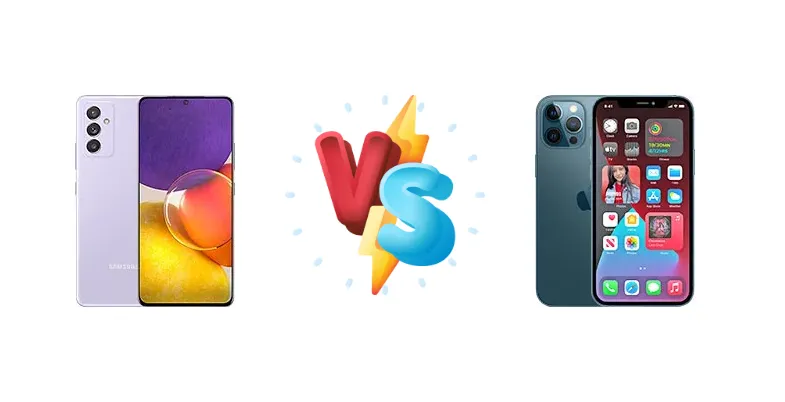
Samsung Galaxy Quantum 2 vs. iPhone 12 Pro Max: A Detailed Comparison of Two Flagships
| Phones Images | |||||
|---|---|---|---|---|---|
|
🏆 Quick Verdict
For the average user prioritizing long-term software support, a superior camera system, and a brighter display, the iPhone 12 Pro Max is the better choice. However, the Galaxy Quantum 2 offers a compelling value proposition for security-conscious users and those seeking a more affordable flagship experience.
| PHONES | ||
|---|---|---|
| Phone Names | Samsung Galaxy Quantum 2 | Apple iPhone 12 Pro Max |
| Network | ||
|---|---|---|
| 2G bands | GSM 850 / 900 / 1800 / 1900 | GSM 850 / 900 / 1800 / 1900 |
| 3G bands | HSDPA 850 / 900 / 1700(AWS) / 1900 / 2100 | HSDPA 850 / 900 / 1700(AWS) / 1900 / 2100 |
| 4G bands | 1, 2, 3, 4, 5, 7, 8, 12, 17, 20, 26, 28, 38, 40, 41, 66 | 1, 2, 3, 4, 5, 7, 8, 12, 13, 14, 17, 18, 19, 20, 25, 26, 28, 29, 30, 32, 34, 38, 39, 40, 41, 42, 46, 48, 66, 71 - A2342 |
| 5G bands | 78 Sub6 | 1, 2, 3, 5, 7, 8, 12, 20, 25, 28, 38, 40, 41, 66, 71, 77, 78, 79, 260, 261 Sub6/mmWave - A2342 |
| Speed | HSPA, LTE, 5G | HSPA, LTE, 5G, EV-DO Rev.A 3.1 Mbps |
| Technology | GSM / HSPA / LTE / 5G | GSM / CDMA / HSPA / EVDO / LTE / 5G |
| - | 1, 2, 3, 5, 7, 8, 12, 20, 25, 28, 38, 40, 41, 66, 77, 78, 79 Sub6 - A2410, A2411, A2412 | |
| Launch | ||
|---|---|---|
| Announced | 2021, April 13 | 2020, October 13 |
| Status | Available. Released 2021, April 23 | Available. Released 2020, November 13 |
| Body | ||
|---|---|---|
| Build | - | Glass front, glass back, stainless steel frame |
| Dimensions | 161.9 x 73.8 x 8.1 mm (6.37 x 2.91 x 0.32 in) | 160.8 x 78.1 x 7.4 mm (6.33 x 3.07 x 0.29 in) |
| SIM | Nano-SIM | · Nano-SIM + eSIM· Nano-SIM + Nano-SIM (China) |
| Weight | 176 g (6.21 oz) | 228 g (8.04 oz) |
| - | IP68 dust/water resistant (up to 6m for 30 min) Apple Pay (Visa, MasterCard, AMEX certified) | |
| Display | ||
|---|---|---|
| Protection | - | Ceramic Shield glass |
| Resolution | 1440 x 3200 pixels, 20:9 ratio (~524 ppi density) | 1284 x 2778 pixels, 19.5:9 ratio (~458 ppi density) |
| Size | 6.7 inches, 108.4 cm2 (~90.7% screen-to-body ratio) | 6.7 inches, 109.8 cm2 (~87.4% screen-to-body ratio) |
| Type | Dynamic AMOLED 2X, 120Hz, 1200 nits (peak) | Super Retina XDR OLED, HDR10, Dolby Vision, 800 nits (HBM), 1200 nits (peak) |
| 120Hz@FHD / 60Hz@QHD refresh rate | - | |
| Platform | ||
|---|---|---|
| CPU | Octa-core (1x2.96 GHz Kryo 485 & 3x2.42 GHz Kryo 485 & 4x1.78 GHz Kryo 485) | Hexa-core (2x3.1 GHz Firestorm + 4x1.8 GHz Icestorm) |
| Chipset | Qualcomm SM8150 Snapdragon 855+ (7 nm), QRNG security chipset | Apple A14 Bionic (5 nm) |
| GPU | Adreno 640 (700 MHz) | Apple GPU (4-core graphics) |
| OS | Android 11, One UI 3.1 | iOS 14.1, upgradable to iOS 26.1 |
| Memory | ||
|---|---|---|
| Card slot | microSDXC (dedicated slot) | No |
| Internal | 128GB 6GB RAM | 128GB 6GB RAM, 256GB 6GB RAM, 512GB 6GB RAM |
| - | NVMe | |
| Main Camera | ||
|---|---|---|
| Features | LED flash, panorama, HDR | Dual-LED dual-tone flash, HDR (photo/panorama) |
| Triple | 64 MP, f/1.8, 26mm (wide), 1/1.7X", 0.8µm, PDAF, OIS 12 MP, f/2.2, 123˚ (ultrawide), 1.12µm 5 MP (macro) | 12 MP, f/1.6, 26mm (wide), 1/1.9", 1.7µm, dual pixel PDAF, sensor-shift OIS 12 MP, f/2.2, 65mm (telephoto), 1/3.4", 1.0µm, PDAF, OIS, 2.5x optical zoom 12 MP, f/2.4, 13mm, 120˚ (ultrawide), 1/3.4", 1.0µm TOF 3D LiDAR scanner (depth) |
| Video | 4K@30fps, 1080p@30/60/240fps; gyro-EIS | 4K@24/25/30/60fps, 1080p@25/30/60/120/240fps, 10‑bit HDR, Dolby Vision HDR (up to 60fps), stereo sound rec. |
| Selfie camera | ||
|---|---|---|
| Features | HDR | HDR |
| Single | 10 MP, f/2.2, (wide) | 12 MP, f/2.2, 23mm (wide), 1/3.6", 1.0µm SL 3D, (depth/biometrics sensor) |
| Video | 1080p@30fps | 4K@24/25/30/60fps, 1080p@25/30/60/120fps, gyro-EIS |
| Sound | ||
|---|---|---|
| 3.5mm jack | No | No |
| 35mm jack | No | No |
| Loudspeaker | Yes, with stereo speakers | Yes, with stereo speakers |
| Comms | ||
|---|---|---|
| Bluetooth | 5.0, A2DP, LE | 5.0, A2DP, LE |
| NFC | Yes | Yes |
| Positioning | GPS, GLONASS, GALILEO, BDS | GPS, GLONASS, GALILEO, QZSS |
| Radio | No | No |
| USB | USB Type-C 2.0, OTG | Lightning, USB 2.0 |
| WLAN | Wi-Fi 802.11 a/b/g/n/ac, dual-band, Wi-Fi Direct | Wi-Fi 802.11 a/b/g/n/ac/6, dual-band, hotspot |
| Features | ||
|---|---|---|
| Sensors | Fingerprint (under display, ultrasonic), accelerometer, gyro, proximity, compass | Face ID, accelerometer, gyro, proximity, compass, barometer |
| - | Ultra Wideband (UWB) support | |
| Battery | ||
|---|---|---|
| Charging | 25W wired | Wired, PD2.0, 50% in 30 min 15W wireless (MagSafe) 15W wireless (Qi2) - requires iOS 17.4 update |
| Type | Li-Po 4500 mAh | Li-Ion 3687 mAh (14.13 Wh) |
| Misc | ||
|---|---|---|
| Colors | Black, White, Violet | Silver, Graphite, Gold, Pacific Blue |
| Models | SM-A826S | A2411, A2342, A2410, A2412, iPhone13,4 |
| Price | About 520 EUR | $ 328.00 / C$ 549.75 / £ 270.67 / € 339.00 |
| SAR EU | - | 0.99 W/kg (head) 0.99 W/kg (body) |
| Pricing | ||
|---|---|---|
| 128GB 6GB RAM | - | $ 599.99 |
| 256GB 6GB RAM | - | $ 728.45 |
| 512GB 6GB RAM | - | $ 886.67 |
| RENEWED | - | $ 627.00 |
| Tests | ||
|---|---|---|
| Battery life | - | Endurance rating 95h |
| Camera | - | Photo / Video |
| Display | - | Contrast ratio: Infinite (nominal) |
| Loudspeaker | - | -23.8 LUFS (Very good) |
| Performance | - | AnTuTu: 638584 (v8) GeekBench: 4240 (v5.1) GFXBench: 55fps (ES 3.1 onscreen) |
Samsung Galaxy Quantum 2
- Integrated QRNG security chipset for enhanced privacy.
- More affordable price point compared to the iPhone 12 Pro Max.
- Android ecosystem offers greater customization options.
- Older Snapdragon 855+ chipset is less powerful than the A14 Bionic.
- Likely shorter software support lifespan compared to the iPhone.
- Camera system likely less refined than the iPhone 12 Pro Max.
Apple iPhone 12 Pro Max
- Powerful A14 Bionic chipset delivers exceptional performance.
- Excellent camera system with advanced features like Dolby Vision HDR.
- Long-term software support and updates guaranteed by Apple.
- Higher price point compared to the Samsung Galaxy Quantum 2.
- Less customization options compared to Android.
- Relies on Lightning port for wired charging (potentially outdated).
Display Comparison
The iPhone 12 Pro Max boasts a significantly brighter display, reaching a measured 822 nits, compared to an unspecified brightness for the Quantum 2. While the Quantum 2’s panel technology isn’t detailed, the iPhone 12 Pro Max’s infinite contrast ratio (typical for OLED) ensures deep blacks and vibrant colors. The larger screen size of the iPhone 12 Pro Max also contributes to a more immersive viewing experience. The lack of LTPO on either device means refresh rates are fixed, but the iPhone’s color accuracy is generally considered best-in-class.
Camera Comparison
Both devices offer capable camera systems, but the iPhone 12 Pro Max generally excels in image processing and video recording. While specific sensor details for the Quantum 2 are unavailable, the iPhone 12 Pro Max’s advanced computational photography features, like Deep Fusion and Smart HDR 3, consistently deliver excellent results in various lighting conditions. The iPhone’s video capabilities, particularly its Dolby Vision HDR recording, are a significant advantage. The Quantum 2’s camera is likely competent, but lacks the refinement and feature set of Apple’s offering.
Performance
The Apple A14 Bionic, fabricated on a 5nm process, demonstrably outperforms the Qualcomm Snapdragon 855+ (7nm) in both CPU and GPU benchmarks. The A14’s hexa-core architecture (2x3.1 GHz Firestorm + 4x1.8 GHz Icestorm) is more efficient and powerful than the Snapdragon 855+'s octa-core configuration (1x2.96 GHz Kryo 485 & 3x2.42 GHz Kryo 485 & 4x1.78 GHz Kryo 485). While the Quantum 2’s 6GB of RAM is comparable to the iPhone 12 Pro Max’s base model, the A14’s superior architecture and memory management translate to smoother multitasking and faster app loading times. The Quantum 2’s QRNG chipset doesn’t impact general performance but enhances security.
Battery Life
Both phones achieve an endurance rating of 95 hours, indicating similar real-world battery life despite differing battery capacities (not specified for the Quantum 2). However, the iPhone 12 Pro Max offers faster charging with 25W wired (50% in 30 minutes) and 15W wireless charging via MagSafe and Qi2 (with iOS 17.4). The Quantum 2’s 25W wired charging is slower than the iPhone’s peak rate. The iPhone’s wireless charging options provide added convenience, while the Quantum 2 lacks these features.
Buying Guide
Buy the Samsung Galaxy Quantum 2 if you prioritize on-device security with its QRNG chipset and are comfortable with the Android ecosystem. It's ideal for users who value privacy and are seeking a flagship experience at a lower price point. Buy the Apple iPhone 12 Pro Max if you prefer a seamless user experience, a consistently excellent camera, and guaranteed software updates for years to come. It’s the better option for those deeply invested in the Apple ecosystem and prioritize ease of use.