
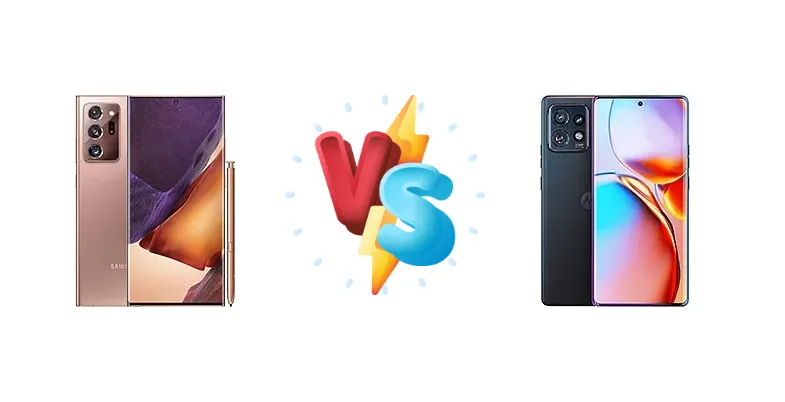
Motorola Edge+ (2023) vs. Samsung Galaxy Note20 Ultra: A Generational Leap?
| Phones Images | |||||
|---|---|---|---|---|---|
|
🏆 Quick Verdict
For most users, the Motorola Edge+ (2023) is the clear winner. The Snapdragon 8 Gen 2’s superior performance and efficiency, coupled with significantly faster 68W charging, outweigh the Note20 Ultra’s legacy features. While the Note20 Ultra still holds its own, the Edge+ offers a more future-proof and responsive experience.
| PHONES | ||
|---|---|---|
| Phone Names | Samsung Galaxy Note20 Ultra | Motorola Edge+ (2023) |
| Network | ||
|---|---|---|
| 2G bands | GSM 850 / 900 / 1800 / 1900 | GSM 850 / 900 / 1800 / 1900 |
| 3G bands | HSDPA 850 / 900 / 1700(AWS) / 1900 / 2100 | HSDPA 850 / 900 / 1700(AWS) / 1900 / 2100 |
| 4G bands | 1, 2, 3, 4, 5, 7, 8, 12, 13, 17, 18, 19, 20, 25, 26, 28, 32, 38, 39, 40, 41, 66 | 1, 2, 3, 4, 5, 7, 8, 12, 13, 14, 17, 18, 20, 25, 26, 28, 29, 30, 38, 39, 40, 41, 41, 46, 48, 66, 71 |
| 5G bands | - | 1, 2, 3, 5, 7, 12, 14, 20, 25, 26, 28, 29, 30, 38, 41, 41, 48, 66, 70, 71, 77, 78 SA/NSA/Sub6/mmWave |
| Speed | HSPA 42.2/5.76 Mbps, LTE (7CA) Cat20 2000/200 Mbps | HSPA, LTE, 5G |
| Technology | GSM / CDMA / HSPA / EVDO / LTE | GSM / HSPA / LTE / 5G |
| CDMA2000 1xEV-DO | - | |
| Launch | ||
|---|---|---|
| Announced | 2020, August 05 | 2023, May 02 |
| Status | Available. Released 2020, August 21 | Available. Released 2023, May 19 |
| Body | ||
|---|---|---|
| Build | Glass front (Gorilla Glass Victus), glass back (Gorilla Glass Victus), stainless steel frame | Glass front (Gorilla Glass Victus), glass back (Gorilla Glass Victus), aluminum frame |
| Dimensions | 164.8 x 77.2 x 8.1 mm (6.49 x 3.04 x 0.32 in) | 161.2 x 74 x 8.6 mm (6.35 x 2.91 x 0.34 in) |
| SIM | · Nano-SIM + eSIM· Nano-SIM + Nano-SIM | Nano-SIM + eSIM |
| Weight | 208 g (7.34 oz) | 203 g (7.16 oz) |
| IP68 dust/water resistant (up to 1.5m for 30 min) Stylus, 9ms latency (Bluetooth integration, accelerometer, gyro) | IP68 dust/water resistant (up to 1.5m for 30 min) | |
| Display | ||
|---|---|---|
| Protection | Corning Gorilla Glass Victus | Corning Gorilla Glass Victus |
| Resolution | 1440 x 3088 pixels, 19.3:9 ratio (~496 ppi density) | 1080 x 2400 pixels, 20:9 ratio (~395 ppi density) |
| Size | 6.9 inches, 116.7 cm2 (~91.7% screen-to-body ratio) | 6.67 inches, 107.4 cm2 (~90.0% screen-to-body ratio) |
| Type | Dynamic AMOLED 2X, 120Hz, HDR10+ | OLED, 1B colors, 165Hz, HDR10+, Dolby Vision, 1300 nits (peak) |
| Always-on display 120Hz@FHD/60Hz@QHD refresh rate | - | |
| Platform | ||
|---|---|---|
| CPU | Octa-core (2x2.73 GHz Mongoose M5 & 2x2.50 GHz Cortex-A76 & 4x2.0 GHz Cortex-A55) - GlobalOcta-core (1x3.0 GHz Kryo 585 & 3x2.42 GHz Cortex-A77 & 4x1.80 GHz Cortex-A55) - USA | Octa-core (1x3.2 GHz Cortex-X3 & 2x2.8 GHz Cortex-A715 & 2x2.8 GHz Cortex-A710 & 3x2.0 GHz Cortex-A510) |
| Chipset | Exynos 990 (7 nm+) - GlobalQualcomm SM8250 Snapdragon 865 5G+ (7 nm+) - USA | Qualcomm SM8550-AB Snapdragon 8 Gen 2 (4 nm) |
| GPU | Mali-G77 MP11 - GlobalAdreno 650 - USA | Adreno 740 |
| OS | Android 10, upgradable to Android 13, One UI 5 | Android 13, upgradable to Android 14 |
| Memory | ||
|---|---|---|
| Card slot | microSDXC (uses shared SIM slot) | No |
| Internal | 256GB 8GB RAM, 256GB 12GB RAM, 512GB 8GB RAM, 512GB 12GB RAM | 512GB 8GB RAM |
| UFS 3.0 | UFS 4.0 | |
| Main Camera | ||
|---|---|---|
| Features | Laser AF, LED flash, auto-HDR, panorama | Dual-LED flash, panorama, HDR |
| Triple | 108 MP, f/1.8, 26mm (wide), 1/1.33", 0.8µm, PDAF, OIS 12 MP, f/3.0, 120mm (periscope telephoto), 1.0µm, PDAF, OIS, 5x optical zoom, 50x hybrid zoom 12 MP, f/2.2, 120˚, 13mm (ultrawide), 1/2.55", 1.4µm | 50 MP, f/1.8, (wide), 1/1.55", 1.0µm, multi-directional PDAF, OIS 12 MP, f/1.6, (telephoto), 1/2.93", 1.22µm, PDAF, 2x optical zoom 50 MP, f/2.2, 114˚ (ultrawide), 1/2.76", 0.64µm, AF |
| Video | 8K@24fps, 4K@30/60fps, 1080p@30/60/240fps, 720p@960fps, HDR10+, stereo sound rec., gyro-EIS & OIS | 8K@30fps, 4K@30/60fps, 1080p@30/60/120/240/960fps, 10-bit HDR10+, gyro-EIS |
| Selfie camera | ||
|---|---|---|
| Features | HDR | HDR |
| Single | 10 MP, f/2.2, 26mm (wide), 1/3.2", 1.22µm, dual pixel PDAF | 60 MP, f/2.2, (wide), 1/2.8", 0.61µm |
| Video | 4K@30/60fps, 1080p@30fps | 4K@30/60fps, 1080p@30/60/120/240fps |
| Sound | ||
|---|---|---|
| 3.5mm jack | No | No |
| 35mm jack | No | No |
| Loudspeaker | Yes, with stereo speakers | Yes, with stereo speakers |
| 32-bit/384kHz audio Tuned by AKG | - | |
| Comms | ||
|---|---|---|
| Bluetooth | 5.0, A2DP, LE, aptX | 5.3, A2DP, LE, aptX HD, aptX Adaptive |
| NFC | Yes | Yes |
| Positioning | GPS, GLONASS, BDS, GALILEO | GPS, GLONASS, GALILEO, BDS |
| Radio | FM radio (Snapdragon model only; market/operator dependent) | No |
| USB | USB Type-C 3.2, OTG | USB Type-C 3.2, OTG, DisplayPort 1.4 |
| WLAN | Wi-Fi 802.11 a/b/g/n/ac/6, dual-band, Wi-Fi Direct | Wi-Fi 802.11 a/b/g/n/ac/6e/7, tri-band, Wi-Fi Direct |
| Features | ||
|---|---|---|
| Sensors | Fingerprint (under display, ultrasonic), accelerometer, gyro, proximity, compass, barometer | Fingerprint (under display, optical), accelerometer, gyro, proximity, compass, barometer |
| Samsung Wireless DeX (desktop experience support) ANT+ Bixby natural language commands and dictation Samsung Pay (Visa, MasterCard certified) Ultra Wideband (UWB) support | Ready For 3.5 support | |
| Battery | ||
|---|---|---|
| Charging | 25W wired, PD3.0 15W wireless (Qi) 4.5W reverse wireless | 68W wired 15W wireless 5W reverse wired 5W reverse wireless |
| Type | Li-Ion 4500 mAh | Li-Po 5100 mAh |
| Misc | ||
|---|---|---|
| Colors | Mystic Bronze, Mystic Black, Mystic White | Interstellar Black |
| Models | SM-N985F, SM-N985F/DS | - |
| Price | About 1250 EUR | $ 298.99 |
| SAR | 0.57 W/kg (head) 1.02 W/kg (body) | - |
| SAR EU | 0.32 W/kg (head) 1.47 W/kg (body) | - |
Samsung Galaxy Note20 Ultra
- Integrated S Pen Stylus
- Mature Samsung Ecosystem
- Potentially higher PWM dimming rate for eye comfort
- Older Chipset (Exynos 990/Snapdragon 865)
- Slower 25W Charging
- Potential for throttling under heavy load
Motorola Edge+ (2023)
- Snapdragon 8 Gen 2 Performance
- 68W Fast Charging
- Improved Power Efficiency
- Modern Image Signal Processor
- Lacks Integrated Stylus
- Motorola's Software Update History (potentially slower)
- May lack some Samsung-specific features
Display Comparison
While both devices feature high-quality displays, the Note20 Ultra’s panel likely benefits from a higher PWM dimming rate, potentially reducing eye strain for sensitive users. However, the Edge+ (2023) benefits from the advancements in display technology since 2020, likely offering improved color accuracy and brightness, though specific nit values aren't provided. The Note20 Ultra's curved display, while visually appealing, can introduce accidental touches, a potential drawback compared to a flatter Edge+ (2023) panel.
Camera Comparison
Without detailed camera specs, a direct comparison is difficult. However, the Motorola Edge+ (2023) likely features a more modern image signal processor (ISP) integrated within the Snapdragon 8 Gen 2, enabling superior image processing and low-light performance. The Note20 Ultra’s camera system, while excellent for its time, is now several generations behind. The Edge+ (2023) likely benefits from advancements in computational photography algorithms, resulting in more detailed and dynamic range-rich images. We can assume the Edge+ has a larger main sensor, a key driver of image quality.
Performance
The core difference lies in the chipsets. The Motorola Edge+ (2023) utilizes the 4nm Snapdragon 8 Gen 2, featuring a Cortex-X3 prime core clocked at 3.2GHz. This represents a substantial leap over the Note20 Ultra’s 7nm+ Exynos 990 (globally) or Snapdragon 865 5G+ (USA). The Snapdragon 8 Gen 2’s architectural improvements – Cortex-A715/A710 replacing the A76/A55 – deliver significantly higher performance *and* improved power efficiency. This translates to less throttling during sustained workloads like gaming and longer battery life. The Note20 Ultra’s CPU, while capable, will struggle to match the Edge+ (2023) in demanding tasks. The Edge+ also benefits from potentially faster LPDDR5x RAM, further enhancing responsiveness.
Battery Life
The Motorola Edge+ (2023)’s 68W wired charging is a game-changer, allowing for a full charge in under 40 minutes. The Note20 Ultra’s 25W charging feels comparatively slow. While battery capacity isn’t specified, the Snapdragon 8 Gen 2’s efficiency means the Edge+ (2023) will likely achieve comparable or better battery life despite potentially having a similar or smaller battery. The Edge+ also offers 5W reverse wired charging, a slight advantage over the Note20 Ultra’s 4.5W reverse wireless.
Buying Guide
Buy the Samsung Galaxy Note20 Ultra if you prioritize the S Pen stylus and are heavily invested in the Samsung ecosystem, and can accept compromises in processing power and charging speed. Buy the Motorola Edge+ (2023) if you demand the fastest possible performance, long-lasting battery life, and rapid charging, and are willing to forgo the stylus functionality.