
Samsung Galaxy Note20 Ultra 5G vs. OnePlus 9 Pro: Which Flagship Reigns Supreme?
| Phones Images | |||||
|---|---|---|---|---|---|
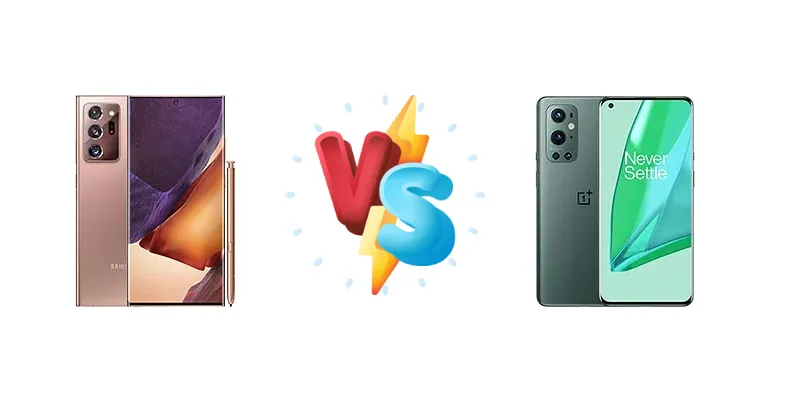
|
🏆 Quick Verdict
For most users, the OnePlus 9 Pro emerges as the stronger choice. Its Snapdragon 888 chipset delivers consistently better performance and thermal management than the Exynos 990 (global variant) found in many Note20 Ultra units. While the Note20 Ultra’s S Pen is a unique feature, the OnePlus 9 Pro’s superior charging speed and competitive camera system provide a more compelling overall package.
| PHONES | ||
|---|---|---|
| Phone Names | Samsung Galaxy Note20 Ultra 5G | OnePlus 9 Pro |
| Network | ||
|---|---|---|
| 2G bands | GSM 850 / 900 / 1800 / 1900 | GSM 850 / 900 / 1800 / 1900 |
| 3G bands | HSDPA 850 / 900 / 1700(AWS) / 1900 / 2100 | HSDPA 800 / 850 / 900 / 1700(AWS) / 1800 / 1900 / 2100 |
| 4G bands | 1, 2, 3, 4, 5, 7, 8, 12, 13, 14, 18, 19, 20, 25, 26, 28, 29, 30, 38, 39, 40, 41, 46, 48, 66, 71 - SM-N986U | 1, 2, 3, 4, 5, 7, 8, 12, 13, 17, 18, 19, 20, 25, 26, 28, 32, 38, 39, 40, 41, 66 - EU |
| 5G bands | 2, 5, 41, 66, 71, 260, 261 SA/NSA/Sub6/mmWave - SM-N986U | 1, 3, 5, 7, 8, 20, 28, 38, 40, 41, 66, 78 SA/NSA - EU |
| Speed | HSPA 42.2/5.76 Mbps, LTE (7CA) Cat20 2000/200 Mbps, 5G | HSPA 42.2/5.76 Mbps, LTE Cat20 2000/200 Mbps, 5G |
| Technology | GSM / CDMA / HSPA / EVDO / LTE / 5G | GSM / CDMA / HSPA / LTE / 5G |
| 41, 66, 71 Sub6 - SM-N986W | 1, 3, 28, 41, 78, 79 SA/NSA - CN | |
| Launch | ||
|---|---|---|
| Announced | 2020, August 05 | 2021, March 23 |
| Status | Available. Released 2020, August 21 | Available. Released 2021, March 30 |
| Body | ||
|---|---|---|
| Build | Glass front (Gorilla Glass Victus), glass back (Gorilla Glass Victus), stainless steel frame | Glass front (Gorilla Glass 5), glass back (Gorilla Glass 5), aluminum frame |
| Dimensions | 164.8 x 77.2 x 8.1 mm (6.49 x 3.04 x 0.32 in) | 163.2 x 73.6 x 8.7 mm (6.43 x 2.90 x 0.34 in) |
| SIM | · Nano-SIM + eSIM· Nano-SIM + Nano-SIM | · Nano-SIM· Nano-SIM + Nano-SIM |
| Weight | 208 g (7.34 oz) | 197 g (6.95 oz) |
| IP68 dust/water resistant (up to 1.5m for 30 min) Stylus, 9ms latency (Bluetooth integration, accelerometer, gyro) | IP68 dust/water resistant (up to 1.5m for 30 min) | |
| Display | ||
|---|---|---|
| Protection | Corning Gorilla Glass Victus | Corning Gorilla Glass 5 |
| Resolution | 1440 x 3088 pixels, 19.3:9 ratio (~496 ppi density) | 1440 x 3216 pixels, 20:9 ratio (~525 ppi density) |
| Size | 6.9 inches, 116.7 cm2 (~91.7% screen-to-body ratio) | 6.7 inches, 108.4 cm2 (~90.3% screen-to-body ratio) |
| Type | Dynamic AMOLED 2X, 120Hz, HDR10+ | LTPO Fluid2 AMOLED, 1B colors, 120Hz, HDR10+, 1300 nits (peak) |
| Always-on display 120Hz@FHD/60Hz@QHD refresh rate | Always-on display | |
| Platform | ||
|---|---|---|
| CPU | Octa-core (2x2.73 GHz Mongoose M5 & 2x2.50 GHz Cortex-A76 & 4x2.0 GHz Cortex-A55) - GlobalOcta-core (1x3.0 GHz Kryo 585 & 3x2.42 GHz Cortex-A77 & 4x1.80 GHz Cortex-A55) - USA | Octa-core (1x2.84 GHz Cortex-X1 & 3x2.42 GHz Cortex-A78 & 4x1.80 GHz Cortex-A55 |
| Chipset | Exynos 990 (7 nm+) - GlobalQualcomm SM8250 Snapdragon 865 5G+ (7 nm+) - USA | Qualcomm SM8350 Snapdragon 888 5G (5 nm) |
| GPU | Mali-G77 MP11 - GlobalAdreno 650 - USA | Adreno 660 |
| OS | Android 10, upgradable to Android 13, One UI 5 | Android 11, upgradable to Android 14, OxygenOS 14 |
| Memory | ||
|---|---|---|
| Card slot | microSDXC (uses shared SIM slot) | No |
| Internal | 128GB 6GB RAM, 128GB 8GB RAM, 128GB 12GB RAM, 256GB 8GB RAM, 256GB 12GB RAM, 512GB 12GB RAM | 128GB 8GB RAM, 256GB 8GB RAM, 256GB 12GB RAM |
| UFS 3.0 | UFS 3.1 | |
| Main Camera | ||
|---|---|---|
| Features | Laser AF, LED flash, auto-HDR, panorama | Laser AF, color spectrum sensor, Hasselblad Color Calibration, dual-LED flash, HDR, panorama |
| Quad | - | 48 MP, f/1.8, 23mm (wide), 1/1.43", 1.12µm, multi-directional PDAF, OIS 8 MP, f/2.4, 77mm (telephoto), 1.0µm, PDAF, OIS, 3.3x optical zoom 50 MP, f/2.2, 14mm (ultrawide), 1/1.56", 1.0µm, AF 2 MP, f/2.4, (monochrome) |
| Single | 3.15 MP | 16 MP, f/2.4, (wide), 1/3.06", 1.0µm |
| Triple | 108 MP, f/1.8, 26mm (wide), 1/1.33", 0.8µm, PDAF, OIS 12 MP, f/3.0, 120mm (periscope telephoto), 1.0µm, PDAF, OIS, 5x optical zoom, 50x hybrid zoom 12 MP, f/2.2, 120˚, 13mm (ultrawide), 1/2.55", 1.4µm | - |
| Video | 8K@24fps, 4K@30/60fps, 1080p@30/60/240fps, 720p@960fps, HDR10+, stereo sound rec., gyro-EIS & OIS | 8K@30fps, 4K@30/60/120fps, 1080p@30/60/240fps, Auto HDR, gyro-EIS |
| Selfie camera | ||
|---|---|---|
| Features | HDR | HDR |
| Single | 10 MP, f/2.2, 26mm (wide), 1/3.2", 1.22µm, dual pixel PDAF | 16 MP, f/2.4, (wide), 1/3.06", 1.0µm |
| Video | 4K@30/60fps, 1080p@30fps | 1080p@30fps, gyro-EIS |
| Sound | ||
|---|---|---|
| 3.5mm jack | No | No |
| 35mm jack | No | No |
| Loudspeaker | Yes, with stereo speakers | Yes, with stereo speakers |
| 32-bit/384kHz audio Tuned by AKG | 24-bit/192kHz audio | |
| Comms | ||
|---|---|---|
| Bluetooth | 5.0, A2DP, LE, aptX | 5.2, A2DP, LE, aptX HD |
| NFC | Yes | Yes |
| Positioning | GPS, GLONASS, BDS, GALILEO | GPS (L1+L5), GLONASS (G1), BDS (B1), GALILEO (E1+E5a) |
| Radio | FM radio (Snapdragon model only; market/operator dependent) | No |
| USB | USB Type-C 3.2, OTG | USB Type-C 3.1, OTG |
| WLAN | Wi-Fi 802.11 a/b/g/n/ac/6, dual-band, Wi-Fi Direct | Wi-Fi 802.11 a/b/g/n/ac/6, dual-band, Wi-Fi Direct, DLNA |
| Features | ||
|---|---|---|
| Sensors | Fingerprint (under display, ultrasonic), accelerometer, gyro, proximity, compass, barometer | Fingerprint (under display, optical), accelerometer, gyro, proximity, compass |
| Samsung Wireless DeX (desktop experience support) ANT+ Bixby natural language commands and dictation Samsung Pay (Visa, MasterCard certified) Ultra Wideband (UWB) support | - | |
| Battery | ||
|---|---|---|
| Charging | 25W wired, PD3.0 15W wireless (Qi) 4.5W reverse wireless | 65W wired, PD, 100% in 29 min 50W wireless, 100% in 43 min 5W reverse wireless |
| Type | Li-Ion 4500 mAh | Li-Po 4500 mAh |
| Misc | ||
|---|---|---|
| Colors | Mystic Bronze, Mystic Black, Mystic White | Morning Mist, Forest Green, Stellar Black |
| Models | SM-N986B, SM-N986B/DS, SM-N986U, SM-N986U1, SM-N986W, SM-N9860, SM-N986N, SC-53A | LE2121, LE2125, LE2123, LE2120, LE2127 |
| Price | € 381.00 / $ 248.44 | € 246.17 / $ 264.95 / £ 287.00 |
| SAR | 0.71 W/kg (head) 1.18 W/kg (body) | - |
| SAR EU | 0.34 W/kg (head) 1.47 W/kg (body) | - |
| Tests | ||
|---|---|---|
| Battery life | Endurance rating 88h | Endurance rating 86h |
| Camera | Photo / Video | Photo / Video |
| Display | Contrast ratio: Infinite (nominal) | - |
| Loudspeaker | -27.8 LUFS (Good) | -24.1 LUFS (Very good) |
| Performance | AnTuTu: 508760 (v8) GeekBench: 2603 (v5.1) GFXBench: 42fps (ES 3.1 onscreen) | - |
Samsung Galaxy Note20 Ultra 5G
- Integrated S Pen for productivity and creativity
- Brighter display for outdoor visibility
- Larger display size for media consumption
- Exynos 990 can suffer from thermal throttling
- Slower charging speeds (25W)
- Potentially lower performance compared to Snapdragon 888
OnePlus 9 Pro
- Faster Snapdragon 888 processor
- 65W SuperVOOC charging (0-100% in 29 mins)
- Hasselblad-tuned camera for natural color accuracy
- Slightly dimmer display compared to Note20 Ultra
- Lacks integrated S Pen functionality
- Wireless charging slower than some competitors (43 mins)
Display Comparison
Both phones feature excellent displays, but the Samsung Galaxy Note20 Ultra 5G edges out the OnePlus 9 Pro in peak brightness, achieving 1024 nits compared to the OnePlus 9 Pro’s 859 nits. This translates to better visibility in direct sunlight. However, the OnePlus 9 Pro’s display technology is also excellent, and the difference in real-world usage is often minimal. Both offer vibrant colors and sharp details, though the Note20 Ultra’s ‘Infinite’ contrast ratio (nominal) suggests deeper blacks, a common strength of Samsung’s AMOLED panels. The Note20 Ultra’s display is also slightly larger, which may appeal to users who consume a lot of media.
Camera Comparison
Both phones offer versatile camera systems, but the OnePlus 9 Pro benefits from its partnership with Hasselblad. While both phones are capable of capturing excellent photos and videos, the OnePlus 9 Pro’s image processing tends to produce more natural-looking colors, while Samsung’s processing often leans towards more saturated and vibrant tones. Sensor size details are missing, but the OnePlus 9 Pro’s camera system is generally considered more consistent across all lenses. The Note20 Ultra’s zoom capabilities are strong, but the OnePlus 9 Pro’s overall image quality and dynamic range are often superior. The inclusion of a 2MP macro camera on both devices is largely a marketing gimmick and offers limited practical benefit.
Performance
The performance gap is significant. The OnePlus 9 Pro, equipped with the Qualcomm SM8350 Snapdragon 888 5G (5nm), boasts a more efficient and powerful chipset than the Samsung Galaxy Note20 Ultra 5G’s Exynos 990 (7nm+) or Snapdragon 865 5G+ (7nm+). The Snapdragon 888’s Cortex-X1 prime core provides a noticeable boost in single-core performance, while its Adreno 660 GPU offers superior graphics capabilities. Crucially, the 5nm process node of the Snapdragon 888 results in better thermal management, reducing the likelihood of throttling during sustained workloads. The Note20 Ultra’s Exynos variant, in particular, has been known to exhibit thermal throttling under heavy load, impacting long-term performance. The USA variant with the Snapdragon 865+ fares better, but still lags behind the 888.
Battery Life
The Samsung Galaxy Note20 Ultra 5G has an endurance rating of 88 hours, while the OnePlus 9 Pro scores 86 hours. However, this doesn’t tell the whole story. The OnePlus 9 Pro’s 65W wired charging is a game-changer, fully charging the device in just 29 minutes. The Note20 Ultra’s 25W charging, while supporting PD3.0, is significantly slower. The OnePlus 9 Pro also offers 50W wireless charging, compared to the Note20 Ultra’s 15W wireless charging. This means the OnePlus 9 Pro can be topped up much more quickly, mitigating any slight disadvantage in overall battery endurance.
Buying Guide
Buy the Samsung Galaxy Note20 Ultra 5G if you absolutely require the S Pen for note-taking, sketching, or remote control functionality, and are willing to potentially accept slightly lower performance and battery efficiency. Buy the OnePlus 9 Pro if you prioritize raw performance, incredibly fast charging (65W vs 25W), and a versatile camera system, and don't need the S Pen's specialized features.