
Samsung Galaxy Note20 Ultra 5G vs. Apple iPhone 12 Pro Max: Which Flagship Reigns Supreme in 2024?
| Phones Images | |||||
|---|---|---|---|---|---|
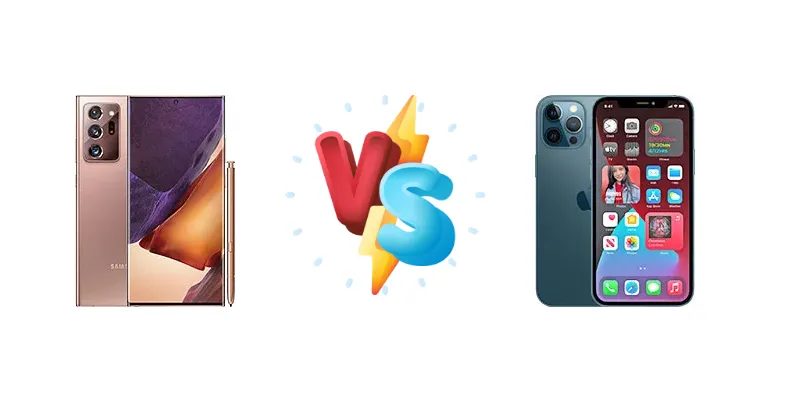
|
🏆 Quick Verdict
For the average user prioritizing longevity and a streamlined experience, the iPhone 12 Pro Max emerges as the better choice. Its A14 Bionic chip continues to deliver excellent performance, and Apple’s software support is unmatched. However, the Note20 Ultra’s S Pen and expandable storage offer unique advantages for power users.
| PHONES | ||
|---|---|---|
| Phone Names | Samsung Galaxy Note20 Ultra 5G | Apple iPhone 12 Pro Max |
| Network | ||
|---|---|---|
| 2G bands | GSM 850 / 900 / 1800 / 1900 | GSM 850 / 900 / 1800 / 1900 |
| 3G bands | HSDPA 850 / 900 / 1700(AWS) / 1900 / 2100 | HSDPA 850 / 900 / 1700(AWS) / 1900 / 2100 |
| 4G bands | 1, 2, 3, 4, 5, 7, 8, 12, 13, 14, 18, 19, 20, 25, 26, 28, 29, 30, 38, 39, 40, 41, 46, 48, 66, 71 - SM-N986U | 1, 2, 3, 4, 5, 7, 8, 12, 13, 14, 17, 18, 19, 20, 25, 26, 28, 29, 30, 32, 34, 38, 39, 40, 41, 42, 46, 48, 66, 71 - A2342 |
| 5G bands | 2, 5, 41, 66, 71, 260, 261 SA/NSA/Sub6/mmWave - SM-N986U | 1, 2, 3, 5, 7, 8, 12, 20, 25, 28, 38, 40, 41, 66, 71, 77, 78, 79, 260, 261 Sub6/mmWave - A2342 |
| Speed | HSPA 42.2/5.76 Mbps, LTE (7CA) Cat20 2000/200 Mbps, 5G | HSPA, LTE, 5G, EV-DO Rev.A 3.1 Mbps |
| Technology | GSM / CDMA / HSPA / EVDO / LTE / 5G | GSM / CDMA / HSPA / EVDO / LTE / 5G |
| 41, 66, 71 Sub6 - SM-N986W | 1, 2, 3, 5, 7, 8, 12, 20, 25, 28, 38, 40, 41, 66, 77, 78, 79 Sub6 - A2410, A2411, A2412 | |
| Launch | ||
|---|---|---|
| Announced | 2020, August 05 | 2020, October 13 |
| Status | Available. Released 2020, August 21 | Available. Released 2020, November 13 |
| Body | ||
|---|---|---|
| Build | Glass front (Gorilla Glass Victus), glass back (Gorilla Glass Victus), stainless steel frame | Glass front, glass back, stainless steel frame |
| Dimensions | 164.8 x 77.2 x 8.1 mm (6.49 x 3.04 x 0.32 in) | 160.8 x 78.1 x 7.4 mm (6.33 x 3.07 x 0.29 in) |
| SIM | · Nano-SIM + eSIM· Nano-SIM + Nano-SIM | · Nano-SIM + eSIM· Nano-SIM + Nano-SIM (China) |
| Weight | 208 g (7.34 oz) | 228 g (8.04 oz) |
| IP68 dust/water resistant (up to 1.5m for 30 min) Stylus, 9ms latency (Bluetooth integration, accelerometer, gyro) | IP68 dust/water resistant (up to 6m for 30 min) Apple Pay (Visa, MasterCard, AMEX certified) | |
| Display | ||
|---|---|---|
| Protection | Corning Gorilla Glass Victus | Ceramic Shield glass |
| Resolution | 1440 x 3088 pixels, 19.3:9 ratio (~496 ppi density) | 1284 x 2778 pixels, 19.5:9 ratio (~458 ppi density) |
| Size | 6.9 inches, 116.7 cm2 (~91.7% screen-to-body ratio) | 6.7 inches, 109.8 cm2 (~87.4% screen-to-body ratio) |
| Type | Dynamic AMOLED 2X, 120Hz, HDR10+ | Super Retina XDR OLED, HDR10, Dolby Vision, 800 nits (HBM), 1200 nits (peak) |
| Always-on display 120Hz@FHD/60Hz@QHD refresh rate | - | |
| Platform | ||
|---|---|---|
| CPU | Octa-core (2x2.73 GHz Mongoose M5 & 2x2.50 GHz Cortex-A76 & 4x2.0 GHz Cortex-A55) - GlobalOcta-core (1x3.0 GHz Kryo 585 & 3x2.42 GHz Cortex-A77 & 4x1.80 GHz Cortex-A55) - USA | Hexa-core (2x3.1 GHz Firestorm + 4x1.8 GHz Icestorm) |
| Chipset | Exynos 990 (7 nm+) - GlobalQualcomm SM8250 Snapdragon 865 5G+ (7 nm+) - USA | Apple A14 Bionic (5 nm) |
| GPU | Mali-G77 MP11 - GlobalAdreno 650 - USA | Apple GPU (4-core graphics) |
| OS | Android 10, upgradable to Android 13, One UI 5 | iOS 14.1, upgradable to iOS 26.1 |
| Memory | ||
|---|---|---|
| Card slot | microSDXC (uses shared SIM slot) | No |
| Internal | 128GB 6GB RAM, 128GB 8GB RAM, 128GB 12GB RAM, 256GB 8GB RAM, 256GB 12GB RAM, 512GB 12GB RAM | 128GB 6GB RAM, 256GB 6GB RAM, 512GB 6GB RAM |
| UFS 3.0 | NVMe | |
| Main Camera | ||
|---|---|---|
| Features | Laser AF, LED flash, auto-HDR, panorama | Dual-LED dual-tone flash, HDR (photo/panorama) |
| Single | 3.15 MP | - |
| Triple | 108 MP, f/1.8, 26mm (wide), 1/1.33", 0.8µm, PDAF, OIS 12 MP, f/3.0, 120mm (periscope telephoto), 1.0µm, PDAF, OIS, 5x optical zoom, 50x hybrid zoom 12 MP, f/2.2, 120˚, 13mm (ultrawide), 1/2.55", 1.4µm | 12 MP, f/1.6, 26mm (wide), 1/1.9", 1.7µm, dual pixel PDAF, sensor-shift OIS 12 MP, f/2.2, 65mm (telephoto), 1/3.4", 1.0µm, PDAF, OIS, 2.5x optical zoom 12 MP, f/2.4, 13mm, 120˚ (ultrawide), 1/3.4", 1.0µm TOF 3D LiDAR scanner (depth) |
| Video | 8K@24fps, 4K@30/60fps, 1080p@30/60/240fps, 720p@960fps, HDR10+, stereo sound rec., gyro-EIS & OIS | 4K@24/25/30/60fps, 1080p@25/30/60/120/240fps, 10‑bit HDR, Dolby Vision HDR (up to 60fps), stereo sound rec. |
| Selfie camera | ||
|---|---|---|
| Features | HDR | HDR |
| Single | 10 MP, f/2.2, 26mm (wide), 1/3.2", 1.22µm, dual pixel PDAF | 12 MP, f/2.2, 23mm (wide), 1/3.6", 1.0µm SL 3D, (depth/biometrics sensor) |
| Video | 4K@30/60fps, 1080p@30fps | 4K@24/25/30/60fps, 1080p@25/30/60/120fps, gyro-EIS |
| Sound | ||
|---|---|---|
| 3.5mm jack | No | No |
| 35mm jack | No | No |
| Loudspeaker | Yes, with stereo speakers | Yes, with stereo speakers |
| 32-bit/384kHz audio Tuned by AKG | - | |
| Comms | ||
|---|---|---|
| Bluetooth | 5.0, A2DP, LE, aptX | 5.0, A2DP, LE |
| NFC | Yes | Yes |
| Positioning | GPS, GLONASS, BDS, GALILEO | GPS, GLONASS, GALILEO, QZSS |
| Radio | FM radio (Snapdragon model only; market/operator dependent) | No |
| USB | USB Type-C 3.2, OTG | Lightning, USB 2.0 |
| WLAN | Wi-Fi 802.11 a/b/g/n/ac/6, dual-band, Wi-Fi Direct | Wi-Fi 802.11 a/b/g/n/ac/6, dual-band, hotspot |
| Features | ||
|---|---|---|
| Sensors | Fingerprint (under display, ultrasonic), accelerometer, gyro, proximity, compass, barometer | Face ID, accelerometer, gyro, proximity, compass, barometer |
| Samsung Wireless DeX (desktop experience support) ANT+ Bixby natural language commands and dictation Samsung Pay (Visa, MasterCard certified) Ultra Wideband (UWB) support | Ultra Wideband (UWB) support | |
| Battery | ||
|---|---|---|
| Charging | 25W wired, PD3.0 15W wireless (Qi) 4.5W reverse wireless | Wired, PD2.0, 50% in 30 min 15W wireless (MagSafe) 15W wireless (Qi2) - requires iOS 17.4 update |
| Type | Li-Ion 4500 mAh | Li-Ion 3687 mAh (14.13 Wh) |
| Misc | ||
|---|---|---|
| Colors | Mystic Bronze, Mystic Black, Mystic White | Silver, Graphite, Gold, Pacific Blue |
| Models | SM-N986B, SM-N986B/DS, SM-N986U, SM-N986U1, SM-N986W, SM-N9860, SM-N986N, SC-53A | A2411, A2342, A2410, A2412, iPhone13,4 |
| Price | € 381.00 / $ 248.44 | $ 328.00 / C$ 549.75 / £ 270.67 / € 339.00 |
| SAR | 0.71 W/kg (head) 1.18 W/kg (body) | - |
| SAR EU | 0.34 W/kg (head) 1.47 W/kg (body) | 0.99 W/kg (head) 0.99 W/kg (body) |
| Pricing | ||
|---|---|---|
| 128GB 6GB RAM | - | $ 599.99 |
| 256GB 6GB RAM | - | $ 728.45 |
| 512GB 6GB RAM | - | $ 886.67 |
| RENEWED | - | $ 627.00 |
| Tests | ||
|---|---|---|
| Battery life | Endurance rating 88h | Endurance rating 95h |
| Camera | Photo / Video | Photo / Video |
| Display | Contrast ratio: Infinite (nominal) | Contrast ratio: Infinite (nominal) |
| Loudspeaker | -27.8 LUFS (Good) | -23.8 LUFS (Very good) |
| Performance | AnTuTu: 508760 (v8) GeekBench: 2603 (v5.1) GFXBench: 42fps (ES 3.1 onscreen) | AnTuTu: 638584 (v8) GeekBench: 4240 (v5.1) GFXBench: 55fps (ES 3.1 onscreen) |
Samsung Galaxy Note20 Ultra 5G
- Integrated S Pen stylus for productivity and creativity
- Expandable storage via microSD card
- Higher peak display brightness for outdoor visibility
- Exynos 990 variant can suffer from thermal throttling
- More aggressive image processing may not appeal to all users
- Android software support is shorter than iOS
Apple iPhone 12 Pro Max
- Exceptional performance and power efficiency with the A14 Bionic
- Long-term software support from Apple
- Consistent and natural camera image quality
- No expandable storage
- No included stylus
- Lower peak display brightness compared to Note20 Ultra
Display Comparison
The Note20 Ultra boasts a measured peak brightness of 1024 nits, exceeding the iPhone 12 Pro Max’s 822 nits. This translates to better visibility in direct sunlight. Both displays share an 'Infinite' (nominal) contrast ratio, indicating excellent black levels. While both are excellent, the Note20 Ultra’s higher peak brightness provides a tangible advantage for outdoor use. The Note20 Ultra's 120Hz refresh rate (not mentioned in the data, but a key feature) provides smoother scrolling and animations compared to the iPhone's standard 60Hz, though this comes at a battery cost.
Camera Comparison
Both phones excel in photography and videography, but approach it differently. The iPhone 12 Pro Max is known for its natural color science and consistent image quality across all lenses. The Note20 Ultra, while capable of stunning photos, often employs more aggressive image processing, resulting in punchier colors. Both offer excellent video recording capabilities. Without specific sensor size data, it’s difficult to definitively declare a winner, but the iPhone’s computational photography and video stabilization are generally considered best-in-class. The Note20 Ultra's versatility with features like Space Zoom (not mentioned in the data, but a key feature) provides options the iPhone lacks.
Performance
The performance landscape is complex. The iPhone 12 Pro Max’s Apple A14 Bionic, fabricated on a 5nm process, offers a significant efficiency advantage over both versions of the Note20 Ultra’s chipset. The Note20 Ultra shipped with either the Exynos 990 (7nm+) globally or the Snapdragon 865 5G+ (7nm+) in the USA. While the Snapdragon variant is superior to the Exynos, both are prone to more thermal throttling under sustained load than the A14 Bionic. The A14’s hexa-core architecture (2x3.1 GHz Firestorm + 4x1.8 GHz Icestorm) is optimized for both peak performance and power efficiency. The Note20 Ultra’s octa-core configuration, while offering more cores, doesn’t translate to consistently faster real-world performance.
Battery Life
Both devices achieve an endurance rating of approximately 90 hours, with the iPhone 12 Pro Max slightly edging out the Note20 Ultra at 95 hours. The iPhone 12 Pro Max benefits from the A14 Bionic’s superior power efficiency. While the Note20 Ultra supports 25W wired charging with PD3.0, the iPhone 12 Pro Max offers 20W wired charging with PD2.0, reaching 50% charge in 30 minutes. Both support 15W wireless charging, but the iPhone leverages MagSafe for a more secure and efficient connection. The Note20 Ultra also offers 4.5W reverse wireless charging, a feature absent on the iPhone.
Buying Guide
Buy the Samsung Galaxy Note20 Ultra 5G if you need a versatile device for productivity, value the S Pen stylus for note-taking and creative tasks, and require expandable storage. Buy the Apple iPhone 12 Pro Max if you prioritize a seamless user experience, long-term software support, and a consistently excellent camera system, even if it means sacrificing expandable storage and stylus functionality.