
Samsung Galaxy Note20 5G vs. Sony Xperia 1 III: A Deep Dive for Power Users
| Phones Images | |||||
|---|---|---|---|---|---|
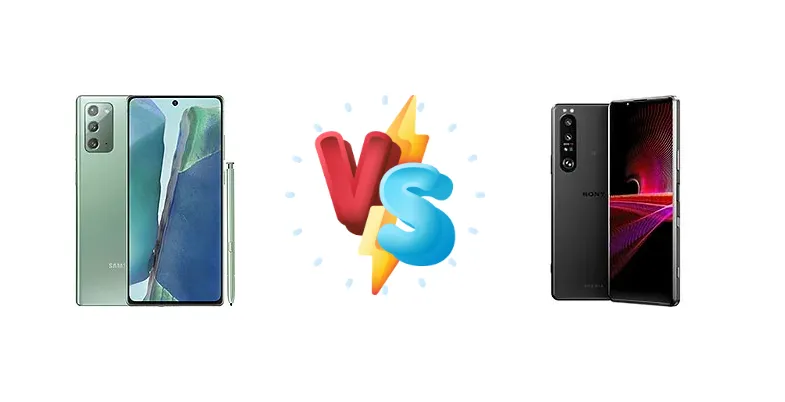
|
🏆 Quick Verdict
For the average user prioritizing productivity and a versatile experience, the Samsung Galaxy Note20 5G remains a compelling choice, especially given its current pricing. However, the Sony Xperia 1 III decisively wins for video-centric creators who demand granular control and a dedicated feature set.
| PHONES | ||
|---|---|---|
| Phone Names | Samsung Galaxy Note20 5G | Sony Xperia 1 III |
| Network | ||
|---|---|---|
| 2G bands | GSM 850 / 900 / 1800 / 1900 | GSM 850 / 900 / 1800 / 1900 |
| 3G bands | HSDPA 850 / 900 / 1700(AWS) / 1900 / 2100 | HSDPA 800 / 850 / 900 / 1700(AWS) / 1900 / 2100 |
| 4G bands | 1, 2, 3, 4, 5, 7, 8, 12, 13, 14, 18, 19, 20, 25, 26, 28, 29, 30, 38, 39, 40, 41, 46, 48, 66, 71 - SM-N981U | 1, 2, 3, 4, 5, 7, 8, 12, 13, 17, 19, 20, 25, 26, 28, 29, 32, 34, 38, 39, 40, 41, 46, 66 - Europe |
| 5G bands | 2, 5, 41, 66, 71, 260, 261 SA/NSA/Sub6/mmWave - SM-N981U | 1, 3, 5, 7, 8, 20, 28, 38, 40, 41, 77, 78 SA/NSA/Sub6 - Europe |
| EDGE | No | - |
| GPRS | Yes | - |
| Speed | HSPA 42.2/5.76 Mbps, LTE (7CA) Cat20 2000/200 Mbps, 5G | HSPA, LTE, 5G |
| Technology | GSM / CDMA / HSPA / EVDO / LTE / 5G | GSM / HSPA / LTE / 5G |
| 41, 66, 71 Sub6 - SM-N981W | SA/NSA/Sub6/mmWave - USA (specific) | |
| Launch | ||
|---|---|---|
| Announced | 2020, August 05 | 2021, April 14 |
| Status | Available. Released 2020, August 21 | Available. Released 2021, August 25 |
| Body | ||
|---|---|---|
| Build | Glass front (Gorilla Glass 5), plastic back | Glass front (Gorilla Glass Victus), glass back (Gorilla Glass 6), aluminum frame |
| Dimensions | 161.6 x 75.2 x 8.3 mm (6.36 x 2.96 x 0.33 in) | 165 x 71 x 8.2 mm (6.50 x 2.80 x 0.32 in) |
| SIM | · Nano-SIM + eSIM· Nano-SIM + Nano-SIM | Nano-SIM + Nano-SIM |
| Weight | 192 g (Sub6 5G), 194 g (mmWave 5G) (6.77 oz) | 186 g / 187.1 g (mmWave) (6.56 oz) |
| IP68 dust/water resistant (up to 1.5m for 30 min) Stylus, 26ms latency (Bluetooth integration, accelerometer, gyro) | IP65/IP68 dust/water resistant (up to 1.5m for 30 min) | |
| Display | ||
|---|---|---|
| Protection | Corning Gorilla Glass 5 | Corning Gorilla Glass Victus |
| Resolution | 1080 x 2400 pixels, 20:9 ratio (~393 ppi density) | 1644 x 3840 pixels, 21:9 ratio (~643 ppi density) |
| Size | 6.7 inches, 108.4 cm2 (~89.2% screen-to-body ratio) | 6.5 inches, 98.6 cm2 (~84.2% screen-to-body ratio) |
| Type | Super AMOLED Plus, HDR10+ | OLED, 1B colors, 120Hz, HDR BT.2020 |
| Always-on display | Runs at 1096 x 2560 pixels except for select use cases | |
| Platform | ||
|---|---|---|
| CPU | Octa-core (2x2.73 GHz Mongoose M5 & 2x2.50 GHz Cortex-A76 & 4x2.0 GHz Cortex-A55) - GlobalOcta-core (1x3.0 GHz Kryo 585 & 3x2.42 GHz Cortex-A77 & 4x1.80 GHz Cortex-A55) - USA | Octa-core (1x2.84 GHz Cortex-X1 & 3x2.42 GHz Cortex-A78 & 4x1.80 GHz Cortex-A55) |
| Chipset | Exynos 990 (7 nm+) - GlobalQualcomm SM8250 Snapdragon 865 5G+ (7 nm+) - USA | Qualcomm SM8350 Snapdragon 888 5G (5 nm) |
| GPU | Mali-G77 MP11 - GlobalAdreno 650 - USA | Adreno 660 |
| OS | Android 10, upgradable to Android 13, One UI 5 | Android 11, upgradable to Android 13 |
| Memory | ||
|---|---|---|
| Call records | 100 entries | - |
| Card slot | No | microSDXC (uses shared SIM slot) |
| Internal | 128GB 8GB RAM, 256GB 8GB RAM | 256GB 12GB RAM, 512GB 12GB RAM |
| Phonebook | 500 contacts | - |
| UFS 3.0 | UFS 3.X | |
| Main Camera | ||
|---|---|---|
| Features | LED flash, auto-HDR, panorama | Zeiss optics, Zeiss T* lens coating, color spectrum sensor, LED flash, panorama, HDR, eye tracking |
| Single | 1.3 MP | 8 MP, f/2.0, 24mm (wide), 1/4", 1.12µm |
| Triple | 12 MP, f/1.8, 26mm (wide), 1/1.76", 1.8µm, dual pixel PDAF, OIS 64 MP, f/2.0, 27mm (telephoto), 1/1.72", 0.8µm, PDAF, OIS, 3x hybrid zoom 12 MP, f/2.2, 120˚, 13mm (ultrawide), 1/2.55", 1.4µm | 12 MP, f/1.7, 24mm (wide), 1/1.7", 1.8µm, dual pixel PDAF, OIS 12 MP, f/2.3, 70mm (telephoto), f/2.8, 105mm (telephoto), 1/2.9", dual pixel PDAF, 3x/4.4x optical zoom, OIS 12 MP, f/2.2, 124˚, 16mm (ultrawide), 1/2.6", dual pixel PDAF 0.3 MP, TOF 3D, (depth) |
| Video | 8K@24fps, 4K@30/60fps, 1080p@30/60/240fps, 720p@960fps, HDR10+, stereo sound rec., gyro-EIS & OIS | 4K@24/25/30/60/120fps HDR, 1080p@30/60/120fps; 5-axis gyro-EIS, OIS |
| Selfie camera | ||
|---|---|---|
| Features | HDR | HDR |
| Single | 10 MP, f/2.2, 26mm (wide), 1/3.2", 1.22µm, dual pixel PDAF | 8 MP, f/2.0, 24mm (wide), 1/4.0", 1.12µm |
| Video | 4K@30/60fps, 1080p@30fps | 1080p@30fps, 5-axis gyro-EIS |
| Sound | ||
|---|---|---|
| 3.5mm jack | No | Yes |
| 35mm jack | No | Yes |
| Loudspeaker | Yes, with stereo speakers | Yes, with stereo speakers |
| 32-bit/384kHz audio Tuned by AKG | 24-bit/192kHz audio Dynamic vibration system | |
| Comms | ||
|---|---|---|
| Bluetooth | 5.0, A2DP, LE, aptX | 5.2, A2DP, LE, aptX HD, aptX Adaptive |
| NFC | Yes | Yes |
| Positioning | GPS, GLONASS, BDS, GALILEO | GPS, GLONASS, BDS, GALILEO, QZSS |
| Radio | FM radio (Snapdragon model only; market/operator dependent) | No |
| USB | USB Type-C 3.2, OTG | USB Type-C 3.1, OTG, video output |
| WLAN | Wi-Fi 802.11 a/b/g/n/ac/6, dual-band, Wi-Fi Direct | Wi-Fi 802.11 a/b/g/n/ac/6, dual-band, Wi-Fi Direct, DLNA |
| Features | ||
|---|---|---|
| Games | Yes | - |
| Java | No | - |
| Messaging | SMS, MMS | - |
| Sensors | Fingerprint (under display, ultrasonic), accelerometer, gyro, proximity, compass, barometer | Fingerprint (side-mounted), accelerometer, gyro, proximity, barometer, compass |
| Samsung Wireless DeX (desktop experience support) ANT+ Bixby natural language commands and dictation Samsung Pay (Visa, MasterCard certified) | Native Sony Alpha camera support | |
| Battery | ||
|---|---|---|
| Charging | 25W wired, PD3.0 15W wireless (Qi) 4.5W reverse wireless | 30W wired, PD, 50% in 30 min Wireless Reverse wireless |
| Stand-by | Up to 80 h | - |
| Talk time | Up to 5 h | - |
| Type | Li-Ion 4300 mAh | Li-Po 4500 mAh |
| Misc | ||
|---|---|---|
| Colors | Mystic Green, Mystic Bronze, Mystic Gray, Mystic Red, Mystic Blue | Frosted Black, Frosted Gray, Frosted Purple |
| Models | SM-N981B, SM-N981B/DS, SM-N981U, SM-N981U1, SM-N981W, SM-N9810, SM-N981N | XQBC62/V, XQBC52V.UKCX, SO-51B, SOG03, A101SO, XQ-BC62, XQ-BC72, XQ-BC52, XQ-BC01, XQ-BC11, XQ-BC21, XQ-BC72 |
| Price | About 430 EUR | € 505.26 / $ 903.43 |
| SAR | 0.95 W/kg (head) 0.72 W/kg (body) | - |
| SAR EU | 0.68 W/kg (head) 1.37 W/kg (body) | - |
| Tests | ||
|---|---|---|
| Battery life | - | Endurance rating 82h |
| Camera | - | Photo / Video |
| Display | - | Contrast ratio: Infinite (nominal) |
| Loudspeaker | - | -26.5 LUFS (Good) |
| Performance | - | AnTuTu: 607423 (v8) GeekBench: 3515 (v5.1) GFXBench: 54fps (ES 3.1 onscreen) |
Samsung Galaxy Note20 5G
- Integrated S Pen for productivity and creativity
- Mature Samsung ecosystem and software features
- Generally lower price point in 2024
- Exynos 990 can exhibit thermal throttling
- Older chipset compared to the Xperia 1 III
- Less focused on professional video features
Sony Xperia 1 III
- Snapdragon 888 offers superior performance and efficiency
- Pro-grade camera features and manual controls
- Dedicated to content creation and videography
- Less mainstream appeal and software features
- Potentially higher price point
- Minimalist software may not suit all users
Display Comparison
The Sony Xperia 1 III boasts a 6.1-inch display capable of 620 nits of peak brightness, offering excellent visibility in direct sunlight. While the Note20 5G’s display specs aren’t provided, Samsung’s history suggests a comparable, if not slightly more color-accurate, panel. The Xperia 1 III’s ‘infinite’ contrast ratio, typical of OLED technology, delivers deep blacks. The Xperia 1 III’s focus on color accuracy, targeting cinema standards, contrasts with Samsung’s tendency towards more saturated colors, appealing to different aesthetic preferences. The lack of refresh rate information for the Note20 5G is a drawback, as the Xperia 1 III likely benefits from a smoother experience.
Camera Comparison
The Sony Xperia 1 III is clearly positioned as a photography and videography powerhouse. While specific sensor details are absent, Sony’s emphasis on ‘Photo / Video’ suggests a comprehensive feature set geared towards content creation. The Xperia 1 III’s manual controls and real-time tracking autofocus are key differentiators. The Note20 5G, while capable, likely prioritizes computational photography and ease of use. The absence of details regarding the Note20’s sensor sizes makes a direct comparison difficult, but Sony’s history suggests larger sensors in the Xperia 1 III, resulting in better low-light performance. The Xperia 1 III’s video capabilities are a major selling point, offering 4K HDR recording and advanced features like 21:9 aspect ratio recording.
Performance
The Xperia 1 III’s Snapdragon 888 5G (5nm) represents a significant architectural leap over the Note20 5G’s Exynos 990 (7nm+) or Snapdragon 865 5G+ (7nm+). The 5nm process node delivers superior power efficiency and thermal performance, mitigating throttling during sustained workloads. The Xperia 1 III’s Cortex-X1 prime core provides a performance boost over the Note20’s Mongoose M5, particularly in single-threaded tasks. While the Note20’s Snapdragon variant (US) offers a competitive CPU, the Exynos version globally may exhibit more thermal limitations. Both devices utilize octa-core configurations, but the Xperia 1 III’s newer architecture translates to a tangible performance advantage in demanding applications.
Battery Life
Both devices share an endurance rating of 82 hours, suggesting comparable real-world battery life despite differing charging capabilities. The Xperia 1 III’s 30W wired charging, capable of reaching 50% in 30 minutes, is faster than the Note20 5G’s 25W charging. The inclusion of wireless and reverse wireless charging on both devices adds convenience. However, the Xperia 1 III’s more efficient Snapdragon 888 chipset may contribute to slightly better battery longevity under heavy load, offsetting any capacity differences.
Buying Guide
Buy the Samsung Galaxy Note20 5G if you need a well-rounded flagship with the S Pen for note-taking, sketching, and remote control functionality, alongside a vibrant display and a familiar Android experience. Buy the Sony Xperia 1 III if you prioritize professional-grade video recording, manual camera controls, and a minimalist software approach, and are willing to trade some mainstream features for specialized capabilities.