
Samsung Galaxy S21 Ultra vs. Note20 5G: Which Samsung Flagship Reigns Supreme?
| Phones Images | |||||
|---|---|---|---|---|---|
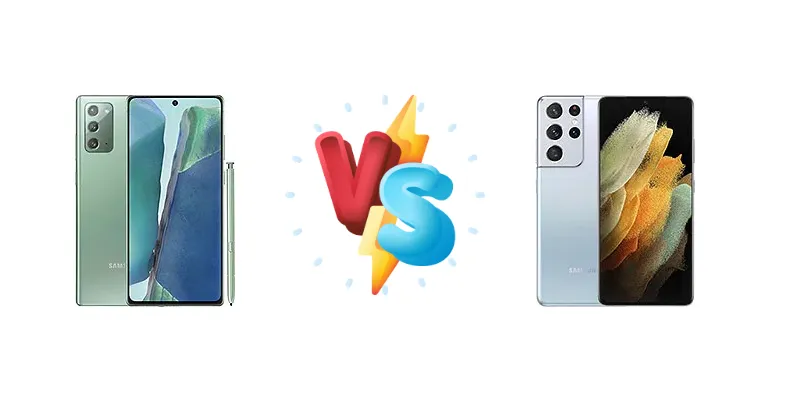
|
🏆 Quick Verdict
For most users, the Samsung Galaxy S21 Ultra 5G is the superior choice. Its Exynos 2100 (or Snapdragon 888) chipset delivers a noticeable performance boost, coupled with a brighter, more advanced display and a more versatile camera system. However, the Note20 5G remains a compelling option for stylus enthusiasts on a tighter budget.
| PHONES | ||
|---|---|---|
| Phone Names | Samsung Galaxy Note20 5G | Samsung Galaxy S21 Ultra 5G |
| Network | ||
|---|---|---|
| 2G bands | GSM 850 / 900 / 1800 / 1900 | GSM 850 / 900 / 1800 / 1900 |
| 3G bands | HSDPA 850 / 900 / 1700(AWS) / 1900 / 2100 | HSDPA 850 / 900 / 1700(AWS) / 1900 / 2100 |
| 4G bands | 1, 2, 3, 4, 5, 7, 8, 12, 13, 14, 18, 19, 20, 25, 26, 28, 29, 30, 38, 39, 40, 41, 46, 48, 66, 71 - SM-N981U | 1, 2, 3, 4, 5, 7, 8, 12, 13, 14, 18, 19, 20, 25, 26, 28, 30, 38, 39, 40, 41, 46, 48, 66, 71 - SM-G998U1 |
| 5G bands | 2, 5, 41, 66, 71, 260, 261 SA/NSA/Sub6/mmWave - SM-N981U | 2, 5, 25, 41, 66, 71, 260, 261 SA/NSA/Sub6/mmWave - SM-G998U1 |
| EDGE | No | - |
| GPRS | Yes | - |
| Speed | HSPA 42.2/5.76 Mbps, LTE (7CA) Cat20 2000/200 Mbps, 5G | HSPA 42.2/5.76 Mbps, LTE (7CA) Cat20 2000/200 Mbps, 5G (5+ Gbps DL) |
| Technology | GSM / CDMA / HSPA / EVDO / LTE / 5G | GSM / CDMA / HSPA / EVDO / LTE / 5G |
| 41, 66, 71 Sub6 - SM-N981W | 1, 3, 5, 7, 8, 20, 28, 38, 40, 41, 66, 77, 78 SA/NSA/Sub6 - SM-G998B | |
| Launch | ||
|---|---|---|
| Announced | 2020, August 05 | 2021, January 14 |
| Status | Available. Released 2020, August 21 | Available. Released 2021, January 29 |
| Body | ||
|---|---|---|
| Build | Glass front (Gorilla Glass 5), plastic back | Glass front (Gorilla Glass Victus), glass back (Gorilla Glass Victus), aluminum frame |
| Dimensions | 161.6 x 75.2 x 8.3 mm (6.36 x 2.96 x 0.33 in) | 165.1 x 75.6 x 8.9 mm (6.5 x 2.98 x 0.35 in) |
| SIM | · Nano-SIM + eSIM· Nano-SIM + Nano-SIM | · Nano-SIM + eSIM· Nano-SIM + Nano-SIM + eSIM (max 2 at a time) |
| Weight | 192 g (Sub6 5G), 194 g (mmWave 5G) (6.77 oz) | 227 g (Sub6), 229 g (mmWave) (8.01 oz) |
| IP68 dust/water resistant (up to 1.5m for 30 min) Stylus, 26ms latency (Bluetooth integration, accelerometer, gyro) | IP68 dust/water resistant (up to 1.5m for 30 min) Stylus support | |
| Display | ||
|---|---|---|
| Protection | Corning Gorilla Glass 5 | Corning Gorilla Glass Victus |
| Resolution | 1080 x 2400 pixels, 20:9 ratio (~393 ppi density) | 1440 x 3200 pixels, 20:9 ratio (~515 ppi density) |
| Size | 6.7 inches, 108.4 cm2 (~89.2% screen-to-body ratio) | 6.8 inches, 112.1 cm2 (~89.8% screen-to-body ratio) |
| Type | Super AMOLED Plus, HDR10+ | Dynamic AMOLED 2X, 120Hz, HDR10+, 1500 nits (peak) |
| Always-on display | Always-on display | |
| Platform | ||
|---|---|---|
| CPU | Octa-core (2x2.73 GHz Mongoose M5 & 2x2.50 GHz Cortex-A76 & 4x2.0 GHz Cortex-A55) - GlobalOcta-core (1x3.0 GHz Kryo 585 & 3x2.42 GHz Cortex-A77 & 4x1.80 GHz Cortex-A55) - USA | Octa-core (1x2.9 GHz Cortex-X1 & 3x2.80 GHz Cortex-A78 & 4x2.2 GHz Cortex-A55) - InternationalOcta-core (1x2.84 GHz Cortex-X1 & 3x2.42 GHz Cortex-A78 & 4x1.80 GHz Cortex-A55) - USA/China |
| Chipset | Exynos 990 (7 nm+) - GlobalQualcomm SM8250 Snapdragon 865 5G+ (7 nm+) - USA | Exynos 2100 (5 nm) - InternationalQualcomm SM8350 Snapdragon 888 5G (5 nm) - USA/China |
| GPU | Mali-G77 MP11 - GlobalAdreno 650 - USA | Mali-G78 MP14 - InternationalAdreno 660 - USA/China |
| OS | Android 10, upgradable to Android 13, One UI 5 | Android 11, up to 4 major Android upgrades, One UI 6.1 |
| Memory | ||
|---|---|---|
| Call records | 100 entries | - |
| Card slot | No | No |
| Internal | 128GB 8GB RAM, 256GB 8GB RAM | 128GB 8GB RAM, 128GB 12GB RAM, 256GB 12GB RAM, 256GB 16GB RAM, 512GB 12GB RAM, 512GB 16GB RAM |
| Phonebook | 500 contacts | - |
| UFS 3.0 | UFS 3.1 | |
| Main Camera | ||
|---|---|---|
| Features | LED flash, auto-HDR, panorama | Laser AF, LED flash, auto-HDR, panorama |
| Quad | - | 108 MP, f/1.8, 24mm (wide), 1/1.33", 0.8µm, PDAF, OIS 10 MP, f/2.4, 72mm (telephoto), 1/3.24", 1.22µm, dual pixel PDAF, OIS, 3x optical zoom 10 MP, f/4.9, 240mm (periscope telephoto), 1/3.24", 1.22µm, dual pixel PDAF, OIS, 10x optical zoom 12 MP, f/2.2, 13mm (ultrawide), 1/2.55", 1.4µm, dual pixel PDAF, Super Steady video |
| Single | 1.3 MP | - |
| Triple | 12 MP, f/1.8, 26mm (wide), 1/1.76", 1.8µm, dual pixel PDAF, OIS 64 MP, f/2.0, 27mm (telephoto), 1/1.72", 0.8µm, PDAF, OIS, 3x hybrid zoom 12 MP, f/2.2, 120˚, 13mm (ultrawide), 1/2.55", 1.4µm | - |
| Video | 8K@24fps, 4K@30/60fps, 1080p@30/60/240fps, 720p@960fps, HDR10+, stereo sound rec., gyro-EIS & OIS | 8K@24fps, 4K@30/60fps, 1080p@30/60/120/240fps, HDR10+, stereo sound rec., gyro-EIS |
| Selfie camera | ||
|---|---|---|
| Features | HDR | HDR |
| Single | 10 MP, f/2.2, 26mm (wide), 1/3.2", 1.22µm, dual pixel PDAF | 40 MP, f/2.2, 26mm (wide), 1/2.8", 0.7µm, PDAF |
| Video | 4K@30/60fps, 1080p@30fps | 4K@30/60fps, 1080p@30fps |
| Sound | ||
|---|---|---|
| 3.5mm jack | No | No |
| 35mm jack | No | No |
| Loudspeaker | Yes, with stereo speakers | Yes, with stereo speakers |
| 32-bit/384kHz audio Tuned by AKG | 32-bit/384kHz audio Tuned by AKG | |
| Comms | ||
|---|---|---|
| Bluetooth | 5.0, A2DP, LE, aptX | 5.2, A2DP, LE |
| NFC | Yes | Yes |
| Positioning | GPS, GLONASS, BDS, GALILEO | GPS, GLONASS, BDS, GALILEO |
| Radio | FM radio (Snapdragon model only; market/operator dependent) | FM radio (Snapdragon model only; market/operator dependent) |
| USB | USB Type-C 3.2, OTG | USB Type-C 3.2, OTG |
| WLAN | Wi-Fi 802.11 a/b/g/n/ac/6, dual-band, Wi-Fi Direct | Wi-Fi 802.11 a/b/g/n/ac/6e, dual-band, Wi-Fi Direct |
| Features | ||
|---|---|---|
| Games | Yes | - |
| Java | No | - |
| Messaging | SMS, MMS | - |
| Sensors | Fingerprint (under display, ultrasonic), accelerometer, gyro, proximity, compass, barometer | Fingerprint (under display, ultrasonic), accelerometer, gyro, proximity, compass, barometer |
| Samsung Wireless DeX (desktop experience support) ANT+ Bixby natural language commands and dictation Samsung Pay (Visa, MasterCard certified) | Samsung DeX, Samsung Wireless DeX (desktop experience support) Bixby natural language commands and dictation Samsung Pay (Visa, MasterCard certified) Ultra Wideband (UWB) support | |
| Battery | ||
|---|---|---|
| Charging | 25W wired, PD3.0 15W wireless (Qi) 4.5W reverse wireless | 25W wired, PD3.0 15W wireless (Qi) 4.5W reverse wireless |
| Stand-by | Up to 80 h | - |
| Talk time | Up to 5 h | - |
| Type | Li-Ion 4300 mAh | Li-Ion 5000 mAh |
| Misc | ||
|---|---|---|
| Colors | Mystic Green, Mystic Bronze, Mystic Gray, Mystic Red, Mystic Blue | Phantom Black, Phantom Silver, Phantom Titanium, Phantom Navy, Phantom Brown, Navy |
| Models | SM-N981B, SM-N981B/DS, SM-N981U, SM-N981U1, SM-N981W, SM-N9810, SM-N981N | SM-G998B, SM-G998B/DS, SM-G998U, SM-G998U1, SM-G998W, SM-G998N, SM-G9980 |
| Price | About 430 EUR | $ 240.01 / C$ 353.20 / £ 202.99 / € 264.99 |
| SAR | 0.95 W/kg (head) 0.72 W/kg (body) | 0.77 W/kg (head) 1.02 W/kg (body) |
| SAR EU | 0.68 W/kg (head) 1.37 W/kg (body) | 0.71 W/kg (head) 1.58 W/kg (body) |
| Pricing | ||
|---|---|---|
| 128GB 12GB RAM | - | $ 384.99 |
| 256GB 12GB RAM | - | $ 998.00 |
| 512GB 12GB RAM | - | $ 1,179.99 |
| RENEWED | - | $ 459.00 |
| Tests | ||
|---|---|---|
| Battery life | - | Endurance rating 114h |
| Camera | - | Photo / Video |
| Display | - | Contrast ratio: Infinite (nominal) |
| Loudspeaker | - | -25.5 LUFS (Very good) |
| Performance | - | AnTuTu: 657150 (v8) GeekBench: 3518 (v5.1) GFXBench: 33fps (ES 3.1 onscreen) |
Samsung Galaxy Note20 5G
- Integrated S Pen for note-taking and creativity
- More affordable price point
- Refined and elegant design
- Older chipset with lower performance
- Less advanced display technology
- Less versatile camera system
Samsung Galaxy S21 Ultra 5G
- Significantly faster processor and GPU
- Brighter and more advanced display
- Superior camera system with advanced zoom capabilities
- Higher price tag
- No integrated S Pen
- Can run warmer under sustained load
Display Comparison
The S21 Ultra boasts a significantly brighter display, reaching a measured 1023 nits, compared to the Note20 5G’s unspecified peak brightness (though typically lower for the era). While both utilize AMOLED technology, the S21 Ultra’s panel likely benefits from advancements in color accuracy and contrast, offering an 'Infinite' (nominal) contrast ratio. The S21 Ultra’s adaptive refresh rate, likely utilizing LTPO technology, allows for more granular control and improved power efficiency compared to the Note20’s standard adaptive refresh rate. This translates to smoother scrolling and animations, and potentially longer battery life.
Camera Comparison
While both phones are capable of excellent photography, the S21 Ultra’s camera system is a clear step ahead. Details regarding sensor sizes are missing for the Note20, but the S21 Ultra’s larger main sensor, coupled with improved image processing algorithms, delivers superior low-light performance and dynamic range. The S21 Ultra’s advanced zoom capabilities, including dual telephoto lenses, provide greater versatility than the Note20’s single telephoto lens. While both phones offer video recording capabilities, the S21 Ultra’s support for 8K video recording and improved stabilization provide a more professional-grade experience. The Note20’s 2MP macro lens is largely superfluous, while the S21 Ultra focuses on delivering quality across all its lenses.
Performance
The core difference lies in the chipset. The Note20 5G shipped with either the Exynos 990 (global) or Snapdragon 865+ (USA), both built on a 7nm+ process. The S21 Ultra, however, utilizes the 5nm Exynos 2100 (international) or Snapdragon 888 (USA/China). This process node shrink, combined with architectural improvements – the Cortex-X1 prime core in the S21 Ultra versus the Mongoose M5 in the Note20 – results in a substantial performance uplift. The S21 Ultra’s CPU, with its Cortex-X1 core clocked at 2.9 GHz (international) or 2.84 GHz (USA/China), offers faster single-core performance, while the more efficient Cortex-A78 cores contribute to improved multi-core scores. The S21 Ultra also benefits from faster LPDDR5 RAM, enhancing overall system responsiveness.
Battery Life
Both devices share the same 25W wired charging, 15W wireless charging, and 4.5W reverse wireless charging capabilities. However, the S21 Ultra’s more efficient chipset and display technology, combined with its 114-hour endurance rating, suggest better real-world battery life despite potentially similar battery capacities (specific capacity for Note20 is not provided). The 5nm process node of the S21 Ultra’s chipset contributes to lower power consumption, allowing it to maintain performance for longer periods. While 0-100% charging times will be similar given the shared wattage, the S21 Ultra will likely spend more time *not* needing to be charged.
Buying Guide
Buy the Samsung Galaxy Note20 5G if you prioritize the S Pen experience and value a more affordable entry point into Samsung’s premium ecosystem. It’s ideal for note-takers, artists, and those who frequently use a stylus for productivity. Buy the Samsung Galaxy S21 Ultra 5G if you demand the best possible performance, a cutting-edge display, and a more capable camera system, even if it means paying a premium. This phone is geared towards power users, mobile photographers, and those who want a future-proofed device.