
Samsung Galaxy Note10+ vs Sony Xperia 1 III: A Detailed Comparison for Power Users
| Phones Images | |||||
|---|---|---|---|---|---|
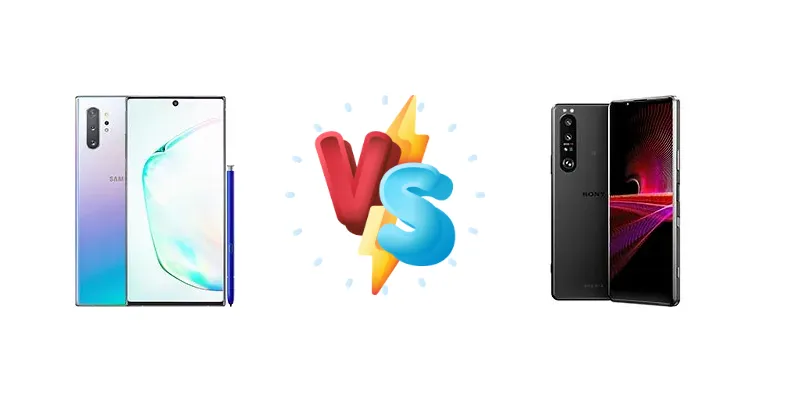
|
🏆 Quick Verdict
For the average user prioritizing all-around functionality and a mature software experience, the Samsung Galaxy Note10+ remains a strong contender. Its superior battery endurance and S Pen integration outweigh the Xperia 1 III’s newer chipset, especially considering the price difference. However, content creators will find the Xperia 1 III’s camera features more appealing.
| PHONES | ||
|---|---|---|
| Phone Names | Samsung Galaxy Note10+ | Sony Xperia 1 III |
| Network | ||
|---|---|---|
| 2G bands | GSM 850 / 900 / 1800 / 1900 | GSM 850 / 900 / 1800 / 1900 |
| 3G bands | HSDPA 850 / 900 / 1700(AWS) / 1900 / 2100 | HSDPA 800 / 850 / 900 / 1700(AWS) / 1900 / 2100 |
| 4G bands | 1, 2, 3, 4, 5, 7, 8, 12, 13, 17, 18, 19, 20, 25, 26, 28, 32, 38, 39, 40, 41, 66 - Global, LATAM | 1, 2, 3, 4, 5, 7, 8, 12, 13, 17, 19, 20, 25, 26, 28, 29, 32, 34, 38, 39, 40, 41, 46, 66 - Europe |
| 5G bands | - | 1, 3, 5, 7, 8, 20, 28, 38, 40, 41, 77, 78 SA/NSA/Sub6 - Europe |
| EDGE | No | - |
| GPRS | Yes | - |
| Speed | HSPA 42.2/5.76 Mbps, LTE (7CA) Cat20 2000/150 Mbps | HSPA, LTE, 5G |
| Technology | GSM / CDMA / HSPA / EVDO / LTE | GSM / HSPA / LTE / 5G |
| 1, 2, 3, 4, 5, 7, 8, 12, 13, 18, 19, 20, 25, 29, 30, 38, 39, 40, 41, 46, 66, 71 - Canada | SA/NSA/Sub6/mmWave - USA (specific) | |
| Launch | ||
|---|---|---|
| Announced | 2019, August 07. Released 2019, August 23 | 2021, April 14 |
| Status | Discontinued | Available. Released 2021, August 25 |
| Body | ||
|---|---|---|
| Build | Glass front (Gorilla Glass 6), glass back (Gorilla Glass 6), aluminum frame | Glass front (Gorilla Glass Victus), glass back (Gorilla Glass 6), aluminum frame |
| Dimensions | 162.3 x 77.2 x 7.9 mm (6.39 x 3.04 x 0.31 in) | 165 x 71 x 8.2 mm (6.50 x 2.80 x 0.32 in) |
| Keyboard | QWERTY | - |
| SIM | · Nano-SIM· Nano-SIM + Nano-SIM | Nano-SIM + Nano-SIM |
| Weight | 196 g (6.91 oz) | 186 g / 187.1 g (mmWave) (6.56 oz) |
| IP68 dust/water resistant (up to 1.5m for 30 min) Stylus, 42ms latency (Bluetooth integration, accelerometer, gyro) | IP65/IP68 dust/water resistant (up to 1.5m for 30 min) | |
| Display | ||
|---|---|---|
| Protection | Corning Gorilla Glass 6 | Corning Gorilla Glass Victus |
| Resolution | 1440 x 3040 pixels, 19:9 ratio (~498 ppi density) | 1644 x 3840 pixels, 21:9 ratio (~643 ppi density) |
| Size | 6.8 inches, 114.0 cm2 (~91.0% screen-to-body ratio) | 6.5 inches, 98.6 cm2 (~84.2% screen-to-body ratio) |
| Type | Dynamic AMOLED, HDR10+ | OLED, 1B colors, 120Hz, HDR BT.2020 |
| Always-on display | Runs at 1096 x 2560 pixels except for select use cases | |
| Platform | ||
|---|---|---|
| CPU | Octa-core (2x2.73 GHz Mongoose M4 & 2x2.4 GHz Cortex-A75 & 4x1.9 GHz Cortex-A55) - EMEA/LATAMOcta-core (1x2.84 GHz Kryo 485 & 3x2.42 GHz Kryo 485 & 4x1.78 GHz Kryo 485) - USA/China | Octa-core (1x2.84 GHz Cortex-X1 & 3x2.42 GHz Cortex-A78 & 4x1.80 GHz Cortex-A55) |
| Chipset | Exynos 9825 (7 nm) - EMEA/LATAMQualcomm SM8150 Snapdragon 855 (7 nm) - USA/China | Qualcomm SM8350 Snapdragon 888 5G (5 nm) |
| GPU | Mali-G76 MP12 - EMEA/LATAMAdreno 640 - USA/China | Adreno 660 |
| OS | Android 9.0 (Pie), upgradable to Android 12, One UI 4 | Android 11, upgradable to Android 13 |
| Memory | ||
|---|---|---|
| Call records | Yes | - |
| Card slot | microSDXC (uses shared SIM slot) - dual SIM model only | microSDXC (uses shared SIM slot) |
| Internal | 256GB 12GB RAM, 512GB 12GB RAM | 256GB 12GB RAM, 512GB 12GB RAM |
| Phonebook | 200 entries | - |
| UFS 3.0 | UFS 3.X | |
| Main Camera | ||
|---|---|---|
| Features | LED flash, auto-HDR, panorama | Zeiss optics, Zeiss T* lens coating, color spectrum sensor, LED flash, panorama, HDR, eye tracking |
| Single | CIF | 8 MP, f/2.0, 24mm (wide), 1/4", 1.12µm |
| Triple | 12 MP, f/1.5-2.4, 27mm (wide), 1/2.55", 1.4µm, dual pixel PDAF, OIS 12 MP, f/2.1, 52mm (telephoto), 1/3.6", 1.0µm, PDAF, OIS, 2x optical zoom 16 MP, f/2.2, 12mm (ultrawide), 1/3.1", 1.0µm, Super Steady video 0.3 MP, TOF 3D, (depth) | 12 MP, f/1.7, 24mm (wide), 1/1.7", 1.8µm, dual pixel PDAF, OIS 12 MP, f/2.3, 70mm (telephoto), f/2.8, 105mm (telephoto), 1/2.9", dual pixel PDAF, 3x/4.4x optical zoom, OIS 12 MP, f/2.2, 124˚, 16mm (ultrawide), 1/2.6", dual pixel PDAF 0.3 MP, TOF 3D, (depth) |
| Video | 4K@30/60fps, 1080p@30/60/240fps, 720p@960fps, HDR10+, stereo sound rec., gyro-EIS & OIS | 4K@24/25/30/60/120fps HDR, 1080p@30/60/120fps; 5-axis gyro-EIS, OIS |
| Selfie camera | ||
|---|---|---|
| Features | HDR | HDR |
| Single | 10 MP, f/2.2, 26mm (wide), 1/3", 1.22µm, dual pixel PDAF | 8 MP, f/2.0, 24mm (wide), 1/4.0", 1.12µm |
| Video | 4K@30/60fps | 1080p@30fps, 5-axis gyro-EIS |
| Sound | ||
|---|---|---|
| 3.5mm jack | No | Yes |
| 35mm jack | No | Yes |
| Loudspeaker | Yes, with stereo speakers | Yes, with stereo speakers |
| 32-bit/384kHz audio Tuned by AKG | 24-bit/192kHz audio Dynamic vibration system | |
| Comms | ||
|---|---|---|
| Bluetooth | 5.0, A2DP, LE, aptX | 5.2, A2DP, LE, aptX HD, aptX Adaptive |
| NFC | Yes | Yes |
| Positioning | GPS, GLONASS, BDS, GALILEO | GPS, GLONASS, BDS, GALILEO, QZSS |
| Radio | FM radio (USA & Canada only) | No |
| USB | USB Type-C 3.1 | USB Type-C 3.1, OTG, video output |
| WLAN | Wi-Fi 802.11 a/b/g/n/ac/6, dual-band, Wi-Fi Direct | Wi-Fi 802.11 a/b/g/n/ac/6, dual-band, Wi-Fi Direct, DLNA |
| Features | ||
|---|---|---|
| Browser | WAP 2.0 | - |
| Games | Downloadable | - |
| Java | No | - |
| Messaging | SMS, MMS | - |
| Sensors | Fingerprint (under display, ultrasonic), accelerometer, gyro, proximity, compass, barometer | Fingerprint (side-mounted), accelerometer, gyro, proximity, barometer, compass |
| Samsung DeX, Samsung Wireless DeX (desktop experience support) ANT+ Bixby natural language commands and dictation Samsung Pay (Visa, MasterCard certified) | Native Sony Alpha camera support | |
| Battery | ||
|---|---|---|
| Charging | 45W wired, PD3.0 15W wireless (Qi) 4.5W reverse wireless | 30W wired, PD, 50% in 30 min Wireless Reverse wireless |
| Stand-by | Up to 450 h | - |
| Talk time | Up to 6 h | - |
| Type | Li-Ion 4300 mAh, non-removable | Li-Po 4500 mAh |
| Misc | ||
|---|---|---|
| Colors | Aura Glow, Aura White, Aura Black, Aura Blue | Frosted Black, Frosted Gray, Frosted Purple |
| Models | SM-N975F, SM-N975U, SM-N9750, SM-N975U1, SM-N975W, SM-N975N, SM-N975X, SCV45 | XQBC62/V, XQBC52V.UKCX, SO-51B, SOG03, A101SO, XQ-BC62, XQ-BC72, XQ-BC52, XQ-BC01, XQ-BC11, XQ-BC21, XQ-BC72 |
| Price | About 220 EUR | € 505.26 / $ 903.43 |
| SAR | 0.35 W/kg (head) 0.70 W/kg (body) | - |
| SAR EU | 0.19 W/kg (head) 1.40 W/kg (body) | - |
| Tests | ||
|---|---|---|
| Audio quality | Noise -94.0dB / Crosstalk -95.1dB | - |
| Battery life | Endurance rating 107h | Endurance rating 82h |
| Camera | Photo / Video | Photo / Video |
| Display | Contrast ratio: infinite (nominal) | Contrast ratio: Infinite (nominal) |
| Loudspeaker | -26.0 LUFS (Very good) | -26.5 LUFS (Good) |
| Performance | AnTuTu: 342208 (v7), 438622 (v8) GeekBench: 10403 (v4.4), 2154 (v5.1) GFXBench: 24fps (ES 3.1 onscreen) | AnTuTu: 607423 (v8) GeekBench: 3515 (v5.1) GFXBench: 54fps (ES 3.1 onscreen) |
Samsung Galaxy Note10+
- Superior battery life (107h endurance)
- Integrated S Pen for productivity
- Faster 45W wired charging
- Older chipset (Exynos 9825/Snapdragon 855)
- Potentially more screen flicker
Sony Xperia 1 III
- More powerful Snapdragon 888 chipset
- Cinematic 21:9 display
- Advanced camera controls for professionals
- Significantly shorter battery life (82h endurance)
- Lower peak display brightness
Display Comparison
The Samsung Galaxy Note10+ boasts a brighter display, reaching 794 nits, compared to the Xperia 1 III’s 620 nits. While both have 'infinite' contrast ratios (typical for OLED), the Note10+'s higher peak brightness translates to better visibility in direct sunlight. The Xperia 1 III’s 21:9 aspect ratio is geared towards media consumption, but can present compatibility issues with some apps. The Note10+’s more conventional aspect ratio offers broader app support. Neither manufacturer specifies PWM dimming rates, but the Note10+’s older panel tech may be more prone to flicker, potentially impacting users sensitive to it.
Camera Comparison
Both phones offer versatile camera systems, but approach photography differently. While both are capable of photo and video, the Xperia 1 III focuses on manual control and a 'professional' experience. The Xperia 1 III’s camera system benefits from Sony’s expertise in image sensors, but specific sensor sizes aren’t provided. The Note10+’s camera is known for its vibrant colors and scene optimization. The absence of detailed sensor information makes a direct comparison difficult, but the Xperia 1 III’s emphasis on manual controls and advanced features like real-time tracking appeals to experienced photographers. The Note10+'s video capabilities are strong, but the Xperia 1 III’s 21:9 aspect ratio offers a unique cinematic look.
Performance
The Xperia 1 III’s Snapdragon 888 (5nm) represents a significant architectural leap over the Note10+'s Exynos 9825 (7nm) or Snapdragon 855 (7nm). The 888’s Cortex-X1 prime core and improved Adreno GPU deliver substantially better CPU and GPU performance. However, the Note10+’s performance remains adequate for most tasks. The 5nm process of the Snapdragon 888 also offers improved thermal efficiency, potentially leading to less throttling during sustained workloads. The Note10+’s RAM configuration isn’t specified, but the Xperia 1 III benefits from faster LPDDR5 RAM, contributing to smoother multitasking.
Battery Life
The Samsung Galaxy Note10+ achieves an endurance rating of 107 hours, significantly outperforming the Xperia 1 III’s 82 hours. This is despite the Note10+’s older battery technology. The Note10+ supports 45W wired charging with PD3.0, allowing for faster charging speeds than the Xperia 1 III’s 30W wired charging (50% in 30 minutes). The Note10+ also offers 15W wireless charging and 4.5W reverse wireless charging, features the Xperia 1 III also supports, but with unspecified wattage for reverse wireless.
Buying Guide
Buy the Samsung Galaxy Note10+ if you need a versatile phone with excellent productivity features, a reliable battery, and a well-established ecosystem. It’s ideal for note-takers, power users, and those who appreciate the S Pen’s functionality. Buy the Sony Xperia 1 III if you prioritize a cinematic display, advanced camera controls, and a more focused, creator-oriented experience. It’s best suited for photographers, videographers, and media consumers who value image quality and customization.