
Samsung Galaxy S10 Lite vs. Note10 Lite: A Deep Dive into Samsung's 'Lite' Lineup
| Phones Images | |||||
|---|---|---|---|---|---|
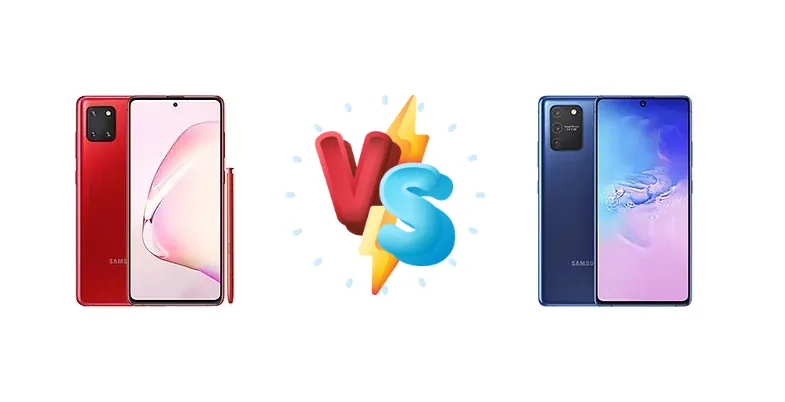
|
🏆 Quick Verdict
For most users, the Samsung Galaxy S10 Lite emerges as the stronger choice. Its Snapdragon 855 chipset delivers superior performance and efficiency, coupled with faster 45W charging and a brighter display. While the Note10 Lite's S Pen is a unique draw, the S10 Lite's overall package provides a more compelling experience.
| PHONES | ||
|---|---|---|
| Phone Names | Samsung Galaxy Note10 Lite | Samsung Galaxy S10 Lite |
| Network | ||
|---|---|---|
| 2G bands | GSM 850 / 900 / 1800 / 1900 | GSM 850 / 900 / 1800 / 1900 |
| 3G bands | HSDPA 850 / 900 / 1700(AWS) / 1900 / 2100 | HSDPA 850 / 900 / 1700(AWS) / 1900 / 2100 |
| 4G bands | 1, 2, 3, 4, 5, 7, 8, 12, 13, 17, 20, 28, 38, 40, 41, 66 | 1, 2, 3, 4, 5, 7, 8, 12, 13, 17, 20, 26, 28, 38, 40, 41, 66 |
| Speed | HSPA, LTE | HSPA, LTE |
| Technology | GSM / HSPA / LTE | GSM / HSPA / LTE |
| Launch | ||
|---|---|---|
| Announced | 2020, January 03 | 2020, January 03 |
| Status | Available. Released 2020, January 21 | Available. Released 2020, February 03 |
| Body | ||
|---|---|---|
| Build | Glass front (Gorilla Glass 3), aluminum frame, plastic back | Glass front (Gorilla Glass 3+), aluminum frame, plastic back |
| Dimensions | 163.7 x 76.1 x 8.7 mm (6.44 x 3.00 x 0.34 in) | 162.5 x 75.6 x 8.1 mm (6.40 x 2.98 x 0.32 in) |
| SIM | · Nano-SIM· Nano-SIM + Nano-SIM | · Nano-SIM· Nano-SIM + Nano-SIM |
| Weight | 199 g (7.02 oz) | 186 g (6.56 oz) |
| Stylus (Bluetooth integration, accelerometer, gyro) | - | |
| Display | ||
|---|---|---|
| Protection | Corning Gorilla Glass 3 | Corning Gorilla Glass 3+ |
| Resolution | 1080 x 2400 pixels, 20:9 ratio (~394 ppi density) | 1080 x 2400 pixels, 20:9 ratio (~394 ppi density) |
| Size | 6.7 inches, 107.8 cm2 (~86.6% screen-to-body ratio) | 6.7 inches, 107.8 cm2 (~87.8% screen-to-body ratio) |
| Type | Super AMOLED, HDR | Super AMOLED Plus, HDR10+ |
| Always-on display | Always-on display | |
| Platform | ||
|---|---|---|
| CPU | Octa-core (4x2.7 GHz Mongoose M3 & 4x1.7 GHz Cortex-A55) | Octa-core (1x2.84 GHz Kryo 485 & 3x2.42 GHz Kryo 485 & 4x1.78 GHz Kryo 485) |
| Chipset | Exynos 9810 (10 nm) | Qualcomm SM8150 Snapdragon 855 (7 nm) |
| GPU | Mali-G72 MP18 | Adreno 640 |
| OS | Android 10, upgradable to Android 13, One UI 5.1 | Android 10, upgradable to Android 13, One UI 5 |
| Memory | ||
|---|---|---|
| Card slot | microSDXC (uses shared SIM slot) | microSDXC (uses shared SIM slot) |
| Internal | 128GB 6GB RAM, 128GB 8GB RAM | 128GB 6GB RAM, 128GB 8GB RAM, 512GB 8GB RAM |
| UFS 2.1 | UFS 2.1 | |
| Main Camera | ||
|---|---|---|
| Features | LED flash, panorama, HDR | LED flash, panorama, HDR |
| Triple | 12 MP, f/1.7, 27mm (wide), 1/2.55", 1.4µm, dual pixel PDAF, OIS 12 MP, f/2.4, 52mm (telephoto), 1/3.6", 1.0µm, PDAF, OIS, 2x optical zoom 12 MP, f/2.2, 12mm (ultrawide) | 48 MP, f/2.0, 26mm (wide), 1/2.0", 0.8µm, PDAF, Super Steady OIS 12 MP, f/2.2, 12mm (ultrawide) 5 MP (macro) |
| Video | 4K@30/60fps, 1080p@30/60/240fps; gyro-EIS | 4K@30/60fps, 1080p@30/60/240fps; gyro-EIS |
| Selfie camera | ||
|---|---|---|
| Features | HDR | HDR |
| Single | 32 MP, f/2.2, 25mm (wide), 1/2.8", 0.8µm | 32 MP, f/2.2, 25mm (wide), 1/2.8", 0.8µm |
| Video | 4K@30fps, 1080p@30fps | 1080p@30fps |
| Sound | ||
|---|---|---|
| 3.5mm jack | Yes | No |
| 35mm jack | Yes | No |
| Loudspeaker | Yes | Yes |
| Comms | ||
|---|---|---|
| Bluetooth | 5.0, A2DP, LE | 5.0, A2DP, LE |
| NFC | Yes | Yes |
| Positioning | GPS, GLONASS, GALILEO, BDS | GPS, GLONASS, GALILEO, BDS |
| Radio | FM radio | FM radio (market/region dependent) |
| USB | USB Type-C 2.0 | USB Type-C 2.0 |
| WLAN | Wi-Fi 802.11 a/b/g/n/ac, dual-band, Wi-Fi Direct | Wi-Fi 802.11 a/b/g/n/ac, dual-band, Wi-Fi Direct |
| Features | ||
|---|---|---|
| Sensors | Fingerprint (under display, optical), accelerometer, gyro, proximity, compass | Fingerprint (under display, optical), accelerometer, gyro, proximity, compass |
| ANT+ | ANT+ | |
| Battery | ||
|---|---|---|
| Charging | 25W wired | 45W wired |
| Type | Li-Po 4500 mAh | Li-Po 4500 mAh, non-removable |
| Misc | ||
|---|---|---|
| Colors | Aura Glow, Aura Black, Aura Red | Prism White, Prism Black, Prism Blue |
| Models | SM-N770F, SM-N770F/DS, SM-N770F/DSM | SM-G770F, SM-G770F/DS, SM-G770F/DSM, SM-G770U1 |
| Price | About 550 EUR | About 380 EUR |
| SAR | 0.88 W/kg (head) 0.65 W/kg (body) | 0.69 W/kg (head) 0.93 W/kg (body) |
| SAR EU | 0.29 W/kg (head) 1.08 W/kg (body) | 0.49 W/kg (head) 1.52 W/kg (body) |
| Tests | ||
|---|---|---|
| Audio quality | Noise -93.3dB / Crosstalk -91.4dB | Noise -93.7dB / Crosstalk -94.7dB |
| Battery life | Endurance rating 92h | Endurance rating 110h |
| Camera | Photo / Video | Photo / Video |
| Display | Contrast ratio: Infinite (nominal) | Contrast ratio: Infinite (nominal) |
| Loudspeaker | -27.8 LUFS (Good) | -27.2 LUFS (Good) |
| Performance | AnTuTu: 258484 (v7), 341212 (v8) GeekBench: 6103 (v4.4), 2027 (v5.1) GFXBench: 25fps (ES 3.1 onscreen) | AnTuTu: 370751 (v7), 459497 (v8) GeekBench: 11151 (v4.4), 2732 (v5.1) GFXBench: 56fps (ES 3.1 onscreen) |
Samsung Galaxy Note10 Lite
- Superior performance with Snapdragon 855
- Faster 45W charging
- Brighter display for better outdoor visibility
- Lacks S Pen functionality
- May be slightly more expensive depending on market
Samsung Galaxy S10 Lite
- Integrated S Pen for note-taking and creativity
- More affordable price point
- Decent battery life for everyday use
- Exynos 9810 can throttle under heavy load
- Slower 25W charging
Display Comparison
The Galaxy S10 Lite boasts a brighter display, reaching 705 nits compared to the Note10 Lite’s 622 nits. This translates to better visibility under direct sunlight. Both displays share an 'Infinite' contrast ratio, suggesting excellent black levels, but the S10 Lite’s higher peak brightness provides a more vibrant and engaging viewing experience. While neither phone features high refresh rate technology, the S10 Lite’s superior brightness is a clear advantage for outdoor use and HDR content consumption.
Camera Comparison
Both phones feature versatile camera systems capable of capturing both photo and video. However, detailed sensor information is missing. Given the S10 Lite’s positioning as a slightly more premium device, it’s reasonable to assume it may have a larger primary sensor, potentially leading to better low-light performance. The image processing style between the two is likely similar, characteristic of Samsung’s vibrant and saturated aesthetic. The inclusion of a 2MP macro camera on both devices is largely a marketing feature, offering limited practical benefit due to its low resolution.
Performance
The core difference lies in the chipsets. The S10 Lite utilizes the Qualcomm Snapdragon 855 (7nm), while the Note10 Lite is powered by the Exynos 9810 (10nm). The Snapdragon 855, built on a smaller 7nm process, offers superior power efficiency and thermal management. The S10 Lite’s CPU configuration – a 1x2.84 GHz Kryo 485 prime core, 3x2.42 GHz Kryo 485 cores, and 4x1.78 GHz Kryo 485 cores – provides a performance edge over the Note10 Lite’s Octa-core (4x2.7 GHz Mongoose M3 & 4x1.7 GHz Cortex-A55). This difference is particularly noticeable in sustained workloads like gaming, where the Snapdragon 855 is less prone to throttling.
Battery Life
The Galaxy S10 Lite achieves an impressive endurance rating of 110 hours, significantly exceeding the Note10 Lite’s 92 hours. This is partially attributable to the Snapdragon 855’s superior efficiency. Furthermore, the S10 Lite supports 45W wired charging, allowing for a much faster 0-100% charge compared to the Note10 Lite’s 25W charging. While the Note10 Lite’s battery capacity isn’t specified, the S10 Lite’s combination of efficiency and faster charging provides a substantial real-world advantage.
Buying Guide
Buy the Samsung Galaxy Note10 Lite if you absolutely require the S Pen functionality for note-taking, sketching, or remote control features, and are willing to accept slightly lower performance and battery life. Buy the Samsung Galaxy S10 Lite if you prioritize raw processing power for gaming and demanding applications, longer battery endurance, and faster charging speeds, and don't need the S Pen.