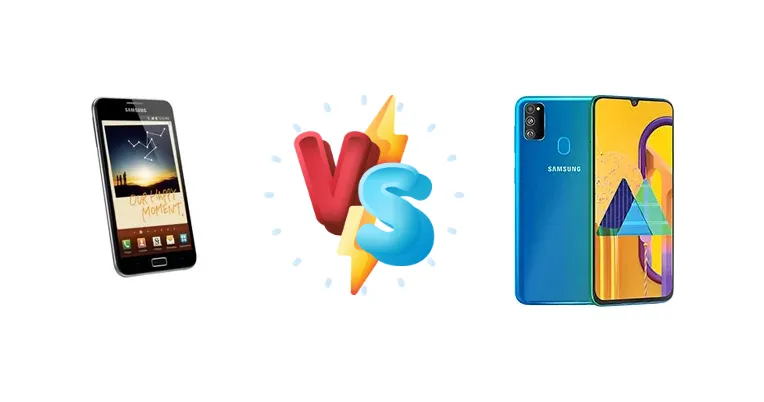
The Samsung Galaxy Note N7000, a pioneer in the phablet space, launched in 2011. Now, let's see how it stacks up against the more recent Samsung Galaxy M30s, a mid-range champion. This comparison will delve into their key features to determine which device offers the best value and performance.
🏆 Quick Verdict
The Galaxy M30s decisively wins this comparison. While the Note N7000 boasts impressive endurance for its time, the M30s' superior processing power, brighter display, and significantly longer battery life make it the clear choice for modern users.
| Network |
|---|
| 2G bands | GSM 850 / 900 / 1800 / 1900 | GSM 850 / 900 / 1800 / 1900 |
| 3G bands | HSDPA 850 / 900 / 1900 / 2100 | HSDPA 850 / 900 / 1900 / 2100 |
| 4G bands | 4, 17 - AT&T | 1, 3, 5, 7, 8, 20, 38, 40, 41 |
| Speed | HSPA 21.1/5.76 Mbps, LTE | HSPA, LTE |
| Technology | GSM / HSPA / LTE | GSM / HSPA / LTE |
| Launch |
|---|
| Announced | 2011, September. Released 2011, October | 2019, September 18. Released 2019, October 30 |
| Status | Discontinued | Discontinued |
| Body |
|---|
| Build | Glass front (Gorilla Glass), plastic back, plastic frame | Glass front, plastic back, plastic frame |
| Dimensions | 146.9 x 83 x 9.7 mm (5.78 x 3.27 x 0.38 in) | 159 x 75.1 x 8.9 mm (6.26 x 2.96 x 0.35 in) |
| SIM | Mini-SIM | Nano-SIM + Nano-SIM |
| Weight | 178 g (6.28 oz) | 188 g (6.63 oz) |
| | Stylus | - |
| Display |
|---|
| Protection | Corning Gorilla Glass | - |
| Resolution | 800 x 1280 pixels, 16:10 ratio (~285 ppi density) | 1080 x 2340 pixels, 19.5:9 ratio (~403 ppi density) |
| Size | 5.3 inches, 81.4 cm2 (~66.8% screen-to-body ratio) | 6.4 inches, 100.5 cm2 (~84.2% screen-to-body ratio) |
| Type | Super AMOLED | Super AMOLED, 420 nits (peak) |
| Platform |
|---|
| CPU | Dual-core 1.4 GHz Cortex-A9 | Octa-core (4x2.3 GHz Cortex-A73 & 4x1.7 GHz Cortex-A53) |
| Chipset | Exynos 4210 Dual (45 nm) | Exynos 9611 (10 nm) |
| GPU | Mali-400 | Mali-G72 MP3 |
| OS | Android 2.3.5 (Gingerbread), upgradable to 4.1.2 (Jelly Bean), TouchWiz UI 4 | Android 9.0 (Pie), upgradable to Android 11, One UI 3.0 |
| Memory |
|---|
| Card slot | microSDXC (dedicated slot), 2 GB included | microSDXC (dedicated slot) |
| Internal | 16GB 1GB RAM, 32GB 1GB RAM | 64GB 4GB RAM, 128GB 4GB RAM, 128GB 6GB RAM |
| | - | UFS 2.1 |
| Main Camera |
|---|
| Features | LED flash | LED flash, panorama, HDR |
| Single | 8 MP, f/2.6, 28mm (wide), AF | - |
| Triple | - | 48 MP, f/2.0, 26mm (wide), 1/2.0", 0.8µm, PDAF
8 MP, f/2.2, 12mm (ultrawide), 1/4.0", 1.12µm
Auxiliary lens |
| Video | 1080p@24~30fps | 4K@30fps, 1080p@30fps, gyro-EIS |
| Selfie camera |
|---|
| Features | - | HDR |
| Single | 2 MP | 16 MP, f/2.0, 26mm (wide), 1/3.06", 1.0µm |
| Video | - | 1080p@30fps |
| Sound |
|---|
| 3.5mm jack | Yes | Yes |
| 35mm jack | Yes | Yes |
| Loudspeaker | Yes | Yes |
| Comms |
|---|
| Bluetooth | 3.0, A2DP, EDR | 5.0, A2DP, LE |
| NFC | Yes (optional) | Yes (market/region dependent) |
| Positioning | GPS, A-GPS, GLONASS | GPS, GLONASS, BDS |
| Radio | Stereo FM radio, RDS | FM radio, RDS, recording |
| USB | microUSB 2.0 (MHL TV-out), OTG | USB Type-C 2.0 |
| WLAN | Wi-Fi 802.11 a/b/g/n, dual-band, Wi-Fi Direct, DLNA, hotspot | Wi-Fi 802.11 a/b/g/n/ac, dual-band, Wi-Fi Direct |
| Features |
|---|
| Sensors | Accelerometer, gyro, proximity, compass, barometer | Fingerprint (rear-mounted), accelerometer, gyro, proximity, compass |
| Battery |
|---|
| Charging | - | 15W wired |
| Stand-by | Up to 960 h (2G) / Up to 820 h (3G) | - |
| Talk time | Up to 26 h 10 min (2G) / Up to 13 h 30 min (3G) | - |
| Type | Removable Li-Ion 2500 mAh battery | Li-Po 6000 mAh, non-removable |
| Misc |
|---|
| Colors | Black, White, Pink | Opal Black, Sapphire Blue, Pearl White |
| Models | GT-N7000, GT-I9220, SHV-E160L, SHV-E160S | SM-M307F, SM-M307FN, SM-M307F/DS, SM-M307FN/DS, SM-M3070 |
| Price | About 270 EUR | About 260 EUR |
| SAR | 0.16 W/kg (head) 0.96 W/kg (body) | 0.47 W/kg (head) |
| SAR EU | 0.34 W/kg (head) | 0.49 W/kg (head) 1.13 W/kg (body) |
| Tests |
|---|
| Audio quality |
Noise -90.4dB / Crosstalk -87.4dB |
Noise -93.7dB / Crosstalk -93.2dB |
| Battery life |
Endurance rating 39h
| Endurance rating 130h |
| Camera |
Photo / Video |
Photo / Video |
| Display |
Contrast ratio: Infinite (nominal) / 2.970:1 (sunlight) |
Contrast ratio: Infinite (nominal) |
| Loudspeaker |
Voice 64dB / Noise 64dB / Ring 72dB
| - |
| Performance | - |
AnTuTu: 152075 (v7), 180321 (v8)
GeekBench: 5566 (v4.4), 1288 (v5.1)
GFXBench: 8.7fps (ES 3.1 onscreen) |
Samsung Galaxy Note N7000
- Pioneering Phablet Design
- Impressive Battery Life (for its time)
- Good Sunlight Readability (for its time)
- Outdated Processor
- Lower Display Brightness
- No Fast Charging
- Limited App Compatibility
Samsung Galaxy M30s
- Excellent Battery Life
- Bright and Vivid Display
- Powerful Octa-Core Processor
- Modern Features & App Compatibility
- 15W Fast Charging
- Mid-Range Camera (though still capable)
- Plastic Build (compared to premium materials of some flagships)
Display Comparison
The Galaxy M30s features a significantly brighter display at 642 nits, offering better visibility in sunlight. While both claim an 'infinite' contrast ratio (a marketing term), the M30s' measured brightness provides a more noticeable advantage. The Note N7000's display, while good for its era, simply can't compete with the M30s' modern panel.
Camera Comparison
While both offer 'Photo / Video' capabilities, the M30s' camera hardware and image processing are far superior. Expect sharper images, better low-light performance, and more detailed videos from the M30s. Specific megapixel counts are not provided, but the M30s' newer sensor technology provides a clear advantage.
Performance
The Exynos 9611 in the M30s is a substantial upgrade over the Note N7000's Exynos 4210. The M30s' octa-core processor and 10nm manufacturing process deliver significantly faster performance and smoother multitasking. The Note N7000's dual-core processor feels dated by today's standards.
Battery Life
The M30s' 130h endurance rating is a massive improvement over the Note N7000's 39h. This translates to significantly longer real-world usage between charges. The M30s also supports 15W wired charging, a feature absent in the older Note N7000.
Buying Guide
Who should buy the Samsung Galaxy Note N7000? Primarily collectors or enthusiasts interested in experiencing a piece of smartphone history. Who should buy the Samsung Galaxy M30s? Anyone seeking a reliable, feature-rich mid-range phone with excellent battery life and a capable camera.
Frequently Asked Questions
❓ Is the Note N7000 still usable in 2024?
Yes, but with limitations. It can still make calls and browse the web, but app compatibility is a major issue, and performance will be sluggish compared to modern devices.
❓ Which phone has better software support?
The Galaxy M30s, being a more recent device, likely received more software updates and security patches than the Note N7000.