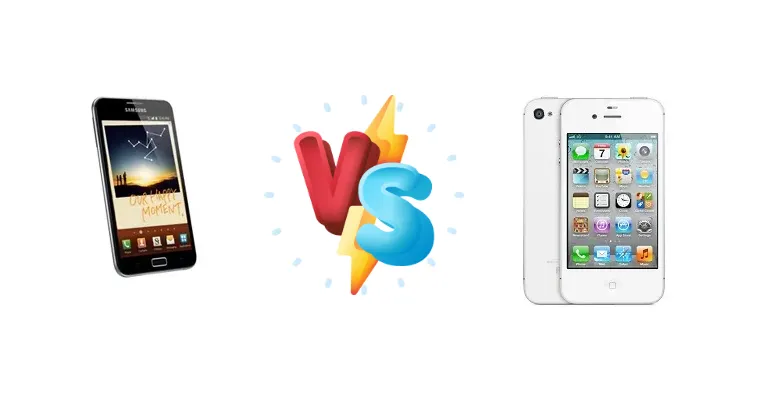
Remember the days when the Galaxy Note and iPhone 4s battled for smartphone supremacy? These devices, though relics of the past, were groundbreaking in their time. Let's revisit these titans and see how they stack up against each other in a detailed comparison.
🏆 Quick Verdict
The iPhone 4s edges out the Note N7000 thanks to slightly better battery life and a more polished iOS experience. However, the Note's larger screen and S Pen offer unique functionality. Ultimately, it depends on your preference for Android's flexibility versus iOS's simplicity.
| Network |
|---|
| 2G bands | GSM 850 / 900 / 1800 / 1900 | GSM 850 / 900 / 1800 / 1900 |
| 3G bands | HSDPA 850 / 900 / 1900 / 2100 | HSDPA 850 / 900 / 1900 / 2100 |
| 4G bands | 4, 17 - AT&T | - |
| Speed | HSPA 21.1/5.76 Mbps, LTE | HSPA 14.4/5.76 Mbps |
| Technology | GSM / HSPA / LTE | GSM / CDMA / HSPA / EVDO |
| | - | CDMA2000 1xEV-DO |
| Launch |
|---|
| Announced | 2011, September. Released 2011, October | 2011, October 04. Released 2011, October 14 |
| Status | Discontinued | Discontinued |
| Body |
|---|
| Build | Glass front (Gorilla Glass), plastic back, plastic frame | Glass front (Corning-made glass), glass back, stainless steel frame |
| Dimensions | 146.9 x 83 x 9.7 mm (5.78 x 3.27 x 0.38 in) | 115.2 x 58.6 x 9.3 mm (4.54 x 2.31 x 0.37 in) |
| SIM | Mini-SIM | Micro-SIM |
| Weight | 178 g (6.28 oz) | 140 g (4.94 oz) |
| | Stylus | Scratch-resistant glass back panel |
| Display |
|---|
| Protection | Corning Gorilla Glass | Corning Gorilla Glass, oleophobic coating |
| Resolution | 800 x 1280 pixels, 16:10 ratio (~285 ppi density) | 640 x 960 pixels, 3:2 ratio (~330 ppi density) |
| Size | 5.3 inches, 81.4 cm2 (~66.8% screen-to-body ratio) | 3.5 inches, 36.5 cm2 (~54.0% screen-to-body ratio) |
| Type | Super AMOLED | IPS LCD |
| Platform |
|---|
| CPU | Dual-core 1.4 GHz Cortex-A9 | Dual-core 1.0 GHz Cortex-A9 |
| Chipset | Exynos 4210 Dual (45 nm) | Apple A5 (45 nm) |
| GPU | Mali-400 | PowerVR SGX543MP2 |
| OS | Android 2.3.5 (Gingerbread), upgradable to 4.1.2 (Jelly Bean), TouchWiz UI 4 | iOS 5, upgradable to iOS 9.3.6 |
| Memory |
|---|
| Card slot | microSDXC (dedicated slot), 2 GB included | No |
| Internal | 16GB 1GB RAM, 32GB 1GB RAM | 8GB 512MB RAM, 16GB 512MB RAM, 32GB 512MB RAM, 64GB 512MB RAM |
| Main Camera |
|---|
| Features | LED flash | LED flash, panorama, HDR |
| Single | 8 MP, f/2.6, 28mm (wide), AF | 8 MP, f/2.4, 35mm (standard), 1/3.2", 1.4µm, AF |
| Video | 1080p@24~30fps | 1080p@30fps |
| Selfie camera |
|---|
| Single | 2 MP | VGA, videocalling over Wi-Fi and 3G |
| Video | - | 480p@30fps |
| Sound |
|---|
| 3.5mm jack | Yes | Yes |
| 35mm jack | Yes | Yes |
| Loudspeaker | Yes | Yes |
| Comms |
|---|
| Bluetooth | 3.0, A2DP, EDR | 4.0, A2DP, LE |
| NFC | Yes (optional) | - |
| Positioning | GPS, A-GPS, GLONASS | GPS, A-GPS, GLONASS |
| Radio | Stereo FM radio, RDS | No |
| USB | microUSB 2.0 (MHL TV-out), OTG | 2.0 |
| WLAN | Wi-Fi 802.11 a/b/g/n, dual-band, Wi-Fi Direct, DLNA, hotspot | Wi-Fi 802.11 b/g/n, hotspot |
| Features |
|---|
| Sensors | Accelerometer, gyro, proximity, compass, barometer | Accelerometer, gyro, proximity, compass |
| Battery |
|---|
| Stand-by | Up to 960 h (2G) / Up to 820 h (3G) | Up to 200 h (3G) |
| Talk time | Up to 26 h 10 min (2G) / Up to 13 h 30 min (3G) | Up to 8 h (3G) |
| Type | Removable Li-Ion 2500 mAh battery | Li-Po 1432 mAh, non-removable (5.3 Wh) |
| Misc |
|---|
| Colors | Black, White, Pink | Black, White |
| Models | GT-N7000, GT-I9220, SHV-E160L, SHV-E160S | A1431, A1387, iPhone4,1 |
| Price | About 270 EUR | About 190 EUR |
| SAR | 0.16 W/kg (head) 0.96 W/kg (body) | 1.18 W/kg (head) 0.98 W/kg (body) |
| SAR EU | 0.34 W/kg (head) | 0.99 W/kg (head) 0.99 W/kg (body) |
| Tests |
|---|
| Audio quality |
Noise -90.4dB / Crosstalk -87.4dB |
Noise -91.2dB / Crosstalk -93.0dB |
| Battery life |
Endurance rating 39h
|
Endurance rating 45h
|
| Camera |
Photo / Video |
Photo / Video |
| Display |
Contrast ratio: Infinite (nominal) / 2.970:1 (sunlight) |
Contrast ratio: 1261:1 (nominal) / 2.269:1 (sunlight) |
| Loudspeaker |
Voice 64dB / Noise 64dB / Ring 72dB
|
Voice 65dB / Noise 64dB / Ring 74dB
|
Samsung Galaxy Note N7000
- Large 5.3-inch display
- S Pen stylus for note-taking and drawing
- Android's open ecosystem
- Expandable storage via microSD
- Slightly lower performance than iPhone 4s
- Larger size can be unwieldy
- Older software support
Apple iPhone 4s
- Smoother performance thanks to iOS optimization
- Compact and pocketable design
- Strong app ecosystem
- Generally reliable
- Smaller display
- No expandable storage
- Older hardware and software
Display Comparison
The Note N7000 boasts a significantly larger display (5.3 inches vs 3.5 inches on the iPhone 4s), offering more screen real estate for media consumption and multitasking. While the Note's contrast ratio is technically higher (Infinite nominal, 2.970:1 sunlight vs 1261:1 nominal, 2.269:1 sunlight), both displays were excellent for their time, providing vibrant colors and good viewing angles. The iPhone 4s's smaller size makes it more pocketable.
Camera Comparison
Both phones offer decent camera capabilities for their time. The iPhone 4s was known for its improved image processing and generally more consistent results. The Note N7000's camera was capable, but often produced slightly less vibrant images. Video recording quality was comparable on both devices.
Performance
The Note N7000's Exynos 4210 Dual processor, while powerful for its era, is generally outperformed by the iPhone 4s's Apple A5 chip. The A5's optimized integration with iOS results in smoother performance and faster app loading times. Both devices feature dual-core Cortex-A9 processors, but the A5's architecture and Apple's software optimization give it an edge.
Battery Life
The iPhone 4s holds a slight advantage in battery life, with an endurance rating of 45 hours compared to the Note N7000's 39 hours. This difference is likely due to the iPhone's smaller screen and more efficient power management.
Buying Guide
The Samsung Galaxy Note N7000 is ideal for users who value a large display, stylus input for note-taking and creativity, and the open nature of Android. The Apple iPhone 4s is a good choice for those who prefer a streamlined user experience, tight integration with Apple's ecosystem, and a generally reliable device.
Frequently Asked Questions
❓ Is the Galaxy Note N7000 still usable in 2024?
Yes, but with limitations. It will struggle with modern apps and software. It's best suited for basic tasks and nostalgia.
❓ Which phone has better software support?
The iPhone 4s, despite being older, likely has slightly better software support due to Apple's longer update cycles, though both are long past receiving updates.