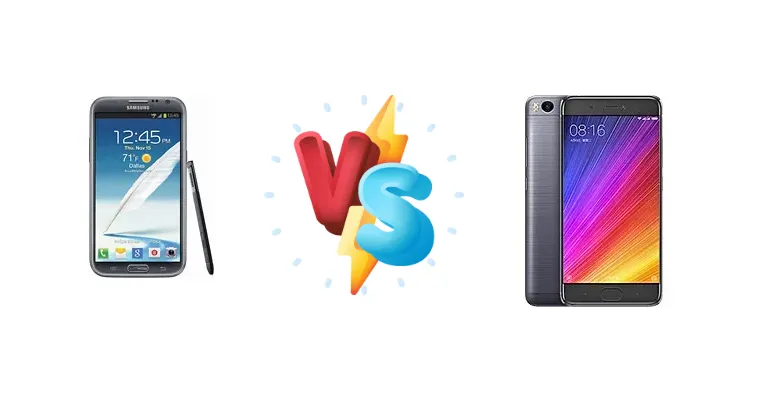
The Samsung Galaxy Note II was a groundbreaking device in its time, popularizing the large-screen phablet form factor. Now, let's pit it against the Xiaomi Mi 5s, a more modern flagship. Can the Note II still compete with a phone boasting newer technology and a more efficient chipset?
🏆 Quick Verdict
The Xiaomi Mi 5s decisively wins this comparison. While the Note II holds nostalgic value, the Mi 5s's Snapdragon 821 chipset, improved camera, and significantly better battery life make it the superior choice for modern usage. The Note II's legacy is undeniable, but it's showing its age.
| Network |
|---|
| 2G bands | GSM 850 / 900 / 1800 / 1900 - SCH-I605, SPH-L900 | GSM 850 / 900 / 1800 / 1900 - SIM 1 & SIM 2 |
| 3G bands | HSDPA 850 / 900 / 1900 / 2100 - SCH-I605, SPH-L900 | HSDPA 850 / 900 / 1900 / 2100 |
| 4G bands | 13 - SCH-I605 | 1, 3, 5, 7, 8, 38, 39, 40, 41 |
| Speed | HSPA 42.2/5.76 Mbps, LTE Cat3 100/50 Mbps, EV-DO Rev.A 3.1 Mbps | HSPA 42.2/5.76 Mbps, LTE (4CA) Cat12 600/150 Mbps |
| Technology | GSM / CDMA / HSPA / EVDO / LTE | GSM / CDMA / HSPA / EVDO / LTE |
| | 2, 4, 5, 12 - SCH-R950 | CDMA2000 1xEV-DO |
| Launch |
|---|
| Announced | 2012, Q3. Released 2012, Q4 | 2016, September. Released 2016, October |
| Status | Discontinued | Discontinued |
| Body |
|---|
| Build | - | Glass front, aluminum back, aluminum frame |
| Dimensions | 151.1 x 80.5 x 9.4 mm (5.95 x 3.17 x 0.37 in) | 145.6 x 70.3 x 8.3 mm (5.73 x 2.77 x 0.33 in) |
| SIM | Micro-SIM | Nano-SIM + Nano-SIM |
| Weight | 179.4 g (6.31 oz) | 145 g (5.11 oz) |
| | Stylus | - |
| Display |
|---|
| Protection | - | To be confirmed |
| Resolution | 720 x 1280 pixels, 16:9 ratio (~267 ppi density) | 1080 x 1920 pixels, 16:9 ratio (~428 ppi density) |
| Size | 5.5 inches, 83.4 cm2 (~68.6% screen-to-body ratio) | 5.15 inches, 73.1 cm2 (~71.4% screen-to-body ratio) |
| Type | Super AMOLED | IPS LCD |
| | - | 3D Touch display (128 GB, 4 GB RAM model) |
| Platform |
|---|
| CPU | Quad-core 1.6 GHz Cortex-A9 | Quad-core (2x2.15 GHz Kryo & 2x1.6 GHz Kryo) |
| Chipset | Exynos 4412 Quad (32 nm) | Qualcomm MSM8996 Snapdragon 821 (14 nm) |
| GPU | Mali-400MP4 | Adreno 530 |
| OS | Android 4.1 (Jelly Bean), upgradable to 4.4.2 (KitKat), TouchWiz UI | Android 6.0 (Marshmallow), upgradable to 7.0 (Nougat), MIUI 10 |
| Memory |
|---|
| Card slot | microSDXC (dedicated slot) | No |
| Internal | 16GB 2GB RAM | 64GB 3GB RAM, 128GB 4GB RAM |
| Main Camera |
|---|
| Features | LED flash | Dual-LED dual-tone flash, panorama |
| Single | 8 MP, AF | 12 MP, f/2.0, 1/2.3", 1.55µm, PDAF |
| Triple | - | 16 MP, f/1.8, (wide), PDAF
8 MP, f/2.2, 13mm (ultrawide)
2 MP, f/2.4, (macro) |
| Video | 1080p@30fps | 4K@30fps, 1080p@120fps |
| Selfie camera |
|---|
| Features | - | HDR |
| Single | 1.9 MP | 4 MP, f/2.0, 1/3", 2µm |
| Video | - | 1080p@30fps |
| Sound |
|---|
| 3.5mm jack | Yes | Yes |
| 35mm jack | Yes | Yes |
| Loudspeaker | Yes | Yes |
| Comms |
|---|
| Bluetooth | 4.0, A2DP, EDR, LE | 4.2, A2DP, LE |
| NFC | Yes | Yes |
| Positioning | GPS, GLONASS | GPS, GLONASS, BDS |
| Radio | Stereo FM radio, RDS - I605 & R950 models | No |
| USB | microUSB 2.0 (MHL TV-out), OTG | USB Type-C |
| WLAN | Wi-Fi 802.11 a/b/g/n, dual-band, Wi-Fi Direct, DLNA, hotspot | Wi-Fi 802.11 a/b/g/n/ac, dual-band, Wi-Fi Direct, DLNA |
| Features |
|---|
| Sensors | Accelerometer, gyro, proximity, compass, barometer | Fingerprint (front-mounted), accelerometer, gyro, proximity, compass, barometer |
| | S-Voice natural language commands and dictation | - |
| Battery |
|---|
| Charging | - | 18W wired, QC3 |
| Music play | Up to 40 h | - |
| Stand-by | Up to 250 h (2G) / Up to 300 h (3G) | - |
| Talk time | Up to 15 h | - |
| Type | Li-Ion 3100 mAh, removable | Li-Ion 3200 mAh, non-removable |
| Misc |
|---|
| Colors | Titanium Gray, Marble White, Amber Brown, Ruby Wine | Silver, Gray, Gold, Rose Gold |
| Models | SCH-I605 | 2015711 |
| Price | About 350 EUR | About 250 EUR |
| SAR | - | 0.77 W/kg (head) 1.01 W/kg (body) |
| Tests |
|---|
| Audio quality | - |
Noise -89.6dB / Crosstalk -85.5dB |
| Battery life | - |
Endurance rating 84h
|
| Camera | - |
Photo / Video |
| Display | - |
Contrast ratio: 1294:1 (nominal), 3.276 (sunlight) |
| Loudspeaker | - |
Voice 64dB / Noise 70dB / Ring 84dB
|
| Performance | - |
Basemark OS II 2.0: 2378Basemark X: 36240 |
Samsung Galaxy Note II CDMA
- Pioneering large-screen design
- S Pen stylus functionality
- Nostalgic Android experience
- Outdated chipset
- Poor performance by modern standards
- Limited app compatibility
- Short battery life
- Lower quality camera
Xiaomi Mi 5s
- Powerful Snapdragon 821 chipset
- Excellent battery life
- Good camera performance
- Compact size
- QC3 fast charging
- Older model (limited software updates)
- May lack some modern features
- Potential for battery degradation
Display Comparison
The Mi 5s boasts a superior display with a higher resolution and likely better color accuracy than the Note II. While both have a contrast ratio of 1294:1 (nominal), the Mi 5s's sunlight readability of 3.276 is a significant advantage, suggesting better brightness and anti-reflective coating. The Note II's display, while large, is noticeably less vibrant and sharp.
Camera Comparison
The Mi 5s's camera is expected to be considerably better than the Note II's. While specific megapixel counts aren't the only factor, the newer sensor, image processing capabilities, and likely improved optics of the Mi 5s will result in sharper, more detailed photos with better low-light performance. Video recording capabilities will also be superior on the Mi 5s.
Performance
The Xiaomi Mi 5s's Snapdragon 821 is a massive upgrade over the Note II's Exynos 4412. The Kryo cores offer significantly faster processing speeds and improved efficiency. Expect smoother multitasking, faster app loading times, and better overall responsiveness on the Mi 5s. The Note II will feel sluggish by comparison, especially with modern apps.
Battery Life
The Mi 5s's endurance rating of 84h is exceptional, indicating a much longer battery life than the Note II. The Note II's battery life was decent for its time, but the Mi 5s's more efficient chipset and potentially larger battery capacity provide a substantial advantage.
Buying Guide
Who should buy the Samsung Galaxy Note II CDMA? Primarily collectors or those seeking a specific, older Android experience. Who should buy the Xiaomi Mi 5s? Anyone looking for a capable, compact Android phone with good performance and battery life at a budget price (given its age).
Frequently Asked Questions
❓ Is the Samsung Galaxy Note II still usable in 2024?
Yes, but with limitations. It can still run basic apps, but performance will be noticeably slow compared to modern devices. Software updates are no longer available, posing security risks.
❓ What is the main advantage of the Samsung Galaxy Note II?
Its S Pen stylus and pioneering large-screen design. It was a revolutionary device that helped popularize the phablet form factor.