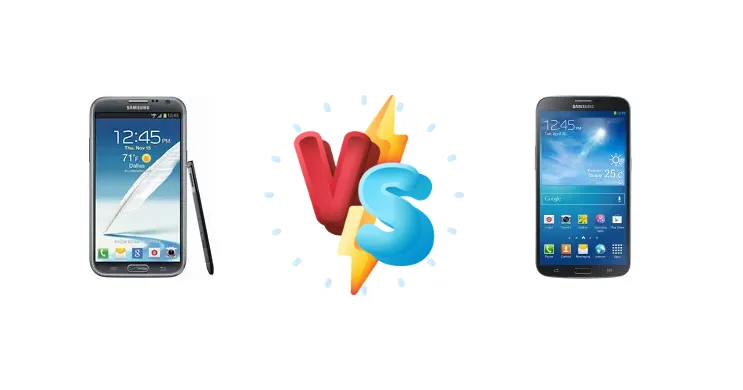
The Samsung Galaxy Note II and Galaxy Mega 6.3 were both popular Android devices, but targeted slightly different users. The Note II aimed for power users, while the Mega 6.3 prioritized screen real estate. Let's dive into a detailed comparison to see which phone holds up best today.
🏆 Quick Verdict
The Galaxy Note II CDMA edges out the Mega 6.3 thanks to its significantly more powerful processor and overall smoother performance. While the Mega 6.3 boasts impressive battery life and a large display, the Note II's superior speed makes it the better choice for most users.
| Network |
|---|
| 2G bands | GSM 850 / 900 / 1800 / 1900 - SCH-I605, SPH-L900 | GSM 850 / 900 / 1800 / 1900 |
| 3G bands | HSDPA 850 / 900 / 1900 / 2100 - SCH-I605, SPH-L900 | HSDPA 850 / 900 / 1900 / 2100 |
| 4G bands | 13 - SCH-I605 | 1, 3, 5, 7, 8, 20 - GT-I9205 |
| Speed | HSPA 42.2/5.76 Mbps, LTE Cat3 100/50 Mbps, EV-DO Rev.A 3.1 Mbps | HSPA 21.1/5.76 Mbps (I9200), LTE Cat3 100/50 Mbps (I9205) |
| Technology | GSM / CDMA / HSPA / EVDO / LTE | GSM / HSPA / LTE |
| | 2, 4, 5, 12 - SCH-R950 | - |
| Launch |
|---|
| Announced | 2012, Q3. Released 2012, Q4 | 2013, April. Released 2013, June |
| Status | Discontinued | Discontinued |
| Body |
|---|
| Dimensions | 151.1 x 80.5 x 9.4 mm (5.95 x 3.17 x 0.37 in) | 167.6 x 88 x 8 mm (6.60 x 3.46 x 0.31 in) |
| SIM | Micro-SIM | Micro-SIM |
| Weight | 179.4 g (6.31 oz) | 199 g (7.02 oz) |
| | Stylus | - |
| Display |
|---|
| Resolution | 720 x 1280 pixels, 16:9 ratio (~267 ppi density) | 720 x 1280 pixels, 16:9 ratio (~233 ppi density) |
| Size | 5.5 inches, 83.4 cm2 (~68.6% screen-to-body ratio) | 6.3 inches, 109.4 cm2 (~74.2% screen-to-body ratio) |
| Type | Super AMOLED | SC-LCD |
| Platform |
|---|
| CPU | Quad-core 1.6 GHz Cortex-A9 | Dual-core 1.7 GHz Krait 300 |
| Chipset | Exynos 4412 Quad (32 nm) | Qualcomm Snapdragon 400 (28 nm) |
| GPU | Mali-400MP4 | Adreno 305 |
| OS | Android 4.1 (Jelly Bean), upgradable to 4.4.2 (KitKat), TouchWiz UI | Android 4.2.2 (Jelly Bean), upgradable to 4.4.2 (KitKat), TouchWiz UI |
| Memory |
|---|
| Card slot | microSDXC (dedicated slot) | microSDXC (dedicated slot) |
| Internal | 16GB 2GB RAM | 8GB 1.5GB RAM, 16GB 1.5GB RAM |
| | - | eMMC 4.5 |
| Main Camera |
|---|
| Features | LED flash | LED flash, HDR, panorama |
| Single | 8 MP, AF | 8 MP, f/2.6, AF |
| Video | 1080p@30fps | 1080p@30fps, stereo sound rec. |
| Selfie camera |
|---|
| Single | 1.9 MP | 1.9 MP |
| Sound |
|---|
| 3.5mm jack | Yes | Yes |
| 35mm jack | Yes | Yes |
| Loudspeaker | Yes | Yes |
| Comms |
|---|
| Bluetooth | 4.0, A2DP, EDR, LE | 4.0, A2DP, LE |
| Infrared port | - | Yes |
| NFC | Yes | Yes |
| Positioning | GPS, GLONASS | GPS, GLONASS |
| Radio | Stereo FM radio, RDS - I605 & R950 models | No |
| USB | microUSB 2.0 (MHL TV-out), OTG | microUSB 2.0 (MHL TV-out), OTG |
| WLAN | Wi-Fi 802.11 a/b/g/n, dual-band, Wi-Fi Direct, DLNA, hotspot | Wi-Fi 802.11 a/b/g/n/ac, dual-band, Wi-Fi Direct, DLNA, hotspot |
| Features |
|---|
| Sensors | Accelerometer, gyro, proximity, compass, barometer | Accelerometer, gyro, proximity, compass |
| | S-Voice natural language commands and dictation | - |
| Battery |
|---|
| Music play | Up to 40 h | Up to 82 h |
| Stand-by | Up to 250 h (2G) / Up to 300 h (3G) | Up to 420 h |
| Talk time | Up to 15 h | Up to 17 h (2G) / Up to 10 h (3G) |
| Type | Li-Ion 3100 mAh, removable | Li-Ion 3200 mAh, removable |
| Misc |
|---|
| Colors | Titanium Gray, Marble White, Amber Brown, Ruby Wine | White, Black, Plum Purple |
| Models | SCH-I605 | GT-I9200, GT-I9205, GT-I9200X, SGH-i527, SGH-I527 |
| Price | About 350 EUR | About 300 EUR |
| SAR | - | 1.09 W/kg (head) 1.09 W/kg (body) |
| SAR EU | - | 0.20 W/kg (head) 0.34 W/kg (body) |
| Tests |
|---|
| Audio quality | - |
Noise -90.4dB / Crosstalk -91.7dB |
| Battery life | - | Endurance rating 60h |
| Camera | - |
Photo / Video |
| Display | - |
Contrast ratio: 1379:1 (nominal) / 1.913:1 (sunlight) |
| Loudspeaker | - |
Voice 67dB / Noise 69dB / Ring 75dB |
Samsung Galaxy Note II CDMA
- Superior Performance
- Vibrant Super AMOLED Display
- Stylus Support
- Generally better camera (historical)
- Older Device
- Battery life not as impressive as Mega 6.3
- CDMA only
Samsung Galaxy Mega 6.3 I9200
- Large 6.3-inch Display
- Exceptional Battery Life
- Good for Media Consumption
- Weaker Processor
- Less Responsive
- LCD Display (less vibrant than AMOLED)
- Older Device
Display Comparison
Both phones feature a large display with a respectable contrast ratio of 1379:1 (nominal) and 1.913:1 (sunlight). The Note II has a 5.5-inch Super AMOLED display, known for vibrant colors and deep blacks. The Mega 6.3 has a larger 6.3-inch LCD display. While the Mega 6.3 offers more screen real estate, the Note II's AMOLED technology generally provides a more visually appealing experience.
Camera Comparison
Camera specifications are not explicitly provided, but both phones feature Photo/Video capabilities. The Note II generally had a better reputation for camera quality during its time, likely due to Samsung's image processing algorithms and potentially a slightly better sensor. However, both cameras are dated by today's standards.
Performance
This is where the Note II truly shines. Its Exynos 4412 Quad chipset with a 1.6 GHz quad-core Cortex-A9 CPU is significantly more powerful than the Mega 6.3's Qualcomm Snapdragon 400 with a 1.7 GHz dual-core Krait 300. Expect smoother multitasking, faster app loading times, and better overall responsiveness on the Note II.
Battery Life
The Galaxy Mega 6.3 boasts an impressive endurance rating of 60 hours, suggesting exceptional battery life. The Note II's battery life was good for its time, but not as exceptional as the Mega 6.3. This is a significant advantage for the Mega 6.3 if battery longevity is a top priority.
Buying Guide
The Samsung Galaxy Note II CDMA is ideal for users who prioritize performance and multitasking. It's a good choice for those who enjoy note-taking and stylus input. The Galaxy Mega 6.3 is best suited for users who value a large screen for media consumption and extended battery life, and are less concerned with raw processing power.
Frequently Asked Questions
❓ Is the Galaxy Note II still worth buying?
While it's an older device, the Note II's performance still holds up reasonably well for basic tasks. However, consider its age and lack of software updates.
❓ Which phone is better for watching videos?
The Galaxy Mega 6.3's larger screen makes it slightly better for video consumption, but the Note II's AMOLED display offers a more vibrant and immersive viewing experience.