
Samsung Galaxy Note Edge vs. Note 9: A Generational Leap?
| Phones Images | |||||
|---|---|---|---|---|---|
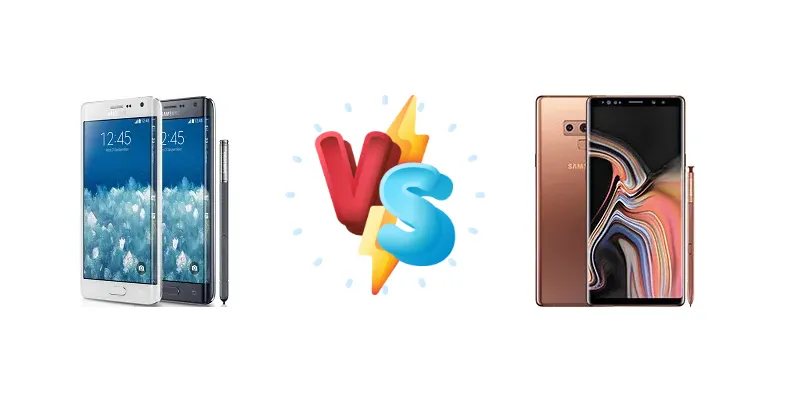
|
🏆 Quick Verdict
The Samsung Galaxy Note 9 is the clear winner. While the Note Edge offered a unique design, the Note 9 boasts significantly improved performance, a better camera, vastly superior battery life, and a more modern feature set. It's a substantial upgrade across the board.
| PHONES | ||
|---|---|---|
| Phone Names | Samsung Galaxy Note Edge | Samsung Galaxy Note9 |
| Network | ||
|---|---|---|
| 2G bands | GSM 850 / 900 / 1800 / 1900 | GSM 850 / 900 / 1800 / 1900 |
| 3G bands | HSDPA 850 / 900 / 1900 / 2100 | HSDPA 850 / 900 / 1700(AWS) / 1900 / 2100 |
| 4G bands | 1, 2, 3, 4, 5, 7, 8, 28 - SM-N915G | 1, 2, 3, 4, 5, 7, 8, 12, 13, 17, 18, 19, 20, 25, 26, 28, 32, 38, 39, 40, 41, 66, 71 - Global |
| Speed | HSPA 42.2/5.76 Mbps, LTE (3CA) Cat6 300/50 Mbps or Cat4 150/50 Mbps | HSPA 42.2/5.76 Mbps, LTE (5CA) Cat18 1200/200 Mbps |
| Technology | GSM / HSPA / LTE | GSM / CDMA / HSPA / EVDO / LTE |
| - | 1, 2, 3, 4, 5, 7, 8, 12, 13, 14, 17, 18, 19, 20, 25, 26, 28, 29, 30, 38, 39, 40, 41, 46, 66, 71 - USA | |
| Launch | ||
|---|---|---|
| Announced | 2014, September. Released 2014, November | 2018, August 09. Released 2018, August 24 |
| Status | Discontinued | Discontinued |
| Body | ||
|---|---|---|
| Build | Glass front (Gorilla Glass 3), plastic back, aluminum frame | Glass front (Gorilla Glass 5), glass back (Gorilla Glass 5), aluminum frame |
| Dimensions | 151.3 x 82.4 x 8.3 mm (5.96 x 3.24 x 0.33 in) | 161.9 x 76.4 x 8.8 mm (6.37 x 3.01 x 0.35 in) |
| SIM | Micro-SIM | · Nano-SIM· Nano-SIM + Nano-SIM |
| Weight | 174 g (6.14 oz) | 201 g (7.09 oz) |
| - | IP68 dust/water resistant (up to 1.5m for 30 min) Stylus (Bluetooth integration) | |
| Display | ||
|---|---|---|
| Protection | Corning Gorilla Glass 3 | Corning Gorilla Glass 5 |
| Resolution | 1600 x 2560 pixels, 16:10 ratio (~524 ppi density) | 1440 x 2960 pixels, 18.5:9 ratio (~516 ppi density) |
| Size | 5.6 inches, 96.2 cm2 (~77.2% screen-to-body ratio) | 6.4 inches, 103.2 cm2 (~83.4% screen-to-body ratio) |
| Type | Super AMOLED | Super AMOLED, HDR10 |
| - | Always-on display | |
| Platform | ||
|---|---|---|
| CPU | Quad-core 2.7 GHz Krait 450 | Octa-core (4x2.7 GHz Mongoose M3 & 4x1.8 GHz Cortex-A55) - EMEAOcta-core (4x2.8 GHz Kryo 385 Gold & 4x1.7 GHz Kryo 385 Silver) - USA/LATAM, China |
| Chipset | Qualcomm APQ8084 Snapdragon 805 (28 nm) | Exynos 9810 (10 nm) - EMEAQualcomm SDM845 Snapdragon 845 (10 nm) - USA/LATAM, China |
| GPU | Adreno 420 | Mali-G72 MP18 - EMEAAdreno 630 - USA/LATAM, China |
| OS | Android 4.4.4 (KitKat), upgradable to 6.0 (Marshmallow) | Android 8.1 (Oreo), upgradable to Android 10, One UI 2.5 |
| Memory | ||
|---|---|---|
| Card slot | microSDXC (dedicated slot) | microSDXC (uses shared SIM slot) |
| Internal | 32GB 3GB RAM, 64GB 3GB RAM | 128GB 6GB RAM, 128GB 8GB RAM, 512GB 8GB RAM |
| - | UFS 2.1 | |
| Main Camera | ||
|---|---|---|
| Dual | - | 12 MP, f/1.5-2.4, 26mm (wide), 1/2.55", 1.4µm, dual pixel PDAF, OIS 12 MP, f/2.4, 52mm (telephoto), 1/3.4", 1.0µm, AF, OIS, 2x optical zoom |
| Features | LED flash, panorama, HDR | LED flash, auto-HDR, panorama |
| Single | 16 MP, f/2.2, 31mm (standard), 1/2.6", 1.12µm, AF, OIS | - |
| Video | 4K@30fps, 1080p@30/60fps, stereo sound rec. | 4K@60fps (no OIS/EIS), 4K@30fps, 1080p@30/60/240fps, 720p@960fps, HDR, stereo sound rec., gyro-EIS & OIS |
| Selfie camera | ||
|---|---|---|
| Dual | - | 8 MP, f/1.7, 25mm (wide), 1/3.6", 1.22µm, AF 2 MP (dedicated iris scanner camera) |
| Features | - | HDR |
| Single | 3.7 MP, f/1.9 | - |
| Video | 1440p@30fps | 1440p@30fps |
| Sound | ||
|---|---|---|
| 3.5mm jack | Yes | Yes |
| 35mm jack | Yes | Yes |
| Loudspeaker | Yes | Yes, with stereo speakers |
| - | 32-bit/384kHz audio | |
| Comms | ||
|---|---|---|
| Bluetooth | 4.1, A2DP, EDR, LE | 5.0, A2DP, LE, aptX |
| Infrared port | Yes | - |
| NFC | Yes | Yes |
| Positioning | GPS, GLONASS, BDS | GPS, GLONASS, BDS, GALILEO |
| Radio | No | No |
| USB | microUSB 2.0 (MHL 3 TV-out), OTG | USB Type-C 3.1 |
| WLAN | Wi-Fi 802.11 a/b/g/n/ac, dual-band, Wi-Fi Direct, hotspot | Wi-Fi 802.11 a/b/g/n/ac, dual-band, Wi-Fi Direct |
| Features | ||
|---|---|---|
| Sensors | Fingerprint (front-mounted), accelerometer, gyro, proximity, compass, barometer, UV, heart rate, SpO2 | Iris scanner, fingerprint (rear-mounted), accelerometer, gyro, proximity, compass, barometer, heart rate, SpO2 |
| - | Samsung DeX (desktop experience support) ANT+ Bixby natural language commands and dictation Samsung Pay (Visa, MasterCard certified) | |
| Battery | ||
|---|---|---|
| Charging | 15W wired, QC2 | 15W wired Wireless (Qi) (market dependent) |
| Music play | Up to 67 h | - |
| Talk time | Up to 18 h (3G) | - |
| Type | Li-Ion 3000 mAh, removable | Li-Ion 4000 mAh, non-removable |
| Misc | ||
|---|---|---|
| Colors | Black, White | Metallic Copper, Lavender Purple, Ocean Blue, Midnight Black, Pure White, Alpine White |
| Models | SM-N9150, SM-N915A, SM-N915D, SM-N915F, SM-N915FY, SM-N915G, SM-N915K, SM-N915L, SM-N915P, SM-N915R4, SM-N915S, SM-N915T, SM-N915V, SM-N915W8, SM-N915X, SC-01G | SM-N960F, SM-N9600, SM-N960F, SM-N960U, SM-N960U1, SM-N960N, SM-N960W, SM-N960X, SCV40 |
| Price | About 300 EUR | About 430 EUR |
| SAR | - | 1.29 W/kg (head) 1.03 W/kg (body) |
| SAR EU | 0.24 W/kg (head) 0.33 W/kg (body) | 0.38 W/kg (head) 1.51 W/kg (body) |
| Tests | ||
|---|---|---|
| Audio quality | Noise -95.9dB / Crosstalk -93.3dB | Noise -93.7dB / Crosstalk -94.1dB |
| Battery life | Endurance rating 68h | Endurance rating 97h |
| Camera | Photo / Video | Photo / Video |
| Display | Contrast ratio: Infinite (nominal), 3.799 (sunlight) | Contrast ratio: Infinite (nominal), 4.531 (sunlight) |
| Loudspeaker | Voice 72dB / Noise 75dB / Ring 70dB | Voice 71dB / Noise 74dB / Ring 80dB |
| Performance | Basemark OS II 2.0: 1255Basemark X: 17108 | AnTuTu: 248823 (v7), 315447 (v8) GeekBench: 9026 (v4.4), 2092 (v5.1) GFXBench: 15fps (ES 3.1 onscreen) |
Samsung Galaxy Note Edge
- Unique curved edge display
- Compact size (for its time)
- Decent performance for its era
- Outdated chipset
- Shorter battery life
- Limited software updates
- Lower camera quality
- Smaller screen
Samsung Galaxy Note9
- Excellent performance
- Long battery life
- Superior camera
- Larger, more immersive display
- Modern software features
- S Pen functionality
- Can be bulky
- Charging speed could be faster (15W is relatively slow now)
Display Comparison
The Note 9's display is noticeably better. While both have 'infinite' contrast ratios (a marketing term), the Note 9's sunlight readability (4.531) is superior to the Note Edge's (3.799). The Note 9 also features a larger, more immersive screen with a more modern aspect ratio. The Note Edge's curved edge, while innovative, is less practical than the Note 9's flat display for many users.
Camera Comparison
The Note 9's camera is a major upgrade. While both offer 'Photo / Video' capabilities, the Note 9 features a more advanced sensor, improved image processing, and often includes features like scene optimization and better low-light performance. The Note 9 also typically has a dual-camera setup for more versatile photography.
Performance
The Note 9's chipset (Exynos 9810 or Snapdragon 845) and octa-core CPU are significantly faster and more efficient than the Note Edge's Snapdragon 805 and quad-core CPU. This translates to smoother multitasking, faster app loading times, and better overall responsiveness. The Note 9 also benefits from more modern software optimization.
Battery Life
Battery life is where the Note 9 truly shines. With an endurance rating of 97 hours, it offers significantly more usage time than the Note Edge's 68 hours. This difference is due to a larger battery capacity and more efficient hardware.
Buying Guide
The Note Edge is only suitable for collectors or those seeking a very specific, nostalgic experience. The Note 9 is a solid choice for anyone needing a reliable, capable Android phone with a great display, camera, and battery, especially if found at a discounted price.