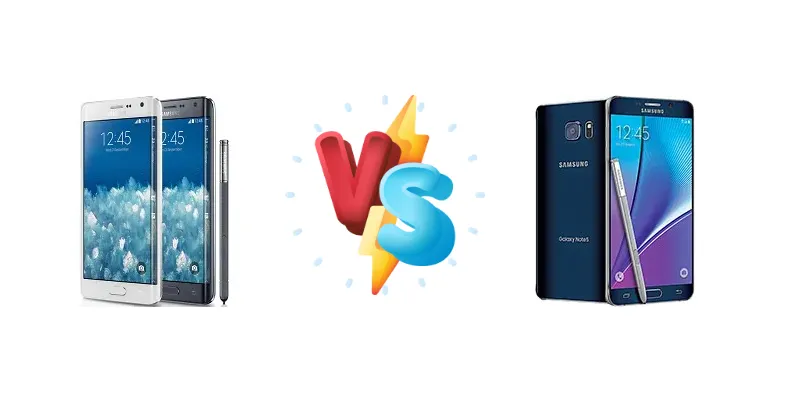
The Samsung Galaxy Note Edge and Note 5 were both flagship devices, pushing the boundaries of mobile technology. The Note Edge introduced a unique curved display, while the Note 5 refined the formula with improved performance and features. Let's dive into a head-to-head comparison to see which phone ultimately comes out on top.
🏆 Quick Verdict
The Samsung Galaxy Note 5 is the clear winner. While the Note Edge's curved display was innovative, the Note 5 boasts superior battery life, a more powerful processor, and wireless charging. It's a more well-rounded and ultimately more practical flagship experience.
| Network |
|---|
| 2G bands | GSM 850 / 900 / 1800 / 1900 | GSM 850 / 900 / 1800 / 1900 |
| 3G bands | HSDPA 850 / 900 / 1900 / 2100 | HSDPA 850 / 900 / 1900 / 2100 |
| 4G bands | 1, 2, 3, 4, 5, 7, 8, 28 - SM-N915G | 1, 2, 3, 4, 5, 7, 8, 12, 17, 18, 19, 25, 26, 28, 38, 39, 40, 41 |
| Speed | HSPA 42.2/5.76 Mbps, LTE (3CA) Cat6 300/50 Mbps or Cat4 150/50 Mbps | HSPA 42.2/5.76 Mbps, LTE Cat6 300/50 Mbps/ LTE (3CA) Cat9 450/50 Mbps |
| Technology | GSM / HSPA / LTE | GSM / HSPA / LTE |
| Launch |
|---|
| Announced | 2014, September. Released 2014, November | 2015, August 13. Released 2015, August |
| Status | Discontinued | Discontinued |
| Body |
|---|
| Build | Glass front (Gorilla Glass 3), plastic back, aluminum frame | Glass front (Gorilla Glass 4), glass back (Gorilla Glass 4), aluminum frame |
| Dimensions | 151.3 x 82.4 x 8.3 mm (5.96 x 3.24 x 0.33 in) | 153.2 x 76.1 x 7.6 mm (6.03 x 3.00 x 0.30 in) |
| SIM | Micro-SIM | Nano-SIM |
| Weight | 174 g (6.14 oz) | 171 g (6.03 oz) |
| | - | Stylus |
| Display |
|---|
| Protection | Corning Gorilla Glass 3 | Corning Gorilla Glass 4 |
| Resolution | 1600 x 2560 pixels, 16:10 ratio (~524 ppi density) | 1440 x 2560 pixels, 16:9 ratio (~518 ppi density) |
| Size | 5.6 inches, 96.2 cm2 (~77.2% screen-to-body ratio) | 5.7 inches, 88.5 cm2 (~75.9% screen-to-body ratio) |
| Type | Super AMOLED | Super AMOLED |
| Platform |
|---|
| CPU | Quad-core 2.7 GHz Krait 450 | Octa-core (4x2.1 GHz Cortex-A57 & 4x1.5 GHz Cortex-A53) |
| Chipset | Qualcomm APQ8084 Snapdragon 805 (28 nm) | Exynos 7420 Octa (14 nm) |
| GPU | Adreno 420 | Mali-T760MP8 |
| OS | Android 4.4.4 (KitKat), upgradable to 6.0 (Marshmallow) | Android 5.1.1 (Lollipop), upgradable to 7.0 (Nougat) |
| Memory |
|---|
| Card slot | microSDXC (dedicated slot) | No |
| Internal | 32GB 3GB RAM, 64GB 3GB RAM | 32GB 4GB RAM, 64GB 4GB RAM, 128GB 4GB RAM |
| | - | UFS 2.0 |
| Main Camera |
|---|
| Features | LED flash, panorama, HDR | LED flash, panorama, HDR |
| Single | 16 MP, f/2.2, 31mm (standard), 1/2.6", 1.12µm, AF, OIS | 16 MP, f/1.9, 28mm (wide), 1/2.6", 1.12µm, AF, OIS |
| Video | 4K@30fps, 1080p@30/60fps, stereo sound rec. | 4K@30fps, 1080p@30/60fps, stereo sound rec., gyro-EIS |
| Selfie camera |
|---|
| Features | - | HDR |
| Single | 3.7 MP, f/1.9 | 5 MP, f/1.9, 22mm (wide), 1/4.1", 1.34µm |
| Video | 1440p@30fps | 1440p@30fps |
| Sound |
|---|
| 3.5mm jack | Yes | Yes |
| 35mm jack | Yes | Yes |
| Loudspeaker | Yes | Yes |
| | - | 24-bit/192kHz audio
|
| Comms |
|---|
| Bluetooth | 4.1, A2DP, EDR, LE | 4.2, A2DP, EDR, LE |
| Infrared port | Yes | - |
| NFC | Yes | Yes |
| Positioning | GPS, GLONASS, BDS | GPS, GLONASS, BDS |
| Radio | No | No |
| USB | microUSB 2.0 (MHL 3 TV-out), OTG | microUSB 2.0, OTG |
| WLAN | Wi-Fi 802.11 a/b/g/n/ac, dual-band, Wi-Fi Direct, hotspot | Wi-Fi 802.11 a/b/g/n/ac, dual-band, Wi-Fi Direct, hotspot |
| Features |
|---|
| Sensors | Fingerprint (front-mounted), accelerometer, gyro, proximity, compass, barometer, UV, heart rate, SpO2 | Fingerprint (front-mounted), accelerometer, gyro, proximity, compass, barometer, heart rate, SpO2 |
| | - | ANT+
S-Voice natural language commands and dictation
Samsung Pay (Visa, MasterCard certified) |
| Battery |
|---|
| Charging | 15W wired, QC2 | 15W wired, QC2
Wireless (Qi) (market dependent) |
| Music play | Up to 67 h | Up to 64 h |
| Talk time | Up to 18 h (3G) | Up to 22 h (3G) |
| Type | Li-Ion 3000 mAh, removable | Li-Po 3000 mAh, non-removable |
| Misc |
|---|
| Colors | Black, White | Black Sapphire, Gold Platinum, Silver Titan, White Pearl |
| Models | SM-N9150, SM-N915A, SM-N915D, SM-N915F, SM-N915FY, SM-N915G, SM-N915K, SM-N915L, SM-N915P, SM-N915R4, SM-N915S, SM-N915T, SM-N915V, SM-N915W8, SM-N915X, SC-01G | SM-N920, SM-N920T, SM-N920A, SM-N920I, SM-N920G, SM-N920F, SM-N920S, SM-N920L, SM-N920K, SM-N9200 |
| Price | About 300 EUR | About 450 EUR |
| SAR | - | 1.53 W/kg (head) 1.28 W/kg (body) |
| SAR EU | 0.24 W/kg (head) 0.33 W/kg (body) | 0.45 W/kg (head) 0.58 W/kg (body) |
| Tests |
|---|
| Audio quality |
Noise -95.9dB / Crosstalk -93.3dB |
Noise -93.6dB / Crosstalk -94.7dB |
| Battery life |
Endurance rating 68h
|
Endurance rating 85h
|
| Camera |
Photo / Video |
Photo / Video |
| Display |
Contrast ratio: Infinite (nominal), 3.799 (sunlight) |
Contrast ratio: Infinite (nominal), 4.090 (sunlight) |
| Loudspeaker |
Voice 72dB / Noise 75dB / Ring 70dB
|
Voice 66dB / Noise 67dB / Ring 71dB
|
| Performance |
Basemark OS II 2.0: 1255Basemark X: 17108 |
Basemark OS II 2.0: 1880Basemark X: 26281 |
Samsung Galaxy Note Edge
- Unique curved display
- Good performance for its time
- S Pen stylus
- Shorter battery life
- Curved display can be divisive
- Older chipset
Samsung Galaxy Note5
- Excellent performance
- Longer battery life
- Wireless charging
- Refined design
- MicroSD card slot absent
- Non-expandable storage
Display Comparison
Both phones feature stunning AMOLED displays with excellent contrast ratios (Infinite nominal, 3.799/4.090 in sunlight). The Note 5's display is slightly brighter in sunlight, offering better visibility outdoors. The Note Edge's defining feature is its curved edge display, providing quick access to notifications and apps, but its utility is debatable for some.
Camera Comparison
Both phones offer capable cameras, but the Note 5 generally produces slightly better image quality, particularly in low-light conditions. The Note 5's image processing is more refined, resulting in more vibrant and detailed photos. Both offer good video recording capabilities.
Performance
The Note 5's Exynos 7420 Octa chipset is significantly faster than the Note Edge's Snapdragon 805. The Note 5's octa-core processor and 14nm manufacturing process provide a noticeable performance boost in everyday tasks and demanding games. The Note Edge, while still capable, shows its age in comparison.
Battery Life
The Note 5 holds a clear advantage in battery life, with an endurance rating of 85 hours compared to the Note Edge's 68 hours. This translates to significantly longer usage between charges, a crucial factor for many users.
Buying Guide
The Samsung Galaxy Note Edge might appeal to those seeking a truly unique and experimental device, particularly if they value the novelty of the curved screen. However, most users will find the Samsung Galaxy Note 5 a better investment due to its improved performance, battery, and overall refinement.
Frequently Asked Questions
❓ Is the Note Edge's curved display worth it?
The curved display is a matter of personal preference. Some find it useful for quick access to information, while others find it gimmicky and distracting. It's best to try it out in person if possible.
❓ Which phone has better software support?
The Note 5 received more software updates and security patches over its lifespan. Both phones are no longer receiving updates.
❓ Can I expand the storage on either phone?
No, neither phone offers a microSD card slot. Storage is fixed at the time of purchase.