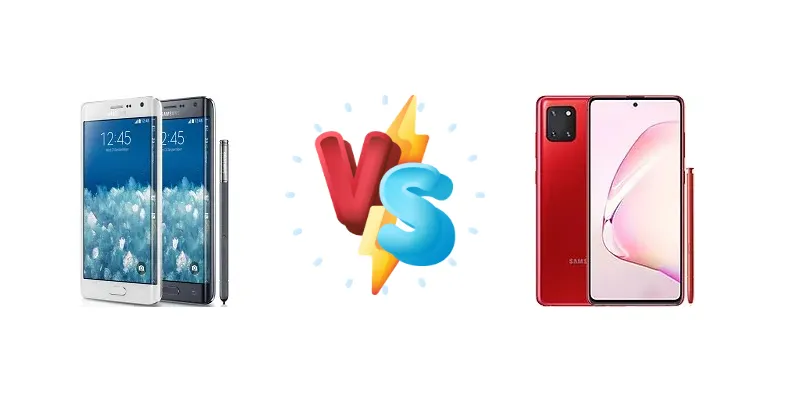
The Samsung Galaxy Note Edge was a bold experiment with its curved edge display, while the Note10 Lite offered a more mainstream, budget-friendly flagship experience. But which phone holds up better today? We're diving deep into their specs, features, and performance to help you decide.
🏆 Quick Verdict
The Samsung Galaxy Note10 Lite is the clear winner. While the Note Edge's innovative edge display was intriguing, the Note10 Lite boasts significantly better battery life, a more modern chipset, faster charging, and a brighter display, making it a more practical choice for most users.
| Network |
|---|
| 2G bands | GSM 850 / 900 / 1800 / 1900 | GSM 850 / 900 / 1800 / 1900 |
| 3G bands | HSDPA 850 / 900 / 1900 / 2100 | HSDPA 850 / 900 / 1700(AWS) / 1900 / 2100 |
| 4G bands | 1, 2, 3, 4, 5, 7, 8, 28 - SM-N915G | 1, 2, 3, 4, 5, 7, 8, 12, 13, 17, 20, 28, 38, 40, 41, 66 |
| Speed | HSPA 42.2/5.76 Mbps, LTE (3CA) Cat6 300/50 Mbps or Cat4 150/50 Mbps | HSPA, LTE |
| Technology | GSM / HSPA / LTE | GSM / HSPA / LTE |
| Launch |
|---|
| Announced | 2014, September. Released 2014, November | 2020, January 03 |
| Status | Discontinued | Available. Released 2020, January 21 |
| Body |
|---|
| Build | Glass front (Gorilla Glass 3), plastic back, aluminum frame | Glass front (Gorilla Glass 3), aluminum frame, plastic back |
| Dimensions | 151.3 x 82.4 x 8.3 mm (5.96 x 3.24 x 0.33 in) | 163.7 x 76.1 x 8.7 mm (6.44 x 3.00 x 0.34 in) |
| SIM | Micro-SIM | · Nano-SIM· Nano-SIM + Nano-SIM |
| Weight | 174 g (6.14 oz) | 199 g (7.02 oz) |
| | - | Stylus (Bluetooth integration, accelerometer, gyro) |
| Display |
|---|
| Protection | Corning Gorilla Glass 3 | Corning Gorilla Glass 3 |
| Resolution | 1600 x 2560 pixels, 16:10 ratio (~524 ppi density) | 1080 x 2400 pixels, 20:9 ratio (~394 ppi density) |
| Size | 5.6 inches, 96.2 cm2 (~77.2% screen-to-body ratio) | 6.7 inches, 107.8 cm2 (~86.6% screen-to-body ratio) |
| Type | Super AMOLED | Super AMOLED, HDR |
| | - | Always-on display |
| Platform |
|---|
| CPU | Quad-core 2.7 GHz Krait 450 | Octa-core (4x2.7 GHz Mongoose M3 & 4x1.7 GHz Cortex-A55) |
| Chipset | Qualcomm APQ8084 Snapdragon 805 (28 nm) | Exynos 9810 (10 nm) |
| GPU | Adreno 420 | Mali-G72 MP18 |
| OS | Android 4.4.4 (KitKat), upgradable to 6.0 (Marshmallow) | Android 10, upgradable to Android 13, One UI 5.1 |
| Memory |
|---|
| Card slot | microSDXC (dedicated slot) | microSDXC (uses shared SIM slot) |
| Internal | 32GB 3GB RAM, 64GB 3GB RAM | 128GB 6GB RAM, 128GB 8GB RAM |
| | - | UFS 2.1 |
| Main Camera |
|---|
| Features | LED flash, panorama, HDR | LED flash, panorama, HDR |
| Single | 16 MP, f/2.2, 31mm (standard), 1/2.6", 1.12µm, AF, OIS | - |
| Triple | - | 12 MP, f/1.7, 27mm (wide), 1/2.55", 1.4µm, dual pixel PDAF, OIS
12 MP, f/2.4, 52mm (telephoto), 1/3.6", 1.0µm, PDAF, OIS, 2x optical zoom
12 MP, f/2.2, 12mm (ultrawide) |
| Video | 4K@30fps, 1080p@30/60fps, stereo sound rec. | 4K@30/60fps, 1080p@30/60/240fps; gyro-EIS |
| Selfie camera |
|---|
| Features | - | HDR |
| Single | 3.7 MP, f/1.9 | 32 MP, f/2.2, 25mm (wide), 1/2.8", 0.8µm |
| Video | 1440p@30fps | 4K@30fps, 1080p@30fps |
| Sound |
|---|
| 3.5mm jack | Yes | Yes |
| 35mm jack | Yes | Yes |
| Loudspeaker | Yes | Yes |
| Comms |
|---|
| Bluetooth | 4.1, A2DP, EDR, LE | 5.0, A2DP, LE |
| Infrared port | Yes | - |
| NFC | Yes | Yes |
| Positioning | GPS, GLONASS, BDS | GPS, GLONASS, GALILEO, BDS |
| Radio | No | FM radio |
| USB | microUSB 2.0 (MHL 3 TV-out), OTG | USB Type-C 2.0 |
| WLAN | Wi-Fi 802.11 a/b/g/n/ac, dual-band, Wi-Fi Direct, hotspot | Wi-Fi 802.11 a/b/g/n/ac, dual-band, Wi-Fi Direct |
| Features |
|---|
| Sensors | Fingerprint (front-mounted), accelerometer, gyro, proximity, compass, barometer, UV, heart rate, SpO2 | Fingerprint (under display, optical), accelerometer, gyro, proximity, compass |
| | - | ANT+ |
| Battery |
|---|
| Charging | 15W wired, QC2 | 25W wired |
| Music play | Up to 67 h | - |
| Talk time | Up to 18 h (3G) | - |
| Type | Li-Ion 3000 mAh, removable | Li-Po 4500 mAh |
| Misc |
|---|
| Colors | Black, White | Aura Glow, Aura Black, Aura Red |
| Models | SM-N9150, SM-N915A, SM-N915D, SM-N915F, SM-N915FY, SM-N915G, SM-N915K, SM-N915L, SM-N915P, SM-N915R4, SM-N915S, SM-N915T, SM-N915V, SM-N915W8, SM-N915X, SC-01G | SM-N770F, SM-N770F/DS, SM-N770F/DSM |
| Price | About 300 EUR | About 550 EUR |
| SAR | - | 0.88 W/kg (head) 0.65 W/kg (body) |
| SAR EU | 0.24 W/kg (head) 0.33 W/kg (body) | 0.29 W/kg (head) 1.08 W/kg (body) |
| Tests |
|---|
| Audio quality |
Noise -95.9dB / Crosstalk -93.3dB |
Noise -93.3dB / Crosstalk -91.4dB |
| Battery life |
Endurance rating 68h
| Endurance rating 92h |
| Camera |
Photo / Video |
Photo / Video |
| Display |
Contrast ratio: Infinite (nominal), 3.799 (sunlight) |
Contrast ratio: Infinite (nominal) |
| Loudspeaker |
Voice 72dB / Noise 75dB / Ring 70dB
|
-27.8 LUFS (Good) |
| Performance |
Basemark OS II 2.0: 1255Basemark X: 17108 |
AnTuTu: 258484 (v7), 341212 (v8)
GeekBench: 6103 (v4.4), 2027 (v5.1)
GFXBench: 25fps (ES 3.1 onscreen) |
Samsung Galaxy Note Edge
- Unique curved edge display
- Compact size
- Outdated chipset
- Shorter battery life
- Dim display
- Slower charging
Samsung Galaxy Note10 Lite
- Excellent battery life
- Modern chipset
- Brighter display
- Faster charging
- More modern design
- No S Pen (compared to other Note models)
- Plastic build (compared to premium models)
Display Comparison
The Note10 Lite's display is brighter (622 nits) and more modern than the Note Edge. While both claim an 'infinite' contrast ratio (likely a marketing term), the Note10 Lite's measured brightness provides a better viewing experience, especially outdoors. The Note Edge's curved edge display is a novelty, but not necessarily a practical advantage.
Camera Comparison
While both phones have 'Photo / Video' capabilities, the Note10 Lite's camera is generally considered superior due to its more modern sensor and image processing. The Note Edge's camera, while decent for its time, struggles in low-light conditions compared to the Note10 Lite.
Performance
The Note10 Lite's Exynos 9810 chipset and Octa-core CPU offer a noticeable performance boost over the Note Edge's Snapdragon 805. The Note10 Lite's 10nm process also contributes to better power efficiency. Expect smoother multitasking and faster app loading on the Note10 Lite.
Battery Life
The Note10 Lite dominates in battery life with an endurance rating of 92h, significantly exceeding the Note Edge's 68h. This translates to noticeably longer usage between charges on the Note10 Lite.
Buying Guide
The Samsung Galaxy Note Edge might appeal to collectors or those fascinated by its unique design. However, the Samsung Galaxy Note10 Lite is the better choice for anyone seeking a reliable, modern smartphone with good performance, a decent camera, and excellent battery life at a reasonable price.
Frequently Asked Questions
❓ Is the Note Edge's curved screen worth it?
The curved screen was innovative, but its practical benefits are limited. The Note10 Lite offers a better overall display experience.
❓ Which phone is better for gaming?
The Note10 Lite is significantly better for gaming due to its more powerful chipset and better thermal management.