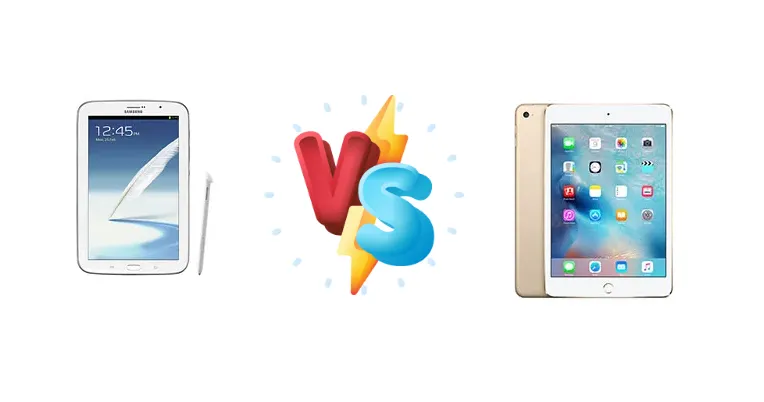
Released in 2013 and 2015 respectively, the Samsung Galaxy Note 8.0 and Apple iPad mini 4 represent distinct approaches to the compact tablet market. The Note 8.0 aimed to bring the S Pen experience to a smaller form factor, while the iPad mini 4 focused on refined iOS performance and portability. This comparison dissects their core hardware to determine which tablet holds up better today.
🏆 Quick Verdict
For the average user seeking a functional, portable tablet, the Apple iPad mini 4 emerges as the winner. Its Apple A8 chipset, fabricated on a 20nm process, delivers superior performance efficiency compared to the Samsung Galaxy Note 8.0’s Exynos 4412. While the Note 8.0’s S Pen is a unique feature, the iPad mini 4’s overall responsiveness and software optimization provide a smoother user experience.
| Network |
|---|
| 2G bands | GSM 850 / 900 / 1800 / 1900 - N5100, N5120 | GSM 850 / 900 / 1800 / 1900 |
| 3G bands | HSDPA 850 / 900 / 1900 / 2100 - N5100 | HSDPA 850 / 900 / 1700 / 1900 / 2100 |
| 4G bands | 3, 7, 8, 20 - N5120 | 1, 2, 3, 4, 5, 7, 8, 13, 17, 18, 19, 20, 25, 26, 28, 29, 38, 39, 40, 41 - A1490 |
| Speed | HSPA 42.2(LTE)/21.1(3G)/5.76 Mbps, LTE Cat3 100/50 Mbps | HSPA 42.2/5.76 Mbps, LTE Cat4 150/50 Mbps, EV-DO Rev.A 3.1 Mbps |
| Technology | GSM / HSPA / LTE | GSM / CDMA / HSPA / EVDO / LTE |
| | - | CDMA2000 1xEV-DO |
| Launch |
|---|
| Announced | 2013, February. Released 2013, April | 2015, September. Released 2015, September |
| Status | Discontinued | Discontinued |
| Body |
|---|
| Build | - | Glass front, aluminum back, aluminum frame |
| Dimensions | 210.8 x 135.9 x 8 mm (8.30 x 5.35 x 0.31 in) | 203.2 x 134.8 x 6.1 mm (8.0 x 5.31 x 0.24 in) |
| SIM | Micro-SIM | Nano-SIM + eSIM |
| Weight | 338 g (3G) / 340 g (LTE) (11.99 oz) | 299 g (Wi-Fi) / 304 g (3G/LTE) (10.55 oz) |
| Display |
|---|
| Protection | - | Scratch-resistant glass, oleophobic coating |
| Resolution | 800 x 1280 pixels, 16:10 ratio (~189 ppi density) | 1536 x 2048 pixels, 4:3 ratio (~324 ppi density) |
| Size | 8.0 inches, 185.6 cm2 (~64.8% screen-to-body ratio) | 7.9 inches, 193.3 cm2 (~70.6% screen-to-body ratio) |
| Type | TFT | IPS LCD |
| Platform |
|---|
| CPU | Quad-core 1.6 GHz Cortex-A9 | Dual-core 1.5 GHz Typhoon |
| Chipset | Exynos 4412 Quad (32 nm) | Apple A8 (20 nm) |
| GPU | Mali-400MP4 | PowerVR GX6450 (quad-core graphics) |
| OS | Android 4.1.2 (Jelly Bean), upgradable to 4.4 (KitKat) | iOS 9, upgradable to iPadOS 15.8.5 |
| Memory |
|---|
| Card slot | microSDXC (dedicated slot) | No |
| Internal | 16GB 2GB RAM, 32GB 2GB RAM | 16GB 2GB RAM, 32GB 2GB RAM, 64GB 2GB RAM, 128GB 2GB RAM |
| Main Camera |
|---|
| Features | - | HDR |
| Single | 5 MP, AF | 8 MP, f/2.4, 32mm (standard), 1.12µm, AF |
| Video | 720p@30fps | 1080p@30fps |
| Selfie camera |
|---|
| Features | - | HDR |
| Single | 1.3 MP | 1.2 MP, f/2.2, 31mm (standard) |
| Video | - | 720p@30fps |
| Sound |
|---|
| 3.5mm jack | - | Yes |
| 35mm jack | Yes | Yes |
| Loudspeaker | Yes, with stereo speakers | Yes, with stereo speakers |
| Comms |
|---|
| Bluetooth | 4.0, A2DP | 4.0, A2DP, EDR |
| Infrared port | Yes | - |
| NFC | No | No |
| Positioning | GPS, GLONASS | GPS, GLONASS (3G/LTE model only) |
| Radio | No | No |
| USB | microUSB 2.0 (MHL TV-out), OTG | Lightning, USB 2.0 |
| WLAN | Wi-Fi 802.11 a/b/g/n, dual-band, Wi-Fi Direct, hotspot, DLNA | Wi-Fi 802.11 a/b/g/n/ac, dual-band, hotspot |
| Features |
|---|
| Sensors | Accelerometer, gyro, proximity, compass | Fingerprint (front-mounted), accelerometer, gyro, compass, barometer |
| Battery |
|---|
| Music play | Up to 120 h | - |
| Stand-by | Up to 710 h (2G) / Up to 480 h (3G) | - |
| Talk time | Up to 28 h (2G) / Up to 24 h (3G) | Up to 10 h (multimedia) |
| Type | Li-Ion 4600 mAh, non-removable | Li-Ion 5124 mAh, non-removable (19.1 Wh) |
| Misc |
|---|
| Colors | Black, White/Silver, brown | Space Gray, Silver, Gold |
| Models | GT-N5100, GT-N5120 | A1538, A1550, iPad5,1, iPad5,2 |
| Price | About 320 EUR | About 360 EUR |
| SAR | - | 1.18 W/kg (body) |
| SAR EU | 0.74 W/kg (head) 0.76 W/kg (body) | 0.42 W/kg (body) |
Samsung Galaxy Note 8.0
- Integrated S Pen stylus for note-taking and drawing
- Expandable storage via microSD card
- Android OS offers greater customization options
- Less powerful Exynos 4412 processor
- Larger 32nm process node leads to lower efficiency
- Older Android version may lack security updates
Apple iPad mini 4 (2015)
- More efficient Apple A8 processor
- Smaller 20nm process node for better battery life
- Optimized iOS ecosystem for smooth performance
- No stylus support
- Limited storage options (no microSD)
- Locked-down iOS ecosystem
Display Comparison
Both tablets feature 8-inch displays, but details beyond size are scarce. The Note 8.0’s panel technology is likely TFT LCD, common for the time, while the iPad mini 4 utilizes IPS LCD for wider viewing angles. Without specific brightness data, it’s reasonable to assume the iPad mini 4, benefiting from Apple’s display calibration, offers superior color accuracy and potentially higher peak brightness. The Note 8.0’s larger bezels, typical of 2013 designs, contribute to a less immersive viewing experience compared to the iPad mini 4’s slimmer profile.
Camera Comparison
Camera performance on both devices was never a primary focus. Without detailed sensor information, it’s difficult to make a definitive statement. However, Apple generally prioritizes image signal processing (ISP) even in lower-end devices. The iPad mini 4 likely delivers more consistent and pleasing images, despite potentially similar sensor resolutions. The Note 8.0’s camera, while functional, likely suffers from the limitations of its older ISP and processing power.
Performance
The core difference lies in the chipsets. The Apple A8, built on a 20nm process, is a dual-core Typhoon processor. This contrasts with the Samsung Galaxy Note 8.0’s Exynos 4412 Quad, a quad-core 1.6 GHz Cortex-A9 processor fabricated on a larger 32nm node. The A8’s architectural advantages and smaller process node translate to significantly better performance per watt. While the Exynos 4412 has more cores, the A8’s superior single-core performance is more crucial for everyday tasks and app responsiveness. The iPad mini 4’s LPDDR3 RAM likely offers faster speeds than the Note 8.0’s, further enhancing performance.
Battery Life
Battery capacity figures are unavailable for both devices. However, the A8’s superior power efficiency, stemming from its 20nm fabrication, gives the iPad mini 4 a distinct advantage. The Note 8.0’s Exynos 4412, built on a 32nm process, consumes more power for comparable tasks. While charging wattage is unknown for both, the iPad mini 4 likely achieves a faster 0-100% charge time due to its more efficient power management.
Buying Guide
Buy the Samsung Galaxy Note 8.0 if you absolutely require a stylus for note-taking, sketching, or precise input, and are willing to accept slightly slower performance. Buy the Apple iPad mini 4 (2015) if you prioritize a responsive user interface, efficient battery life, and access to Apple’s ecosystem, even if it lacks a built-in stylus.
Frequently Asked Questions
❓ Does the Exynos 4412 chip in the Note 8.0 overheat during prolonged use?
The Exynos 4412, being a 32nm chip, is more prone to thermal throttling than the iPad mini 4’s A8. While it won’t likely reach critical temperatures, expect performance to dip during extended gaming sessions or demanding tasks.
❓ Is the S Pen on the Note 8.0 compatible with newer Samsung devices?
No, the S Pen included with the Note 8.0 uses an older technology and is not compatible with newer Samsung Galaxy Note or S Pen-enabled devices. It’s exclusive to the Note 8.0.
❓ Can the iPad mini 4 be updated to the latest version of iPadOS?
The iPad mini 4 is no longer supported by Apple’s latest iPadOS updates. It’s currently capped at iPadOS 9.3.5, meaning it lacks features and security updates found in newer versions.
❓ How does the multitasking experience differ between the Note 8.0 and the iPad mini 4?
The iPad mini 4’s iOS offers a more refined and responsive multitasking experience, particularly with features like Slide Over and Split View. The Note 8.0’s Android version, being older, may feel less fluid and lack these advanced multitasking capabilities.