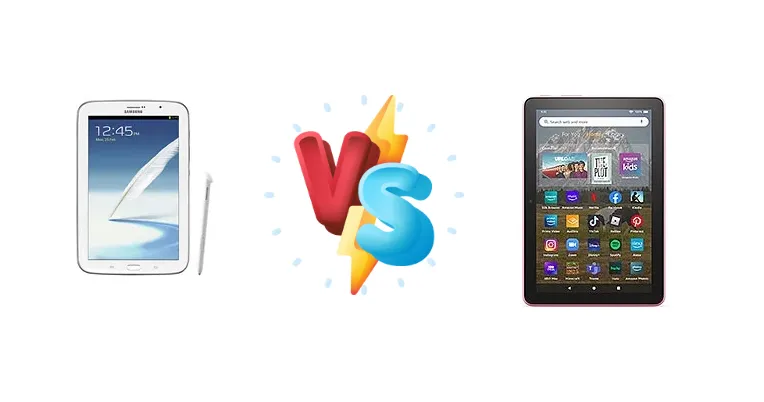
The Samsung Galaxy Note 8.0, released in 2013, represents a bygone era of premium compact tablets. Now, we compare it to the 2022 Amazon Fire HD 8, a device focused on affordability and media consumption. This isn't a head-to-head battle of flagship specs, but a look at how a legacy device stacks up against a modern, budget-oriented offering.
🏆 Quick Verdict
For the average user in 2024, the Amazon Fire HD 8 (2022) is the better choice. While the Note 8.0 offered stylus support and a more refined Android experience in its time, the Fire HD 8’s significantly more powerful hexa-core processor and faster charging provide a smoother, more responsive experience for everyday tasks and media playback.
| Network |
|---|
| 2G bands | GSM 850 / 900 / 1800 / 1900 - N5100, N5120 | N/A |
| 3G bands | HSDPA 850 / 900 / 1900 / 2100 - N5100 | - |
| 4G bands | 3, 7, 8, 20 - N5120 | - |
| EDGE | - | N/A |
| GPRS | - | N/A |
| Speed | HSPA 42.2(LTE)/21.1(3G)/5.76 Mbps, LTE Cat3 100/50 Mbps | - |
| Technology | GSM / HSPA / LTE | No cellular connectivity |
| Launch |
|---|
| Announced | 2013, February. Released 2013, April | 2022, September 21 |
| Status | Discontinued | Available. Released 2022, September 21 |
| Body |
|---|
| Dimensions | 210.8 x 135.9 x 8 mm (8.30 x 5.35 x 0.31 in) | 201.9 x 137.4 x 9.6 mm (7.95 x 5.41 x 0.38 in) |
| SIM | Micro-SIM | No |
| Weight | 338 g (3G) / 340 g (LTE) (11.99 oz) | 337 g (11.89 oz) |
| Display |
|---|
| Resolution | 800 x 1280 pixels, 16:10 ratio (~189 ppi density) | 800 x 1280 pixels, 16:10 ratio (~189 ppi density) |
| Size | 8.0 inches, 185.6 cm2 (~64.8% screen-to-body ratio) | 8.0 inches, 185.6 cm2 (~66.9% screen-to-body ratio) |
| Type | TFT | IPS LCD |
| Platform |
|---|
| CPU | Quad-core 1.6 GHz Cortex-A9 | Hexa-core (6x2.0 GHz Cortex-A55) |
| Chipset | Exynos 4412 Quad (32 nm) | Mediatek MT8169A |
| GPU | Mali-400MP4 | Mali-G52 2EE MC2 |
| OS | Android 4.1.2 (Jelly Bean), upgradable to 4.4 (KitKat) | Android 11, Fire OS 8 |
| Memory |
|---|
| Card slot | microSDXC (dedicated slot) | microSDXC (dedicated slot) |
| Internal | 16GB 2GB RAM, 32GB 2GB RAM | 32GB 2GB RAM, 64GB 2GB RAM |
| | - | eMMC 5.1 |
| Main Camera |
|---|
| Single | 5 MP, AF | 5 MP |
| Video | 720p@30fps | 1080p |
| Selfie camera |
|---|
| Single | 1.3 MP | 2 MP |
| Video | - | 720p |
| Sound |
|---|
| 3.5mm jack | - | Yes |
| 35mm jack | Yes | Yes |
| Loudspeaker | Yes, with stereo speakers | Yes, with stereo speakers |
| Comms |
|---|
| Bluetooth | 4.0, A2DP | 5.2, A2DP, LE |
| Infrared port | Yes | - |
| NFC | No | No |
| Positioning | GPS, GLONASS | No |
| Radio | No | No |
| USB | microUSB 2.0 (MHL TV-out), OTG | USB Type-C 2.0 |
| WLAN | Wi-Fi 802.11 a/b/g/n, dual-band, Wi-Fi Direct, hotspot, DLNA | Wi-Fi 802.11 a/b/g/n/ac, dual-band |
| Features |
|---|
| Sensors | Accelerometer, gyro, proximity, compass | Accelerometer |
| | - | Alexa natural language commands
Text-to-Speech English-language content reader |
| Battery |
|---|
| Charging | - | 15W wired |
| Music play | Up to 120 h | - |
| Stand-by | Up to 710 h (2G) / Up to 480 h (3G) | - |
| Talk time | Up to 28 h (2G) / Up to 24 h (3G) | Up to 13 h |
| Type | Li-Ion 4600 mAh, non-removable | - |
| Misc |
|---|
| Colors | Black, White/Silver, brown | Black, Denim, Rose |
| Models | GT-N5100, GT-N5120 | KFRAWI |
| Price | About 320 EUR | About 110 EUR |
| SAR EU | 0.74 W/kg (head) 0.76 W/kg (body) | - |
Samsung Galaxy Note 8.0
- Integrated S Pen stylus support
- Compact and portable form factor
- More refined Android experience (at launch)
- Outdated processor and architecture
- Likely degraded battery health
- Limited software support and security updates
- Unknown display specifications
Amazon Fire HD 8 (2022)
- More powerful hexa-core processor
- Faster charging (15W)
- Access to Amazon’s ecosystem
- Modern software and security updates
- Fire OS is heavily customized and ad-supported
- Lower camera quality compared to modern smartphones
- Limited app availability outside of the Amazon Appstore
Display Comparison
The Samsung Galaxy Note 8.0’s display specifications are unavailable, but being a 2013 device, it likely features a TFT LCD panel. The Amazon Fire HD 8 (2022) utilizes an IPS LCD. While both are LCD technologies, the Fire HD 8 benefits from a more recent manufacturing process, potentially offering improved color accuracy and viewing angles. The Note 8.0’s smaller 8-inch form factor may offer a slightly higher pixel density, but the Fire HD 8’s display is likely brighter, making it more usable outdoors. The Note 8.0’s age means it lacks modern features like adaptive refresh rates.
Camera Comparison
Neither tablet was ever known for its camera prowess. The Note 8.0’s camera specifications are unavailable, but it’s unlikely to compete with even the basic cameras found in modern budget tablets. The Fire HD 8 (2022) features a 5MP rear camera and a 2MP front camera. While these sensors are modest, they are likely superior to the Note 8.0’s aging optics. Image processing capabilities have also improved significantly in the intervening years, meaning the Fire HD 8 will produce more usable photos in good lighting conditions. The 2MP front camera on the Fire HD 8 is adequate for video calls.
Performance
This is where the Fire HD 8 (2022) truly shines. Its Mediatek MT8169A chipset, featuring a hexa-core (6x2.0 GHz Cortex-A55) CPU, represents a significant leap in processing power compared to the Note 8.0’s quad-core 1.6 GHz Cortex-A9 and Exynos 4412 Quad (32 nm) chipset. The Cortex-A55 cores are far more efficient and offer better performance per watt. The Note 8.0’s older architecture will struggle with modern multitasking and demanding applications. The Fire HD 8’s processor will provide a noticeably smoother experience for web browsing, video streaming, and light gaming. The 32nm process node of the Exynos 4412 also means it will generate more heat under load.
Battery Life
Battery capacity for the Note 8.0 is unavailable. The Amazon Fire HD 8 (2022) has a battery capacity of 4000 mAh and supports 15W wired charging. While the Note 8.0 may have a comparable battery size, its older, less efficient processor will likely result in shorter battery life. The Fire HD 8’s 15W charging allows for a relatively quick recharge, minimizing downtime. The Note 8.0’s charging speed will be significantly slower, and its battery health may have degraded over time.
Buying Guide
Buy the Samsung Galaxy Note 8.0 if you absolutely require stylus input on a small form factor and can tolerate older hardware and software. Its S Pen integration remains a unique selling point, albeit one hampered by age. Buy the Amazon Fire HD 8 (2022) if you prioritize value, a modern processor for smooth streaming and browsing, and access to Amazon’s ecosystem of content and services. It’s the practical choice for most users.
Frequently Asked Questions
❓ Does the Exynos 4412 chip in the Note 8.0 overheat during prolonged use?
Given its age and the 32nm manufacturing process, the Exynos 4412 is prone to thermal throttling under sustained load. While it won't likely reach dangerous temperatures, performance will decrease as the chip heats up, making it unsuitable for extended gaming sessions or demanding tasks.
❓ Is Fire OS on the Amazon Fire HD 8 (2022) difficult to use for someone accustomed to standard Android?
Fire OS is a heavily customized version of Android. While it shares a similar foundation, the user interface is significantly different and emphasizes Amazon’s services. Users may find the lack of Google Play Store and the presence of Amazon’s appstore restrictive, but sideloading is possible for experienced users.
❓ Can the Samsung Galaxy Note 8.0 still be used for note-taking with the S Pen?
Yes, the S Pen functionality remains the Note 8.0’s primary advantage. However, the software support for the S Pen is outdated, and the experience won’t be as refined as on newer Samsung devices. Expect limited app compatibility and potential lag.
❓ What kind of gaming performance can I expect from the Amazon Fire HD 8 (2022)?
The Mediatek MT8169A can handle casual games and older titles reasonably well. However, demanding 3D games will require lower graphics settings and may still experience occasional frame drops. It’s suitable for light gaming, but not a dedicated gaming device.