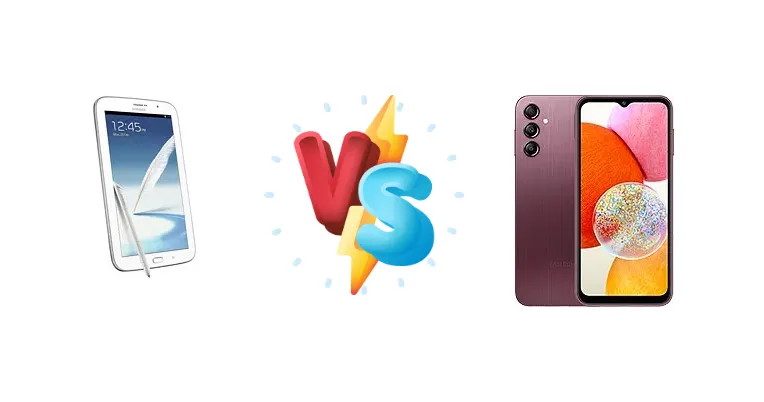
The Samsung Galaxy Note 8.0 Wi-Fi, a tablet released in 2013, offered a unique blend of productivity and portability. Now, let's pit it against the more modern Samsung Galaxy A14, a smartphone designed for everyday use. Can the older tablet still compete with a contemporary phone?
🏆 Quick Verdict
The Galaxy A14 is the clear winner. While the Note 8.0 boasts a larger screen, the A14's significantly more powerful processor, modern camera, and longer software support make it the superior choice for most users. The Note 8.0's legacy is undeniable, but it's showing its age.
| Network |
|---|
| 2G bands | N/A | GSM 850 / 900 / 1800 / 1900 |
| 3G bands | - | HSDPA 850 / 900 / 2100 |
| 4G bands | - | 1, 3, 5, 7, 8, 20, 28, 38, 40, 41 |
| EDGE | No | - |
| GPRS | No | - |
| Speed | - | HSPA, LTE |
| Technology | No cellular connectivity | GSM / HSPA / LTE |
| Launch |
|---|
| Announced | 2013, February. Released 2013, April | 2023, February 28 |
| Status | Discontinued | Available. Released 2023, March 27 |
| Body |
|---|
| Build | - | Glass front, plastic back, plastic frame |
| Dimensions | 210.8 x 135.9 x 8 mm (8.30 x 5.35 x 0.31 in) | 167.7 x 78 x 9.1 mm (6.60 x 3.07 x 0.36 in) |
| SIM | No | · Nano-SIM· Nano-SIM + Nano-SIM |
| Weight | 338 g (11.92 oz) | 201 g (7.09 oz) |
| Display |
|---|
| Resolution | 800 x 1280 pixels, 16:10 ratio (~189 ppi density) | 1080 x 2408 pixels, 20:9 ratio (~400 ppi density) |
| Size | 8.0 inches, 185.6 cm2 (~64.8% screen-to-body ratio) | 6.6 inches, 104.9 cm2 (~80.2% screen-to-body ratio) |
| Type | TFT | PLS LCD |
| Platform |
|---|
| CPU | Quad-core 1.6 GHz Cortex-A9 | Octa-core (2x2.0 GHz Cortex-A75 & 6x1.8 GHz Cortex-A55) - Version AOcta-core (4x2.0 GHz Cortex-A55 & 4x2.0 GHz Cortex-A55) - Version B |
| Chipset | Exynos 4412 Quad (32 nm) | Mediatek MT6769 Helio G80 (12 nm) - Version AExynos 850 (8 nm) - Version B |
| GPU | Mali-400MP4 | Mali-G52 MC2 |
| OS | Android 4.1.2 (Jelly Bean), upgradable to 4.4 (KitKat) | Android 13, upgradable to Android 15, One UI 7 |
| Memory |
|---|
| Card slot | microSDXC (dedicated slot) | microSDXC (dedicated slot) |
| Internal | 16GB 2GB RAM, 32GB 2GB RAM | 64GB 4GB RAM, 128GB 4GB RAM, 128GB 6GB RAM |
| Main Camera |
|---|
| Features | - | LED flash, panorama, HDR |
| Single | 5 MP, AF | 13 MP, f/2.0, (wide) |
| Triple | - | 50 MP, f/1.8, 26mm (wide), 1/2.75", 0.64µm, PDAF
5 MP, f/2.2, 17mm (ultrawide), 1/5.0", 1.12µm
2 MP (macro) |
| Video | 720p@30fps | 1080p@30fps |
| Selfie camera |
|---|
| Single | 1.3 MP | 13 MP, f/2.0, 26mm (wide), 1/3.1", 1.12µm |
| Video | - | 1080p@30fps |
| Sound |
|---|
| 3.5mm jack | Yes | Yes |
| 35mm jack | Yes | Yes |
| Loudspeaker | Yes, with stereo speakers | Yes |
| Comms |
|---|
| Bluetooth | 4.0, A2DP | 5.1 or 5.3, A2DP, LE |
| Infrared port | Yes | - |
| NFC | No | Yes (market/region dependent) |
| Positioning | GPS, GLONASS | GPS, GALILEO, GLONASS, BDS, QZSS |
| Radio | No | Unspecified |
| USB | microUSB 2.0 (MHL TV-out), OTG | USB Type-C 2.0 |
| WLAN | Wi-Fi 802.11 a/b/g/n, dual-band, Wi-Fi Direct, DLNA | Wi-Fi 802.11 a/b/g/n/ac, dual-band, Wi-Fi Direct |
| Features |
|---|
| Sensors | Accelerometer, gyro, proximity, compass | Fingerprint (side-mounted), accelerometer, proximity, compass |
| Battery |
|---|
| Charging | - | 15W wired |
| Music play | Up to 120 h | - |
| Talk time | Up to 8 h (multimedia) | - |
| Type | Li-Ion 4600 mAh, non-removable | Li-Po 5000 mAh |
| Misc |
|---|
| Colors | Black, White/Silver, brown | Black, Dark Red, Silver, Green |
| Models | GT-N5110 | SM-A145F, SM-A145F/DSN, SM-A145M, SM-A145M/DS, SM-A145P, SM-A145R |
| Price | About 280 EUR | € 85.76 / $ 147.60 / £ 79.95 |
| SAR | 0.98 W/kg (body) | - |
| SAR EU | 0.34 W/kg (body) | 0.46 W/kg (head) 1.37 W/kg (body) |
| Tests |
|---|
| Audio quality |
Noise -85.2dB / Crosstalk -83.3dB | - |
| Camera |
Photo / Video | - |
| Loudspeaker |
Voice 66dB / Noise 64dB / Ring 74dB | - |
Samsung Galaxy Note 8.0 Wi-Fi
- Larger screen
- S-Pen support
- Compact tablet form factor (for a tablet)
- Outdated processor
- Low resolution display
- Poor camera
- Limited software support
- Short battery life
Samsung Galaxy A14
- Modern processor
- Vibrant Super AMOLED display
- Good camera
- Longer software support
- Decent battery life
- More modern features
- Smaller screen than Note 8.0
- Charging speed could be faster
Display Comparison
The Note 8.0 features an 8.0-inch LCD display, offering a larger canvas for reading, browsing, and media. The A14 typically has a 6.6-inch Super AMOLED display, providing vibrant colors and deeper blacks. While the Note 8.0 wins on size, the A14's display technology is superior.
Camera Comparison
The A14's camera system is vastly superior. While the Note 8.0's camera was adequate for its time, the A14 offers higher resolution sensors, improved image processing, and more advanced features like night mode. Expect noticeably better photo and video quality from the A14.
Performance
The A14's Mediatek Helio G80 (or Exynos 850) chipset and Octa-core CPU significantly outperform the Note 8.0's Quad-core Cortex-A9 processor and Exynos 4412. Expect smoother multitasking, faster app loading, and better gaming performance on the A14.
Battery Life
The A14 generally has a larger battery capacity and more efficient processor, resulting in longer battery life than the Note 8.0. While the Note 8.0's battery life was decent for its time, it struggles to keep up with modern usage patterns.
Buying Guide
Who should buy the Samsung Galaxy Note 8.0 Wi-Fi? Primarily those seeking a very large screen for media consumption on a tight budget, or those who specifically need a tablet with S-Pen functionality and don't mind the limitations of an older device. Who should buy the Samsung Galaxy A14? Anyone looking for a reliable, modern smartphone with a good camera, decent performance, and a longer lifespan of software updates.
Frequently Asked Questions
❓ Is the Note 8.0 still usable in 2024?
Yes, but with significant limitations. It can handle basic tasks like browsing and media consumption, but performance will be sluggish compared to modern devices. Software updates are no longer available.
❓ Which device is better for gaming?
The Samsung Galaxy A14 is significantly better for gaming due to its more powerful processor and graphics capabilities.