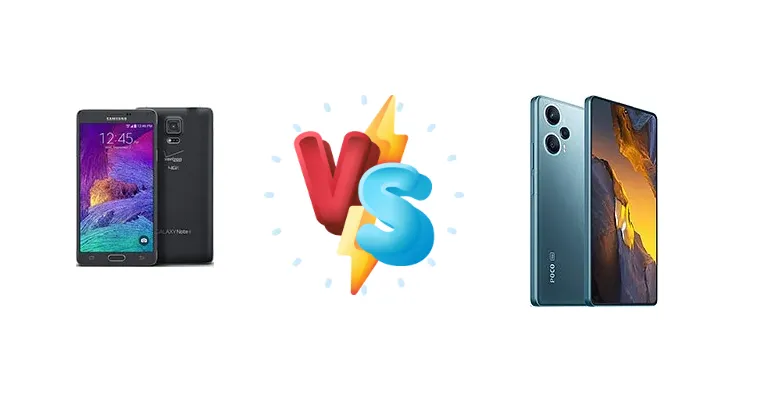
The Samsung Galaxy Note 4 was a flagship titan in its time, boasting a stylus and premium features. Now, the Xiaomi Poco F5 arrives with modern specs and aggressive pricing. Can the Poco F5 dethrone a legend, or does the Note 4's legacy still hold weight?
🏆 Quick Verdict
The Xiaomi Poco F5 is the clear winner. While the Note 4 holds nostalgic appeal, the Poco F5's superior performance, faster charging, brighter display, and modern chipset make it a significantly better value for today's user. It's a modern marvel versus a capable, but dated, flagship.
| Network |
|---|
| 2G bands | CDMA 800 / 1900 | GSM 850 / 900 / 1800 / 1900 |
| 3G bands | CDMA2000 1xEV-DO | HSDPA 850 / 900 / 1700(AWS) / 1900 / 2100 |
| 4G bands | 2, 4, 5, 12, 17 | 1, 2, 3, 4, 5, 7, 8, 20, 28, 38, 40, 41, 66 |
| 5G bands | - | 1, 3, 5, 7, 8, 20, 28, 38, 40, 41, 77, 78 SA/NSA |
| Speed | HSPA, LTE Cat4 150/50 Mbps, EV-DO Rev.A 3.1 Mbps | HSPA, LTE, 5G |
| Technology | GSM / CDMA / HSPA / EVDO / LTE | GSM / HSPA / LTE / 5G |
| | HSDPA 850 / 900 / 1900 / 2100 | - |
| Launch |
|---|
| Announced | 2014, Q4. Released 2014, Q4 | 2023, May 09 |
| Status | Discontinued | Available. Released 2023, May |
| Body |
|---|
| Build | - | Glass front (Gorilla Glass 5), plastic back, plastic frame |
| Dimensions | 153.5 x 78.6 x 8.5 mm (6.04 x 3.09 x 0.33 in) | 161.1 x 75 x 7.9 mm (6.34 x 2.95 x 0.31 in) |
| SIM | Micro-SIM | Nano-SIM + Nano-SIM |
| Weight | 176 g (6.21 oz) | 181 g (6.38 oz) |
| | Stylus | IP53, dust and splash resistant |
| Display |
|---|
| Protection | Corning Gorilla Glass 4 | Corning Gorilla Glass 5 |
| Resolution | 1440 x 2560 pixels, 16:9 ratio (~518 ppi density) | 1080 x 2400 pixels, 20:9 ratio (~395 ppi density) |
| Size | 5.7 inches, 88.5 cm2 (~73.4% screen-to-body ratio) | 6.67 inches, 107.4 cm2 (~88.9% screen-to-body ratio) |
| Type | Super AMOLED | AMOLED, 68B colors, Dolby Vision, HDR10+, 120Hz, 500 nits (typ), 1000 nits (peak) |
| Platform |
|---|
| CPU | Quad-core 2.7 GHz Krait 450 | Octa-core (1x2.91 GHz Cortex-X2 & 3x2.49 GHz Cortex-A710 & 4x1.8 GHz Cortex-A510) |
| Chipset | Qualcomm APQ8084 Snapdragon 805 (28 nm) | Qualcomm SM7475-AB Snapdragon 7+ Gen 2 (4 nm) |
| GPU | Adreno 420 | Adreno 725 |
| OS | Android 4.4.4 (KitKat), upgradable to 6.0.1 (Marshmallow) | Android 13, upgradable to Android 15, HyperOS |
| Memory |
|---|
| Card slot | microSDXC (dedicated slot) | No |
| Internal | 32GB 3GB RAM | 256GB 8GB RAM, 256GB 12GB RAM |
| | eMMC 5.0 | UFS 3.1 |
| Main Camera |
|---|
| Features | LED flash, panorama, HDR | LED flash, HDR, panorama |
| Single | 16 MP, f/2.2, 31mm (standard), 1/2.6", 1.12µm, AF, OIS | - |
| Triple | - | 64 MP, f/1.8, (wide), 1/2.0", 0.7µm, PDAF, OIS
8 MP, f/2.2, 120˚ (ultrawide), 1/4.0", 1.12µm
2 MP (macro) |
| Video | 4K@30fps, 1080p@30/60fps, stereo sound rec. | 4K@30fps, 1080p@30/60/120fps, gyro-EIS |
| Selfie camera |
|---|
| Features | HDR | - |
| Single | 3.7 MP, f/1.9, 22mm (wide) | 16 MP, f/2.5, (wide) |
| Video | 1440p@30fps | 1080p@30/60fps |
| Sound |
|---|
| 3.5mm jack | Yes | Yes |
| 35mm jack | Yes | Yes |
| Loudspeaker | Yes | Yes, with stereo speakers |
| | 24-bit/192kHz audio
| 24-bit/192kHz audio |
| Comms |
|---|
| Bluetooth | 4.1, A2DP, EDR, LE | 5.3, A2DP, LE |
| Infrared port | Yes | Yes |
| NFC | Yes | Yes (market/region dependent) |
| Positioning | GPS, GLONASS | GPS (L1), GLONASS (G1), BDS (B1I), GALILEO (E1), QZSS (L1) |
| Radio | No | No |
| USB | microUSB 2.0 (MHL 3 TV-out), OTG | USB Type-C 2.0, OTG |
| WLAN | Wi-Fi 802.11 a/b/g/n/ac, dual-band, Wi-Fi Direct, hotspot | Wi-Fi 802.11 a/b/g/n/ac/6, dual-band |
| Features |
|---|
| Sensors | Fingerprint (front-mounted), accelerometer, gyro, proximity, compass, barometer, gesture, UV, heart rate, SpO2 | Fingerprint (side-mounted), accelerometer, gyro, proximity, compass |
| | ANT+
S-Voice natural language commands and dictation
Air gestures | - |
| Battery |
|---|
| Charging | 15W wired, QC2 | 67W wired, PD3.0, QC4, 100% in 46 min |
| Music play | Up to 80 h | - |
| Stand-by | Up to 212 h (3G) | - |
| Talk time | Up to 31 h 20 min (3G) | - |
| Type | Li-Ion 3220 mAh, removable | Li-Po 5000 mAh |
| Misc |
|---|
| Colors | Frosted white, Charcoal black, Bronze Gold, Blossom Pink | Black, Blue, White |
| Models | SM-N910A, SM-N910T, SM-N910V, SM-N910M, SM-N910P, SM-N910R4, SM-N910W8, SM-N910T3 | 23049PCD8G, 23049PCD8I |
| Price | About 250 EUR | € 202.76 / $ 289.99 / ₹ 23,790 |
| SAR | 0.88 W/kg (head) 1.40 W/kg (body) | 1.09 W/kg (head) 1.08 W/kg (body) |
| SAR EU | - | 0.99 W/kg (head) 1.00 W/kg (body) |
| Tests |
|---|
| Battery life | - |
Endurance rating 118h
|
| Camera | - |
Photo / Video |
| Display | - |
Contrast ratio: Infinite (nominal) |
| Loudspeaker | - |
-24.3 LUFS (Very good)
|
Samsung Galaxy Note 4 (USA)
- Classic Design
- S Pen Stylus
- Nostalgic Android Experience
- Durable Build Quality
- Outdated Processor
- Slow Charging
- Lower Display Brightness
- Limited Software Updates
- Lower Camera Quality
Xiaomi Poco F5
- Excellent Performance
- Bright & Vibrant Display
- Fast Charging (67W)
- Long Battery Life
- Competitive Price
- Modern Chipset
- MIUI Software (can be polarizing)
- Plastic Build (less premium feel)
- Camera not flagship level
Display Comparison
The Poco F5 boasts a significantly brighter display (963 nits vs. Note 4's estimated 300-400 nits) and an 'infinite' contrast ratio, offering richer colors and deeper blacks. The Note 4's display was excellent for its time, but the Poco F5's AMOLED panel is a noticeable upgrade in visual quality.
Camera Comparison
While both phones offer Photo/Video capabilities, the Poco F5's modern image processing and sensor technology provide superior image quality, especially in low light. The Note 4's camera was good for its era, but struggles compared to modern smartphone cameras.
Performance
The Poco F5's Snapdragon 7+ Gen 2 is a powerhouse, easily outperforming the Note 4's Snapdragon 805. Expect smoother multitasking, faster app loading, and significantly better gaming performance on the Poco F5. The Poco F5's CPU architecture is also more efficient.
Battery Life
The Poco F5 demonstrates exceptional battery life with an endurance rating of 118h and active use lasting 11:52h. The Note 4's battery life was respectable for its time, but falls short of the Poco F5's longevity. The Poco F5's 67W charging is also a game-changer, fully charging in just 46 minutes, compared to the Note 4's 15W charging.
Buying Guide
Who should buy the Samsung Galaxy Note 4 (USA)? Primarily enthusiasts seeking a retro Android experience or those specifically needing the S Pen functionality and are comfortable with older hardware. Who should buy the Xiaomi Poco F5? Anyone looking for a high-performing, feature-rich smartphone at an incredibly competitive price point. It's ideal for gamers, content creators, and everyday users.
Frequently Asked Questions
❓ Is the Samsung Galaxy Note 4 still worth buying?
Only if you specifically need the S Pen or are seeking a retro Android experience. Otherwise, newer phones offer significantly better value.
❓ What is the biggest advantage of the Xiaomi Poco F5?
Its exceptional performance and value for money. You get a lot of power and features for a surprisingly affordable price.
❓ How does the Poco F5's charging speed compare to the Note 4?
The Poco F5 charges incredibly fast with 67W charging, fully charging in around 46 minutes. The Note 4's 15W charging is significantly slower.