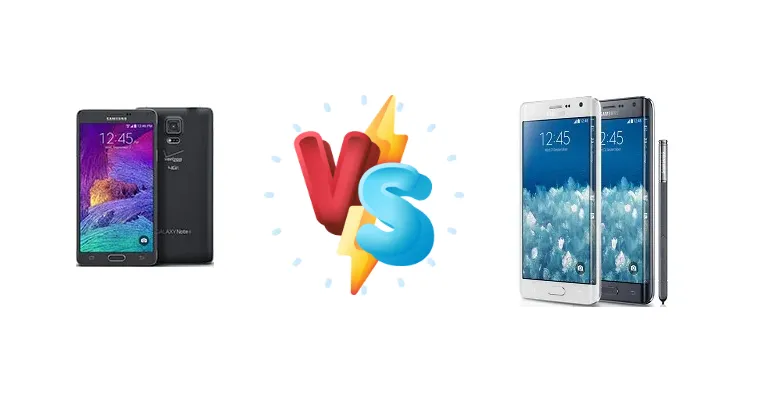
The Samsung Galaxy Note 4 and Note Edge were groundbreaking devices, pushing the boundaries of smartphone innovation. Both packed powerful specs for their time, but the Note Edge’s unique curved display set it apart. Let's dive into a comprehensive comparison to see which phone holds up best today.
🏆 Quick Verdict
The Note Edge's innovative curved display is its biggest draw, but the Note 4 generally offers a more refined and practical experience. While both are aging, the Note 4's slightly better overall balance of features and usability gives it a slight edge for most users.
| Network |
|---|
| 2G bands | CDMA 800 / 1900 | GSM 850 / 900 / 1800 / 1900 |
| 3G bands | CDMA2000 1xEV-DO | HSDPA 850 / 900 / 1900 / 2100 |
| 4G bands | 2, 4, 5, 12, 17 | 1, 2, 3, 4, 5, 7, 8, 28 - SM-N915G |
| Speed | HSPA, LTE Cat4 150/50 Mbps, EV-DO Rev.A 3.1 Mbps | HSPA 42.2/5.76 Mbps, LTE (3CA) Cat6 300/50 Mbps or Cat4 150/50 Mbps |
| Technology | GSM / CDMA / HSPA / EVDO / LTE | GSM / HSPA / LTE |
| | HSDPA 850 / 900 / 1900 / 2100 | - |
| Launch |
|---|
| Announced | 2014, Q4. Released 2014, Q4 | 2014, September. Released 2014, November |
| Status | Discontinued | Discontinued |
| Body |
|---|
| Build | - | Glass front (Gorilla Glass 3), plastic back, aluminum frame |
| Dimensions | 153.5 x 78.6 x 8.5 mm (6.04 x 3.09 x 0.33 in) | 151.3 x 82.4 x 8.3 mm (5.96 x 3.24 x 0.33 in) |
| SIM | Micro-SIM | Micro-SIM |
| Weight | 176 g (6.21 oz) | 174 g (6.14 oz) |
| | Stylus | - |
| Display |
|---|
| Protection | Corning Gorilla Glass 4 | Corning Gorilla Glass 3 |
| Resolution | 1440 x 2560 pixels, 16:9 ratio (~518 ppi density) | 1600 x 2560 pixels, 16:10 ratio (~524 ppi density) |
| Size | 5.7 inches, 88.5 cm2 (~73.4% screen-to-body ratio) | 5.6 inches, 96.2 cm2 (~77.2% screen-to-body ratio) |
| Type | Super AMOLED | Super AMOLED |
| Platform |
|---|
| CPU | Quad-core 2.7 GHz Krait 450 | Quad-core 2.7 GHz Krait 450 |
| Chipset | Qualcomm APQ8084 Snapdragon 805 (28 nm) | Qualcomm APQ8084 Snapdragon 805 (28 nm) |
| GPU | Adreno 420 | Adreno 420 |
| OS | Android 4.4.4 (KitKat), upgradable to 6.0.1 (Marshmallow) | Android 4.4.4 (KitKat), upgradable to 6.0 (Marshmallow) |
| Memory |
|---|
| Card slot | microSDXC (dedicated slot) | microSDXC (dedicated slot) |
| Internal | 32GB 3GB RAM | 32GB 3GB RAM, 64GB 3GB RAM |
| | eMMC 5.0 | - |
| Main Camera |
|---|
| Features | LED flash, panorama, HDR | LED flash, panorama, HDR |
| Single | 16 MP, f/2.2, 31mm (standard), 1/2.6", 1.12µm, AF, OIS | 16 MP, f/2.2, 31mm (standard), 1/2.6", 1.12µm, AF, OIS |
| Video | 4K@30fps, 1080p@30/60fps, stereo sound rec. | 4K@30fps, 1080p@30/60fps, stereo sound rec. |
| Selfie camera |
|---|
| Features | HDR | - |
| Single | 3.7 MP, f/1.9, 22mm (wide) | 3.7 MP, f/1.9 |
| Video | 1440p@30fps | 1440p@30fps |
| Sound |
|---|
| 3.5mm jack | Yes | Yes |
| 35mm jack | Yes | Yes |
| Loudspeaker | Yes | Yes |
| | 24-bit/192kHz audio
| - |
| Comms |
|---|
| Bluetooth | 4.1, A2DP, EDR, LE | 4.1, A2DP, EDR, LE |
| Infrared port | Yes | Yes |
| NFC | Yes | Yes |
| Positioning | GPS, GLONASS | GPS, GLONASS, BDS |
| Radio | No | No |
| USB | microUSB 2.0 (MHL 3 TV-out), OTG | microUSB 2.0 (MHL 3 TV-out), OTG |
| WLAN | Wi-Fi 802.11 a/b/g/n/ac, dual-band, Wi-Fi Direct, hotspot | Wi-Fi 802.11 a/b/g/n/ac, dual-band, Wi-Fi Direct, hotspot |
| Features |
|---|
| Sensors | Fingerprint (front-mounted), accelerometer, gyro, proximity, compass, barometer, gesture, UV, heart rate, SpO2 | Fingerprint (front-mounted), accelerometer, gyro, proximity, compass, barometer, UV, heart rate, SpO2 |
| | ANT+
S-Voice natural language commands and dictation
Air gestures | - |
| Battery |
|---|
| Charging | 15W wired, QC2 | 15W wired, QC2 |
| Music play | Up to 80 h | Up to 67 h |
| Stand-by | Up to 212 h (3G) | - |
| Talk time | Up to 31 h 20 min (3G) | Up to 18 h (3G) |
| Type | Li-Ion 3220 mAh, removable | Li-Ion 3000 mAh, removable |
| Misc |
|---|
| Colors | Frosted white, Charcoal black, Bronze Gold, Blossom Pink | Black, White |
| Models | SM-N910A, SM-N910T, SM-N910V, SM-N910M, SM-N910P, SM-N910R4, SM-N910W8, SM-N910T3 | SM-N9150, SM-N915A, SM-N915D, SM-N915F, SM-N915FY, SM-N915G, SM-N915K, SM-N915L, SM-N915P, SM-N915R4, SM-N915S, SM-N915T, SM-N915V, SM-N915W8, SM-N915X, SC-01G |
| Price | About 250 EUR | About 300 EUR |
| SAR | 0.88 W/kg (head) 1.40 W/kg (body) | - |
| SAR EU | - | 0.24 W/kg (head) 0.33 W/kg (body) |
| Tests |
|---|
| Audio quality | - |
Noise -95.9dB / Crosstalk -93.3dB |
| Battery life | - |
Endurance rating 68h
|
| Camera | - |
Photo / Video |
| Display | - |
Contrast ratio: Infinite (nominal), 3.799 (sunlight) |
| Loudspeaker | - |
Voice 72dB / Noise 75dB / Ring 70dB
|
| Performance | - |
Basemark OS II 2.0: 1255Basemark X: 17108 |
Samsung Galaxy Note 4 (USA)
- Larger, more practical display
- Slightly better camera software
- More conventional design
- Generally more reliable software support (historically)
- Aging hardware
- Design feels dated compared to modern phones
- Battery life may be degraded with age
Samsung Galaxy Note Edge
- Unique curved display
- Eye-catching design
- Potentially better battery optimization (reported)
- Curved display can be impractical
- Smaller main display area
- Software quirks related to the curved screen
- Aging hardware
Display Comparison
The Note Edge's defining feature is its curved edge display, offering quick access to notifications and apps. The Note 4 boasts a larger, more traditional 5.7-inch Quad HD display, known for its vibrant colors and sharp detail. While the Edge's curve is visually striking, the Note 4's screen is arguably more practical for everyday use and media consumption.
Camera Comparison
Both phones feature a 16MP main camera and a 3.7MP front-facing camera. Image quality is decent in good lighting conditions, but low-light performance is noticeably lacking. The Note 4's camera software offered slightly more features and processing capabilities, potentially resulting in marginally better photos.
Performance
Both devices share the same Qualcomm Snapdragon 805 chipset and 2.7 GHz Krait 450 CPU, ensuring comparable performance. Expect smooth multitasking and responsive app loading, though modern devices will naturally outperform them. Gaming performance is adequate for titles of their era, but demanding games may struggle.
Battery Life
The Note Edge is reported to have an endurance rating of 68h, suggesting potentially better battery optimization. However, real-world usage will vary. The Note 4's battery capacity is 3200 mAh, which is comparable to the Note Edge. Battery life on both devices will be significantly impacted by age and usage patterns.
Buying Guide
Who should buy the Samsung Galaxy Note 4 (USA)? Users prioritizing a larger, more conventional display, reliable performance, and a slightly more robust software experience. Who should buy the Samsung Galaxy Note Edge? Those fascinated by the novelty of the curved display and willing to accept potential usability quirks for a unique aesthetic.
Frequently Asked Questions
❓ Are these phones still worth buying in 2024?
Both phones are quite old and have limitations compared to modern devices. However, they can be a fun retro experience or a budget option if you're aware of their age and limitations. Don't expect long-term software support.
❓ Which phone is more durable?
The Note 4 generally has a reputation for slightly better build quality and durability, although both are susceptible to damage from drops and wear and tear.