
Samsung Galaxy Note 4 vs Google Pixel 6 Pro: A Generational Leap?
| Phones Images | |||||
|---|---|---|---|---|---|
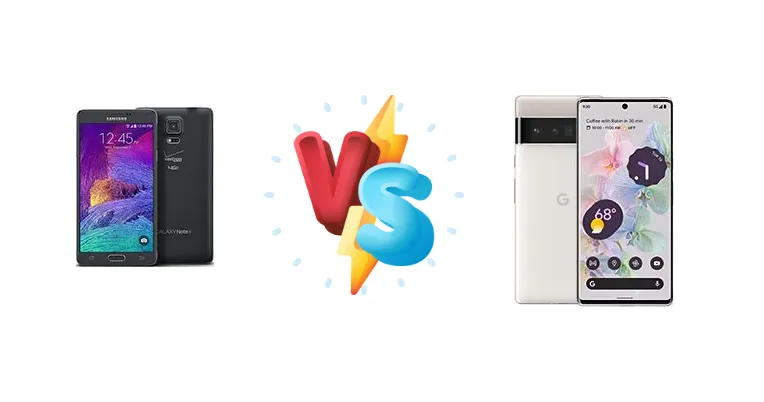
|
🏆 Quick Verdict
The Google Pixel 6 Pro overwhelmingly wins this comparison. While the Note 4 holds nostalgic value, the Pixel 6 Pro's superior performance, camera, display, and battery life make it the clear choice for modern users seeking a top-tier Android experience. The Note 4's S Pen is its main advantage.
| PHONES | ||
|---|---|---|
| Phone Names | Samsung Galaxy Note 4 (USA) | Google Pixel 6 Pro |
| Network | ||
|---|---|---|
| 2G bands | CDMA 800 / 1900 | GSM 850 / 900 / 1800 / 1900 |
| 3G bands | CDMA2000 1xEV-DO | HSDPA 800 / 850 / 900 / 1700(AWS) / 1900 / 2100 |
| 4G bands | 2, 4, 5, 12, 17 | 1, 2, 3, 4, 5, 7, 8, 12, 13, 14, 17, 18, 19, 20, 25, 26, 28, 29, 30, 32, 38, 39, 40, 41, 42, 46, 48, 66, 71 - GLUOG, G8VOU |
| 5G bands | - | 1, 2, 3, 5, 7, 8, 12, 14, 20, 25, 28, 30, 38, 40, 41, 48, 66, 71, 77, 78, 257, 258, 260, 261 SA/NSA/Sub6/mmWave - G8VOU |
| Speed | HSPA, LTE Cat4 150/50 Mbps, EV-DO Rev.A 3.1 Mbps | HSPA, LTE, 5G |
| Technology | GSM / CDMA / HSPA / EVDO / LTE | GSM / CDMA / HSPA / EVDO / LTE / 5G |
| HSDPA 850 / 900 / 1900 / 2100 | 1, 2, 3, 5, 7, 8, 12, 14, 20, 25, 28, 30, 38, 40, 41, 48, 66, 71, 77, 78 SA/NSA/Sub6 - GLUOG | |
| Launch | ||
|---|---|---|
| Announced | 2014, Q4. Released 2014, Q4 | 2021, October 19 |
| Status | Discontinued | Available. Released 2021, October 28 |
| Body | ||
|---|---|---|
| Build | - | Glass front (Gorilla Glass Victus), glass back (Gorilla Glass Victus), aluminum frame |
| Dimensions | 153.5 x 78.6 x 8.5 mm (6.04 x 3.09 x 0.33 in) | 163.9 x 75.9 x 8.9 mm (6.45 x 2.99 x 0.35 in) |
| SIM | Micro-SIM | Nano-SIM + eSIM |
| Weight | 176 g (6.21 oz) | 210 g (7.41 oz) |
| Stylus | IP68 dust/water resistant (up to 1.5m for 30 min) | |
| Display | ||
|---|---|---|
| Protection | Corning Gorilla Glass 4 | Corning Gorilla Glass Victus |
| Resolution | 1440 x 2560 pixels, 16:9 ratio (~518 ppi density) | 1440 x 3120 pixels, 19.5:9 ratio (~512 ppi density) |
| Size | 5.7 inches, 88.5 cm2 (~73.4% screen-to-body ratio) | 6.7 inches, 110.6 cm2 (~88.9% screen-to-body ratio) |
| Type | Super AMOLED | LTPO AMOLED, 120Hz, HDR10+ |
| - | Always-on display | |
| Platform | ||
|---|---|---|
| CPU | Quad-core 2.7 GHz Krait 450 | Octa-core (2x2.80 GHz Cortex-X1 & 2x2.25 GHz Cortex-A76 & 4x1.80 GHz Cortex-A55) |
| Chipset | Qualcomm APQ8084 Snapdragon 805 (28 nm) | Google Tensor (5 nm) |
| GPU | Adreno 420 | Mali-G78 MP20 |
| OS | Android 4.4.4 (KitKat), upgradable to 6.0.1 (Marshmallow) | Android 12, upgradable to Android 15, up to 5 major Android upgrades |
| Memory | ||
|---|---|---|
| Card slot | microSDXC (dedicated slot) | No |
| Internal | 32GB 3GB RAM | 128GB 12GB RAM, 256GB 12GB RAM, 512GB 12GB RAM |
| eMMC 5.0 | UFS 3.1 | |
| Main Camera | ||
|---|---|---|
| Features | LED flash, panorama, HDR | Laser AF, Dual-LED flash, Pixel Shift, Auto-HDR, panorama |
| Single | 16 MP, f/2.2, 31mm (standard), 1/2.6", 1.12µm, AF, OIS | 11.1 MP, f/2.2, 20mm (ultrawide), 1.22µm |
| Triple | - | 50 MP, f/1.9, 25mm (wide), 1/1.31", 1.2µm, dual pixel PDAF, OIS 48 MP, f/3.5, 104mm (periscope telephoto), 1/2.0", 0.8µm, PDAF, OIS, 4x optical zoom 12 MP, f/2.2, 17mm, 114˚ (ultrawide), 1.25µm |
| Video | 4K@30fps, 1080p@30/60fps, stereo sound rec. | 4K@30/60fps, 1080p@30/60/120/240fps; gyro-EIS, OIS |
| Selfie camera | ||
|---|---|---|
| Features | HDR | HDR, panorama |
| Single | 3.7 MP, f/1.9, 22mm (wide) | 11.1 MP, f/2.2, 20mm (ultrawide), 1.22µm |
| Video | 1440p@30fps | 4K@30fps, 1080p@30/60fps |
| Sound | ||
|---|---|---|
| 3.5mm jack | Yes | No |
| 35mm jack | Yes | No |
| Loudspeaker | Yes | Yes, with stereo speakers |
| 24-bit/192kHz audio | - | |
| Comms | ||
|---|---|---|
| Bluetooth | 4.1, A2DP, EDR, LE | 5.2, A2DP, LE, aptX HD |
| Infrared port | Yes | - |
| NFC | Yes | Yes |
| Positioning | GPS, GLONASS | GPS (L1+L5), GLONASS (G1), BDS (B1I+B1c+B2a), GALILEO (E1+E5a), QZSS (L1+L5) |
| Radio | No | No |
| USB | microUSB 2.0 (MHL 3 TV-out), OTG | USB Type-C 3.1 |
| WLAN | Wi-Fi 802.11 a/b/g/n/ac, dual-band, Wi-Fi Direct, hotspot | Wi-Fi 802.11 a/b/g/n/ac/6e, dual-band, Wi-Fi Direct |
| Features | ||
|---|---|---|
| Sensors | Fingerprint (front-mounted), accelerometer, gyro, proximity, compass, barometer, gesture, UV, heart rate, SpO2 | Fingerprint (under display, optical), accelerometer, gyro, proximity, compass, barometer |
| ANT+ S-Voice natural language commands and dictation Air gestures | Ultra Wideband (UWB) support | |
| Battery | ||
|---|---|---|
| Charging | 15W wired, QC2 | 23W wired, PD3.0, 50% in 30 min 23W wireless Reverse wireless |
| Music play | Up to 80 h | - |
| Stand-by | Up to 212 h (3G) | - |
| Talk time | Up to 31 h 20 min (3G) | - |
| Type | Li-Ion 3220 mAh, removable | Li-Ion 5003 mAh |
| Misc | ||
|---|---|---|
| Colors | Frosted white, Charcoal black, Bronze Gold, Blossom Pink | Cloudy White, Sorta Sunny, Stormy Black |
| Models | SM-N910A, SM-N910T, SM-N910V, SM-N910M, SM-N910P, SM-N910R4, SM-N910W8, SM-N910T3 | GLUOG, G8VOU, GF5KQ |
| Price | About 250 EUR | € 199.99 / $ 204.99 / £ 275.00 / ₹ 29,699 |
| SAR | 0.88 W/kg (head) 1.40 W/kg (body) | - |
| Tests | ||
|---|---|---|
| Battery life | - | Endurance rating 84h |
| Display | - | Contrast ratio: Infinite (nominal) |
| Performance | - | AnTuTu: 585485 (v8), 719815 (v9) GeekBench: 2831 (v5.1) GFXBench: 39 fps (ES 3.1 onscreen) |
Samsung Galaxy Note 4 (USA)
- S Pen functionality
- Compact size
- Durable build quality (for its age)
- Nostalgic Android experience
- Outdated processor
- Poor battery life
- Low resolution camera
- Slow charging
Google Pixel 6 Pro
- Exceptional camera
- Smooth performance
- Vibrant display
- Long battery life
- Fast charging
- Google Tensor chip
- Clean Android experience
- Large size
- Tensor chip can have occasional software quirks
- Charging speed not the fastest compared to competitors
Display Comparison
The Pixel 6 Pro's 6.7-inch LTPO OLED display with 846 nits brightness and infinite contrast ratio blows the Note 4's 5.7-inch Super AMOLED display out of the water. Colors are more vibrant, viewing angles are better, and outdoor visibility is significantly improved. The Pixel 6 Pro also supports a 120Hz refresh rate for smoother scrolling.
Camera Comparison
Google's computational photography prowess shines in the Pixel 6 Pro. Its triple-camera system delivers stunning image quality, especially in low light. The Note 4's camera was good for its time, but it simply can't compete with the Pixel 6 Pro's detail, dynamic range, and overall image processing.
Performance
The Google Tensor chip in the Pixel 6 Pro offers a massive performance advantage over the Snapdragon 805 in the Note 4. The Tensor's octa-core architecture and 5nm process provide significantly faster processing speeds and improved efficiency. Gaming and multitasking are noticeably smoother on the Pixel 6 Pro.
Battery Life
The Pixel 6 Pro boasts an impressive endurance rating of 84 hours, far exceeding what the Note 4 could achieve. The Pixel 6 Pro also supports faster charging (23W wired and wireless) and reverse wireless charging, adding to its convenience.
Buying Guide
Who should buy the Samsung Galaxy Note 4? Primarily those seeking a retro Android experience, a functional S Pen, or a budget-friendly device for basic tasks. Who should buy the Google Pixel 6 Pro? Anyone wanting a flagship Android phone with exceptional camera capabilities, smooth performance, and a vibrant display, and access to the latest Android features.