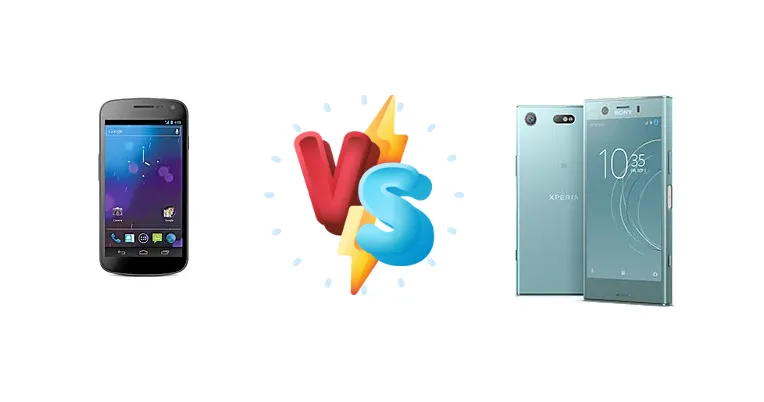
Reliving the golden age of Android, we pit the Samsung Galaxy Nexus I9250M, a pioneer of Ice Cream Sandwich, against the more modern Sony Xperia XZ1 Compact. This comparison explores how these devices stack up today, considering their age and capabilities.
🏆 Quick Verdict
The Xperia XZ1 Compact is the clear winner. While the Galaxy Nexus holds nostalgic value, the XZ1 Compact's Snapdragon 835 chipset, superior camera, and significantly better battery life make it a more practical and enjoyable device in 2024.
| Network |
|---|
| 2G bands | GSM 850 / 900 / 1800 / 1900 | GSM 850 / 900 / 1800 / 1900 |
| 3G bands | HSDPA 850 / 1700 / 1900 / 2100 | HSDPA 800 / 850 / 900 / 1700(AWS) / 1900 / 2100 |
| 4G bands | - | 1, 2, 3, 4, 5, 7, 8, 12, 13, 17, 19, 20, 25, 26, 28, 29, 32, 38, 39, 40, 41, 66 |
| Speed | HSPA 21.1/5.76 Mbps | HSPA 42.2/5.76 Mbps, LTE (4CA) Cat15 800/75 Mbps |
| Technology | GSM / HSPA | GSM / HSPA / LTE |
| Launch |
|---|
| Announced | 2012, January. Released 2012, January | 2017, August. Released 2017, October |
| Status | Discontinued | Discontinued |
| Body |
|---|
| Build | - | Glass front (Gorilla Glass 4), plastic back, plastic frame |
| Dimensions | 135.5 x 67.9 x 8.9 mm (5.33 x 2.67 x 0.35 in) | 129 x 65 x 9.3 mm (5.08 x 2.56 x 0.37 in) |
| SIM | Mini-SIM | Nano-SIM |
| Weight | 135 g (4.76 oz) | 140 g (4.94 oz) |
| | - | IP68 dust/water resistant (up to 1.5m for 30 mins) |
| Display |
|---|
| Protection | Oleophobic coating | Corning Gorilla Glass 5 |
| Resolution | 720 x 1280 pixels, 16:9 ratio (~316 ppi density) | 720 x 1280 pixels, 16:9 ratio (~319 ppi density) |
| Size | 4.65 inches, 59.6 cm2 (~64.8% screen-to-body ratio) | 4.6 inches, 58.3 cm2 (~69.6% screen-to-body ratio) |
| Type | Super AMOLED | IPS LCD |
| | - | Triluminos display
X-Reality Engine |
| Platform |
|---|
| CPU | Dual-core 1.2 GHz Cortex-A9 | Octa-core (4x2.45 GHz Kryo & 4x1.9 GHz Kryo) |
| Chipset | TI OMAP 4460 | Qualcomm MSM8998 Snapdragon 835 (10 nm) |
| GPU | PowerVR SGX540 | Adreno 540 |
| OS | Android 4.0 (Ice Cream Sandwich) | Android 8.0 (Oreo), upgradable to Android 9.0 (Pie) |
| Memory |
|---|
| Card slot | No | microSDXC (dedicated slot) |
| Internal | 16GB 1GB RAM | 32GB 4GB RAM |
| | - | UFS 2.0 |
| Main Camera |
|---|
| Features | LED flash | Laser AF, color spectrum sensor, LED flash, panorama, HDR |
| Single | 5 MP, AF | 19 MP, f/2.0, 25mm (wide), 1/2.3", 1.22µm, predictive PDAF |
| Video | 1080p@30fps | 4K@30fps, 1080p@60fps, 1080p@30fps (gyro-EIS), 720p@960fps |
| Selfie camera |
|---|
| Single | 1.3 MP | 8 MP, f/2.4, 18mm, 1/4.0" |
| Video | 720p@30fps | 1080p@30fps (gyro-EIS) |
| Sound |
|---|
| 3.5mm jack | Yes | Yes |
| 35mm jack | Yes | Yes |
| Loudspeaker | Yes | Yes, with stereo speakers |
| | - | 24-bit/192kHz audio
|
| Comms |
|---|
| Bluetooth | 3.0, A2DP | 5.0, A2DP, aptX HD, LE |
| NFC | Yes | Yes |
| Positioning | GPS, A-GPS | GPS, GLONASS, BDS, GALILEO |
| Radio | No | No |
| USB | microUSB 2.0 (MHL TV-out) | USB Type-C 2.0, OTG |
| WLAN | Wi-Fi 802.11 a/b/g/n, dual-band, DLNA, hotspot | Wi-Fi 802.11 a/b/g/n/ac, dual-band, Wi-Fi Direct, DLNA |
| Features |
|---|
| Sensors | Accelerometer, gyro, proximity, compass, barometer | Fingerprint (side-mounted), accelerometer, gyro, proximity, barometer, compass |
| | MP4/H.264 player
MP3/WAV/eAAC+ player
Photo/video editor
Document viewer | - |
| Battery |
|---|
| Charging | - | 18W wired, QC3 |
| Stand-by | Up to 600 h | - |
| Talk time | Up to 9 h | - |
| Type | Removable Li-Ion 1750 mAh battery | Li-Ion 2700 mAh, non-removable |
| Misc |
|---|
| Colors | Black | Black, White Silver, Horizon Blue, Twilight Pink |
| Models | GT-I9250M | G8441, SO-02K |
| Price | About 240 EUR | About 300 EUR |
| SAR | 0.40 W/kg (head) 0.74 W/kg (body) | - |
| SAR EU | 0.35 W/kg (head) | - |
| Tests |
|---|
| Audio quality | - |
Noise -93.7dB / Crosstalk -85.5dB |
| Battery life | - |
Endurance rating 108h
|
| Camera | - |
Photo / Video |
| Display | - |
Contrast ratio: 1243:1 (nominal), 3.729 (sunlight) |
| Loudspeaker | - |
Voice 65dB / Noise 70dB / Ring 76dB
|
| Performance | - |
AnTuTu: 204581 (v7), 255140 (v8)
GeekBench: 5596 (v4.4), 1681 (v5.1)
GFXBench: 50fps (ES 3.1 onscreen) |
Samsung Galaxy Nexus I9250M
- Pioneering Android experience
- Compact size (for its era)
- Super AMOLED display (for its time)
- Outdated processor
- Poor battery life
- Slow performance
- Limited app compatibility
Sony Xperia XZ1 Compact
- Powerful Snapdragon 835 chipset
- Excellent battery life
- Good camera quality
- Compact and durable design
- Fast charging (QC3)
- Older design
- May lack the latest Android updates
Display Comparison
The Xperia XZ1 Compact boasts a brighter and more vibrant display with excellent sunlight readability (3.729 contrast ratio). While the Galaxy Nexus had a decent Super AMOLED display for its time, it lacks the XZ1 Compact's modern color accuracy and outdoor visibility. Both have a nominal contrast ratio of 1243:1.
Camera Comparison
The Xperia XZ1 Compact's camera is a clear winner. It offers superior image quality, faster autofocus, and better low-light performance. The Galaxy Nexus camera was adequate for its time but struggles compared to the XZ1 Compact's capabilities.
Performance
The XZ1 Compact's Snapdragon 835 is a massive leap over the Galaxy Nexus's TI OMAP 4460. The octa-core Kryo processor provides significantly faster processing speeds and smoother multitasking. The Galaxy Nexus will feel sluggish by modern standards.
Battery Life
The XZ1 Compact's endurance rating of 108h is exceptional, indicating significantly longer battery life than the Galaxy Nexus. The Nexus's battery life was a common complaint even when new.
Buying Guide
The Samsung Galaxy Nexus I9250M is for Android enthusiasts seeking a piece of history or a budget-friendly project phone. The Sony Xperia XZ1 Compact is ideal for users wanting a compact, reliable Android phone with a good camera and battery, especially those appreciating a smaller form factor.
Frequently Asked Questions
❓ Is the Galaxy Nexus still usable in 2024?
Yes, but with significant limitations. App compatibility is a major issue, and performance will be slow. It's best suited for niche uses or as a historical artifact.
❓ Which phone is more likely to receive software updates?
The Sony Xperia XZ1 Compact. While updates are no longer guaranteed, it's more likely to have received some security patches compared to the Galaxy Nexus.
❓ Which phone is more durable?
The Sony Xperia XZ1 Compact is generally considered more durable due to Sony's reputation for build quality and the use of Corning Gorilla Glass.