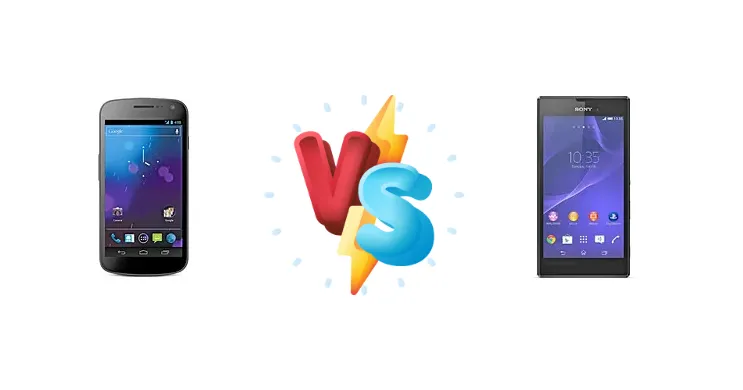
Remember the days of early Android innovation? We're revisiting two devices from that era: the Samsung Galaxy Nexus and the Sony Xperia T3. Both offer a glimpse into a different time in mobile technology, but which one holds up better today? Let's dive into a detailed comparison.
🏆 Quick Verdict
The Xperia T3 edges out the Galaxy Nexus thanks to its quad-core processor and slightly better battery life. While the Nexus boasts a more powerful CPU core, the T3's overall efficiency and endurance give it a slight advantage for everyday use, especially considering their age.
| Network |
|---|
| 2G bands | GSM 850 / 900 / 1800 / 1900 | GSM 850 / 900 / 1800 / 1900 - all versions |
| 3G bands | HSDPA 850 / 1700 / 1900 / 2100 | HSDPA 900 / 2100 - D5103 |
| 4G bands | - | 1, 3, 7, 8, 20 - D5103 |
| Speed | HSPA 21.1/5.76 Mbps | HSPA 42.2/21.1(D5102)/5.76 Mbps, LTE Cat4 150/50 Mbps |
| Technology | GSM / HSPA | GSM / HSPA / LTE |
| | - | 4, 7, 17 - D5106 |
| Launch |
|---|
| Announced | 2012, January. Released 2012, January | 2014, June. Released 2014, July |
| Status | Discontinued | Discontinued |
| Body |
|---|
| Dimensions | 135.5 x 67.9 x 8.9 mm (5.33 x 2.67 x 0.35 in) | 150.7 x 77 x 7 mm (5.93 x 3.03 x 0.28 in) |
| SIM | Mini-SIM | Micro-SIM |
| Weight | 135 g (4.76 oz) | 148 g (5.22 oz) |
| Display |
|---|
| Protection | Oleophobic coating | - |
| Resolution | 720 x 1280 pixels, 16:9 ratio (~316 ppi density) | 720 x 1280 pixels, 16:9 ratio (~277 ppi density) |
| Size | 4.65 inches, 59.6 cm2 (~64.8% screen-to-body ratio) | 5.3 inches, 77.4 cm2 (~66.7% screen-to-body ratio) |
| Type | Super AMOLED | IPS LCD |
| | - | Triluminos display |
| Platform |
|---|
| CPU | Dual-core 1.2 GHz Cortex-A9 | Quad-core 1.4 GHz Cortex-A7 |
| Chipset | TI OMAP 4460 | Qualcomm MSM8928-2 Snapdragon 400 (28 nm) (D5103,D5106)/ Qualcomm MSM8228 (D5102) |
| GPU | PowerVR SGX540 | Adreno 305 |
| OS | Android 4.0 (Ice Cream Sandwich) | Android 4.4.2 (KitKat) |
| Memory |
|---|
| Card slot | No | microSDHC (dedicated slot) |
| Internal | 16GB 1GB RAM | 8GB 1GB RAM |
| | - | eMMC 4.5 |
| Main Camera |
|---|
| Features | LED flash | LED flash, HDR, panorama |
| Single | 5 MP, AF | 8 MP, f/2.4, AF |
| Video | 1080p@30fps | 1080p@30fps, HDR |
| Selfie camera |
|---|
| Single | 1.3 MP | 1.1 MP |
| Video | 720p@30fps | 720p@30fps |
| Sound |
|---|
| 3.5mm jack | Yes | Yes |
| 35mm jack | Yes | Yes |
| Loudspeaker | Yes | Yes |
| Comms |
|---|
| Bluetooth | 3.0, A2DP | 4.0, A2DP, LE, aptX |
| NFC | Yes | Yes |
| Positioning | GPS, A-GPS | GPS, GLONASS |
| Radio | No | Stereo FM radio, RDS |
| USB | microUSB 2.0 (MHL TV-out) | microUSB 2.0, OTG |
| WLAN | Wi-Fi 802.11 a/b/g/n, dual-band, DLNA, hotspot | Wi-Fi 802.11 a/b/g/n, dual-band, Wi-Fi Direct, DLNA, hotspot |
| Features |
|---|
| Sensors | Accelerometer, gyro, proximity, compass, barometer | Accelerometer, gyro, proximity, compass |
| | MP4/H.264 player
MP3/WAV/eAAC+ player
Photo/video editor
Document viewer | ANT+ |
| Battery |
|---|
| Music play | - | Up to 63 h |
| Stand-by | Up to 600 h | Up to 639 h (2G) / Up to 688 h (3G) |
| Talk time | Up to 9 h | Up to 12 h 46 min (2G) / Up to 14 h 47 min (3G) |
| Type | Removable Li-Ion 1750 mAh battery | Li-Ion 2500 mAh, non-removable |
| Misc |
|---|
| Colors | Black | Black, White, Purple |
| Models | GT-I9250M | D5103, D5102 |
| Price | About 240 EUR | About 200 EUR |
| SAR | 0.40 W/kg (head) 0.74 W/kg (body) | 0.48 W/kg (head) 0.97 W/kg (body) |
| SAR EU | 0.35 W/kg (head) | 0.36 W/kg (head) |
| Tests |
|---|
| Audio quality | - |
Noise -89.1dB / Crosstalk -46.5dB |
| Battery life | - |
Endurance rating 75h
|
| Camera | - |
Photo / Video |
| Display | - |
Contrast ratio: 963 (nominal), 2.609 (sunlight) |
| Loudspeaker | - |
Voice 69dB / Noise 66dB / Ring 75dB
|
Samsung Galaxy Nexus I9250M
- Pure Android experience
- Stronger single-core CPU performance
- Slightly higher display resolution
- Weaker battery life
- Outdated camera
- Limited app compatibility
Sony Xperia T3
- Excellent battery life
- Quad-core processor for better multitasking
- Good sunlight visibility
- Lower display resolution
- Less powerful single-core performance
- Outdated camera
Display Comparison
Both phones feature a similar contrast ratio of 963 (nominal) and 2.609 in sunlight, suggesting comparable outdoor visibility. The Galaxy Nexus has a slightly higher resolution (1280 x 720) on its 4.65-inch display, potentially offering sharper images. The Xperia T3 has a 4.6-inch display. Viewing angles and color accuracy are likely to be dated on both devices.
Camera Comparison
Camera specifications are similar, both offering Photo/Video capabilities. Image quality on both will be noticeably inferior to modern smartphones. The Galaxy Nexus's camera was generally considered slightly better in its prime, but both are limited by their age and sensor technology. Low-light performance will be a significant weakness on both.
Performance
The Galaxy Nexus has a dual-core 1.2 GHz Cortex-A9 processor, known for its strong single-core performance. The Xperia T3 features a quad-core 1.4 GHz Cortex-A7 processor. While the Nexus's A9 core is generally faster, the T3's quad-core architecture can handle multitasking slightly better. However, both phones will struggle with modern, demanding apps.
Battery Life
The Xperia T3 shines here, boasting an endurance rating of 75 hours, significantly better than the Galaxy Nexus (estimated around 30-40 hours). This is a crucial factor for daily usability, especially given the age of these devices.
Buying Guide
The Samsung Galaxy Nexus is for Android enthusiasts who appreciate a pure Android experience and a slightly more powerful single core. The Sony Xperia T3 is ideal for users seeking longer battery life and a more modern (for its time) design, prioritizing endurance over raw processing power.
Frequently Asked Questions
❓ Are these phones still worth buying?
Only for collectors or those seeking a nostalgic Android experience. Modern smartphones offer vastly superior performance, features, and security.
❓ Which phone has better software support?
Neither. Both phones are long past their official software update cycles and are vulnerable to security risks.
❓ Can I use these phones with a modern SIM card?
Potentially. Check SIM card compatibility with your carrier. Older phones may not support newer network technologies.