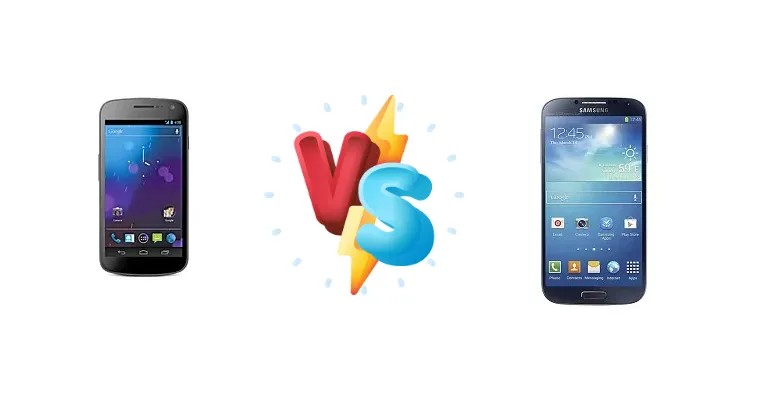
The Samsung Galaxy Nexus and Galaxy S4 were flagship devices in their time, representing significant leaps in Android technology. But how do they stack up against each other today? This comprehensive comparison dives deep into their specs, performance, and features to help you decide which phone was the better choice.
🏆 Quick Verdict
The Galaxy S4 decisively wins this comparison. Its octa-core processor, superior display, improved camera, and longer battery life offer a significantly better user experience than the Galaxy Nexus, despite both being older devices. The Nexus was a pioneer, but the S4 was a refinement.
| Network |
|---|
| 2G bands | GSM 850 / 900 / 1800 / 1900 | GSM 850 / 900 / 1800 / 1900 |
| 3G bands | HSDPA 850 / 1700 / 1900 / 2100 | HSDPA 850 / 900 / 1900 / 2100 |
| EDGE | - | Yes |
| GPRS | - | Yes |
| Speed | HSPA 21.1/5.76 Mbps | HSPA 42.2/5.76 Mbps |
| Technology | GSM / HSPA | GSM / HSPA |
| Launch |
|---|
| Announced | 2012, January. Released 2012, January | 2013, March. Released 2013, April |
| Status | Discontinued | Discontinued |
| Body |
|---|
| Build | - | Glass front (Gorilla Glass 3), plastic back, plastic frame |
| Dimensions | 135.5 x 67.9 x 8.9 mm (5.33 x 2.67 x 0.35 in) | 136.6 x 69.8 x 7.9 mm (5.38 x 2.75 x 0.31 in) |
| SIM | Mini-SIM | Micro-SIM |
| Weight | 135 g (4.76 oz) | 130 g (4.59 oz) |
| Display |
|---|
| Protection | Oleophobic coating | Corning Gorilla Glass 3 |
| Resolution | 720 x 1280 pixels, 16:9 ratio (~316 ppi density) | 1080 x 1920 pixels, 16:9 ratio (~441 ppi density) |
| Size | 4.65 inches, 59.6 cm2 (~64.8% screen-to-body ratio) | 5.0 inches, 68.9 cm2 (~72.3% screen-to-body ratio) |
| Type | Super AMOLED | Super AMOLED |
| Platform |
|---|
| CPU | Dual-core 1.2 GHz Cortex-A9 | Octa-core (4x1.6 GHz Cortex-A15 & 4x1.2 GHz Cortex-A7) |
| Chipset | TI OMAP 4460 | Exynos 5410 Octa (28 nm) |
| GPU | PowerVR SGX540 | PowerVR SGX544MP3 |
| OS | Android 4.0 (Ice Cream Sandwich) | Android 4.2.2 (Jelly Bean), upgradable to 5.0.1 (Lollipop), TouchWiz UI |
| Memory |
|---|
| Call records | - | Yes |
| Card slot | No | microSDXC (dedicated slot) |
| Internal | 16GB 1GB RAM | 16GB 2GB RAM, 32GB 2GB RAM, 64GB 2GB RAM |
| Phonebook | - | 2000 entries |
| | - | eMMC 5.0 |
| Main Camera |
|---|
| Features | LED flash | LED flash, HDR |
| Single | 5 MP, AF | 13 MP, f/2.2, 31mm (standard), 1/3.1", 1.14µm, AF |
| Video | 1080p@30fps | 1080p@30fps |
| Selfie camera |
|---|
| Features | - | Dual video call |
| Single | 1.3 MP | 2 MP, f/2.4, 31mm (standard) |
| Video | 720p@30fps | 1080p@30fps |
| Sound |
|---|
| 3.5mm jack | Yes | Yes |
| 35mm jack | Yes | Yes |
| Loudspeaker | Yes | Yes |
| Comms |
|---|
| Bluetooth | 3.0, A2DP | 4.0, A2DP, EDR, LE, aptX |
| Infrared port | - | Yes |
| NFC | Yes | Yes |
| Positioning | GPS, A-GPS | GPS, GLONASS |
| Radio | No | No |
| USB | microUSB 2.0 (MHL TV-out) | microUSB 2.0 (MHL 2 TV-out), OTG |
| WLAN | Wi-Fi 802.11 a/b/g/n, dual-band, DLNA, hotspot | Wi-Fi 802.11 a/b/g/n/ac, dual-band, Wi-Fi Direct, DLNA, hotspot |
| Features |
|---|
| Games | - | Downloadable |
| Java | - | Yes |
| Messaging | - | SMS(threaded view), MMS, Email, IM |
| Sensors | Accelerometer, gyro, proximity, compass, barometer | Accelerometer, gyro, proximity, compass, barometer, temperature, humidity, gesture |
| | MP4/H.264 player
MP3/WAV/eAAC+ player
Photo/video editor
Document viewer | ANT+
S-Voice natural language commands and dictation
Air gestures |
| Battery |
|---|
| Charging | - | Wireless (Qi) (market dependent) |
| Music play | - | Up to 62 h |
| Stand-by | Up to 600 h | Up to 370 h (3G) |
| Talk time | Up to 9 h | Up to 17 h (3G) |
| Type | Removable Li-Ion 1750 mAh battery | Li-Ion 2600 mAh, removable |
| Misc |
|---|
| Colors | Black | White Frost, Black Mist, Arctic Blue, Black Edition |
| Models | GT-I9250M | GT-I9500, SGH-I337M, SGH-M919, GT-I9507V, SHV-E330L, SPH-L720T, SHV-E300S, SHV-E300L, SHV-E300K, GT-I9507, SGH-M919N |
| Price | About 240 EUR | About 320 EUR |
| SAR | 0.40 W/kg (head) 0.74 W/kg (body) | 0.85 W/kg (head) 1.55 W/kg (body) |
| SAR EU | 0.35 W/kg (head) | 0.42 W/kg (head) 0.54 W/kg (body) |
| Tests |
|---|
| Audio quality | - |
Noise -95.9dB / Crosstalk -96.4dB |
| Battery life | - |
Endurance rating 65h
|
| Camera | - |
Photo / Video |
| Display | - |
Contrast ratio: Infinite (nominal) / 3.352:1 (sunlight) |
| Loudspeaker | - |
Voice 70dB / Noise 66dB / Ring 77dB
|
Samsung Galaxy Nexus I9250M
- Pioneering Android experience
- Compact size
- Clean Android software (at launch)
- Outdated processor
- Limited storage
- Poor battery life by today's standards
- No wireless charging
- Security vulnerabilities
Samsung I9500 Galaxy S4
- Powerful octa-core processor
- Vibrant Super AMOLED display
- Improved camera
- Wireless charging (market dependent)
- Larger screen
- Outdated software
- Security vulnerabilities
- Plastic build quality
Display Comparison
The Galaxy S4 boasts a larger 5.0-inch Super AMOLED display compared to the Nexus's 4.65-inch display. While both offer excellent contrast (Infinite nominal, 3.352:1 sunlight), the S4's higher resolution and vibrant colors provide a noticeably richer visual experience. The S4 also has better viewing angles.
Camera Comparison
The Galaxy S4's camera system is a clear winner. While specific megapixel counts are similar, the S4's image processing and features are superior, resulting in better photos and videos, especially in low light. The S4 also offered more advanced camera modes and options.
Performance
The Galaxy S4's Exynos 5410 Octa chipset with its octa-core processor (4x1.6 GHz Cortex-A15 & 4x1.2 GHz Cortex-A7) utterly dominates the Nexus's TI OMAP 4460 dual-core 1.2 GHz Cortex-A9. The S4 handles multitasking and demanding apps with ease, while the Nexus can feel sluggish by modern standards. The S4's GPU is also significantly more powerful.
Battery Life
Both phones have an endurance rating of 65h, but the S4's more efficient chipset and larger battery capacity likely translate to longer real-world usage. The S4 also had wireless charging (Qi), a feature absent in the Nexus.
Buying Guide
Who should buy the Samsung Galaxy Nexus I9250M? Primarily enthusiasts seeking a taste of older Android experiences or developers needing a specific legacy platform. Who should buy the Samsung Galaxy S4 I9500? No one. Both phones are outdated and security risks. Consider modern alternatives.
Frequently Asked Questions
❓ Is the Galaxy Nexus still worth using?
No. The Galaxy Nexus is severely outdated and no longer receives security updates, making it a significant security risk. It's not recommended for daily use.
❓ Which phone was released first?
The Samsung Galaxy Nexus was released first, in late 2011, while the Galaxy S4 followed in early 2013.