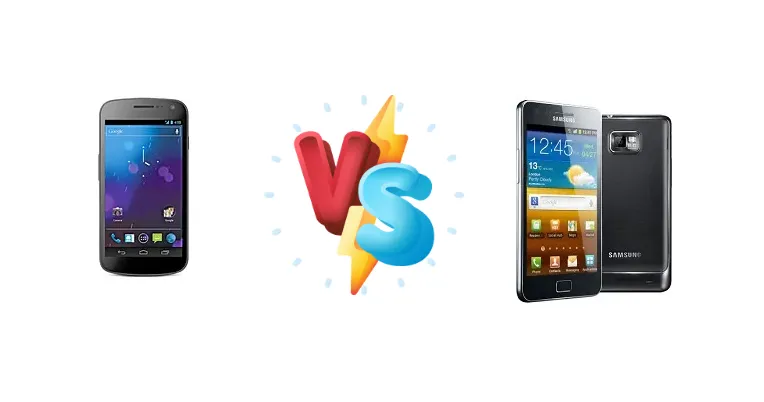
The Samsung Galaxy Nexus and Galaxy S II were titans of their time, representing the pinnacle of Android innovation. Both offered impressive features and performance, but which one truly stood out? This detailed comparison will revisit these iconic devices to help you understand their strengths and weaknesses.
🏆 Quick Verdict
The Galaxy S II edges out the Nexus due to its slightly better overall performance, more refined software experience at the time, and arguably superior display. While the Nexus had a cleaner Android experience, the S II's broader appeal and slightly more powerful hardware give it a narrow victory.
| Network |
|---|
| 2G bands | GSM 850 / 900 / 1800 / 1900 | GSM 850 / 900 / 1800 / 1900 |
| 3G bands | HSDPA 850 / 1700 / 1900 / 2100 | HSDPA 850 / 900 / 1900 / 2100 |
| Speed | HSPA 21.1/5.76 Mbps | HSPA 21.1/5.76 Mbps |
| Technology | GSM / HSPA | GSM / HSPA |
| Launch |
|---|
| Announced | 2012, January. Released 2012, January | 2011, February. Released 2011, April |
| Status | Discontinued | Discontinued |
| Body |
|---|
| Build | - | Glass front (Gorilla Glass), plastic back, plastic frame |
| Dimensions | 135.5 x 67.9 x 8.9 mm (5.33 x 2.67 x 0.35 in) | 125.3 x 66.1 x 8.5 mm (4.93 x 2.60 x 0.33 in) |
| SIM | Mini-SIM | Mini-SIM |
| Weight | 135 g (4.76 oz) | 116 g (4.09 oz) |
| Display |
|---|
| Protection | Oleophobic coating | Corning Gorilla Glass |
| Resolution | 720 x 1280 pixels, 16:9 ratio (~316 ppi density) | 480 x 800 pixels, 5:3 ratio (~217 ppi density) |
| Size | 4.65 inches, 59.6 cm2 (~64.8% screen-to-body ratio) | 4.3 inches, 52.6 cm2 (~63.5% screen-to-body ratio) |
| Type | Super AMOLED | Super AMOLED Plus |
| Platform |
|---|
| CPU | Dual-core 1.2 GHz Cortex-A9 | Dual-core 1.2 GHz Cortex-A9 |
| Chipset | TI OMAP 4460 | Exynos 4210 Dual |
| GPU | PowerVR SGX540 | Mali-400MP4 |
| OS | Android 4.0 (Ice Cream Sandwich) | Android 2.3.4 (Gingerbread), upgradable to 4.1 (Jelly Bean), TouchWiz UI 4 |
| Memory |
|---|
| Card slot | No | microSDHC (dedicated slot) |
| Internal | 16GB 1GB RAM | 16GB 1GB RAM, 32GB 1GB RAM |
| Main Camera |
|---|
| Features | LED flash | LED flash |
| Single | 5 MP, AF | 8 MP, f/2.6, 1/3.2", AF |
| Video | 1080p@30fps | 1080p@30fps |
| Selfie camera |
|---|
| Single | 1.3 MP | 2 MP |
| Video | 720p@30fps | - |
| Sound |
|---|
| 3.5mm jack | Yes | Yes |
| 35mm jack | Yes | Yes |
| Loudspeaker | Yes | Yes |
| Comms |
|---|
| Bluetooth | 3.0, A2DP | 3.0, A2DP, aptX |
| NFC | Yes | Optional |
| Positioning | GPS, A-GPS | GPS, A-GPS |
| Radio | No | Stereo FM radio, RDS |
| USB | microUSB 2.0 (MHL TV-out) | microUSB 2.0 (MHL TV-out), OTG |
| WLAN | Wi-Fi 802.11 a/b/g/n, dual-band, DLNA, hotspot | Wi-Fi 802.11 a/b/g/n, dual-band, Wi-Fi Direct, DLNA, hotspot |
| Features |
|---|
| Browser | - | HTML, Adobe Flash |
| Sensors | Accelerometer, gyro, proximity, compass, barometer | Accelerometer, gyro, proximity, compass |
| | MP4/H.264 player
MP3/WAV/eAAC+ player
Photo/video editor
Document viewer | - |
| Battery |
|---|
| Stand-by | Up to 600 h | Up to 710 h (2G) / Up to 610 h (3G) |
| Talk time | Up to 9 h | Up to 18 h 20 min (2G) / Up to 8 h 40 min (3G) |
| Type | Removable Li-Ion 1750 mAh battery | Removable Li-Ion 1650 mAh battery |
| Misc |
|---|
| Colors | Black | Black, White, Pink |
| Models | GT-I9250M | GT-I9100, GT-I9100G, GT-I9100T |
| Price | About 240 EUR | About 170 EUR |
| SAR | 0.40 W/kg (head) 0.74 W/kg (body) | 0.16 W/kg (head) 0.96 W/kg (body) |
| SAR EU | 0.35 W/kg (head) | 0.34 W/kg (head) |
| Tests |
|---|
| Audio quality | - |
Noise -91.4dB / Crosstalk -89.7dB |
| Battery life | - | Endurance rating 40h |
| Camera | - |
Photo / Video |
| Display | - |
Contrast ratio: Infinite (nominal) / 2.832:1 (sunlight) |
| Loudspeaker | - |
Voice 70dB / Noise 66dB / Ring 75dB |
Samsung Galaxy Nexus I9250M
- Pure Android experience
- Slightly higher resolution display
- Modern design for its time
- Good performance
- Less powerful chipset than S II
- Camera slightly inferior to S II
- Software updates ceased earlier
Samsung I9100 Galaxy S II
- Vibrant Super AMOLED display
- Slightly better performance
- Refined software experience (at the time)
- Good camera quality
- Longer software support (initially)
- Older design
- Lower resolution display compared to Nexus
- Battery life, while good, not exceptional
Display Comparison
Both phones feature Super AMOLED displays with a contrast ratio of Infinite (nominal) / 2.832:1 (sunlight). The Galaxy S II's display is generally considered slightly more vibrant and color-accurate, while the Nexus had a slightly higher resolution (1280 x 720 vs 800 x 480). However, both screens were excellent for their time.
Camera Comparison
Camera performance was comparable. Both phones offered Photo and Video capabilities, but image quality was generally considered to be slightly better on the Galaxy S II, particularly in low-light conditions. The S II's image processing algorithms were more refined.
Performance
Both devices are powered by dual-core 1.2 GHz Cortex-A9 processors. The Galaxy S II utilizes the Exynos 4210 chipset, which generally offered slightly better performance than the TI OMAP 4460 found in the Nexus. This translates to smoother multitasking and slightly faster app loading times on the S II.
Battery Life
Both phones boasted an endurance rating of 40 hours. Real-world battery life was generally good on both devices, lasting a full day with moderate usage. However, the Galaxy S II's slightly more efficient chipset and software optimization gave it a slight edge in battery longevity.
Buying Guide
Who should buy the Samsung Galaxy Nexus I9250M? Enthusiasts seeking a pure Android experience and a slightly more modern design. Who should buy the Samsung I9100 Galaxy S II? Users prioritizing a well-rounded package with a vibrant display, solid performance, and a more established software ecosystem (at the time).
Frequently Asked Questions
❓ Which phone was released first?
The Samsung Galaxy S II was released first, followed by the Galaxy Nexus.
❓ Are software updates still available for these phones?
No, both phones have reached their end of life and no longer receive official software updates. Security patches are no longer provided.