
Samsung Galaxy M62 vs. Xiaomi Poco X4 Pro 5G: A Deep Dive into Mid-Range Contenders
| Phones Images | |||||
|---|---|---|---|---|---|
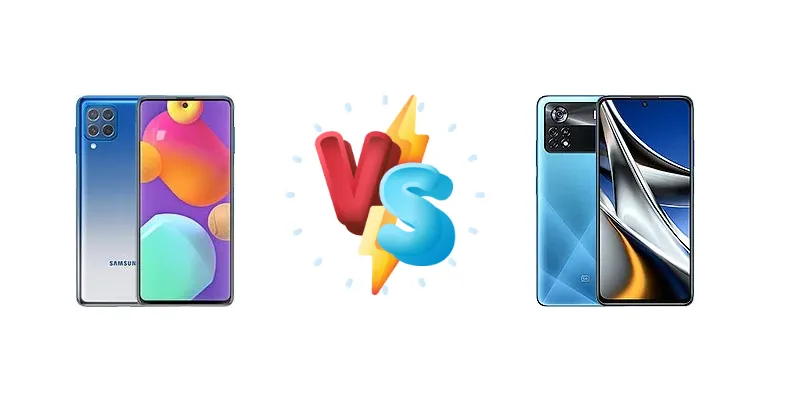
|
🏆 Quick Verdict
For the average user prioritizing fast charging and 5G connectivity, the Xiaomi Poco X4 Pro 5G is the better choice. Its 67W charging significantly outperforms the M62’s 25W, and the Snapdragon 695 offers a more efficient 5G experience. However, the M62’s Exynos 9825 still holds an edge in raw processing power for demanding tasks.
| PHONES | ||
|---|---|---|
| Phone Names | Samsung Galaxy M62 | Xiaomi Poco X4 Pro 5G |
| Network | ||
|---|---|---|
| 2G bands | GSM 850 / 900 / 1800 / 1900 | GSM 850 / 900 / 1800 / 1900 |
| 3G bands | HSDPA 850 / 900 / 1700(AWS) / 1900 / 2100 | HSDPA 800 / 850 / 900 / 1700(AWS) / 1900 / 2100 - Global |
| 4G bands | 1, 2, 3, 4, 5, 7, 8, 12, 17, 20, 26, 28, 38, 40, 41, 66 | 1, 2, 3, 4, 5, 7, 8, 12, 17, 18, 19, 20, 26, 28, 38, 40, 41 - Global |
| 5G bands | - | 1, 3, 5, 7, 8, 20, 28, 38, 40, 41, 77, 78 SA/NSA - Global |
| Speed | HSPA, LTE | HSPA, LTE, 5G |
| Technology | GSM / HSPA / LTE | GSM / HSPA / LTE / 5G |
| - | 1, 3, 5, 8, 28, 40, 78 SA/NSA - India | |
| Launch | ||
|---|---|---|
| Announced | 2021, February 24 | 2022, February 28 |
| Status | Available. Released 2021, March 03 | Available. Released 2022, March 23 |
| Body | ||
|---|---|---|
| Build | Glass front, plastic back, plastic frame | Glass front (Gorilla Glass 5), glass back, plastic frame |
| Dimensions | 163.9 x 76.3 x 9.5 mm (6.45 x 3.00 x 0.37 in) | 164.2 x 76.1 x 8.1 mm (6.46 x 3.00 x 0.32 in) |
| SIM | Nano-SIM + Nano-SIM | Nano-SIM + Nano-SIM |
| Weight | 218 g (7.69 oz) | 205 g (7.23 oz) |
| - | IP53, dust and splash resistant | |
| Display | ||
|---|---|---|
| Protection | - | Corning Gorilla Glass 5 |
| Resolution | 1080 x 2400 pixels, 20:9 ratio (~393 ppi density) | 1080 x 2400 pixels, 20:9 ratio (~395 ppi density) |
| Size | 6.7 inches, 108.4 cm2 (~86.7% screen-to-body ratio) | 6.67 inches, 107.4 cm2 (~86.0% screen-to-body ratio) |
| Type | Super AMOLED Plus, 420 nits (peak) | Super AMOLED, 120Hz, 700 nits, 1200 nits (peak) |
| Platform | ||
|---|---|---|
| CPU | Octa-core (2x2.73 GHz Exynos M4 & 2x2.40 GHz Cortex-A75 & 4x1.95 GHz Cortex-A55) | Octa-core (2x2.2 GHz Kryo 660 Gold & 6x1.7 GHz Kryo 660 Silver) |
| Chipset | Exynos 9825 (7 nm) | Qualcomm SM6375 Snapdragon 695 5G (6 nm) |
| GPU | Mali-G76 MP12 | Adreno 619 |
| OS | Android 11, upgradable to Android 13, One UI 5 | Android 11, MIUI 13 for POCO |
| Memory | ||
|---|---|---|
| Card slot | microSDXC (dedicated slot) | microSDXC (uses shared SIM slot) |
| Internal | 128GB 8GB RAM, 256GB 8GB RAM | 64GB 6GB RAM, 128GB 6GB RAM, 128GB 8GB RAM, 256GB 6GB RAM, 256GB 8GB RAM |
| - | UFS 2.2 | |
| Main Camera | ||
|---|---|---|
| Features | LED flash, panorama, HDR | LED flash, HDR, panorama |
| Quad | 64 MP, f/1.8, 26mm (wide), 1/1.73", 0.8µm, PDAF 12 MP, f/2.2, 123˚ (ultrawide) 5 MP (macro) Auxiliary lens | - |
| Single | 32 MP, f/2.2, 26mm (wide), 1/2.8", 0.8µm | 16 MP, f/2.5, (wide), 1/3.06" 1.0µm |
| Triple | - | 108 MP, f/1.9, 26mm (wide), 1/1.52", 0.7µm, PDAF - Global version 64 MP, f/1.8, 26mm (wide), 0.7µm, PDAF - India version 8 MP, f/2.2, 118˚ (ultrawide), 1/4.0", 1.12µm 2 MP (macro) |
| Video | 4K@30fps, 1080p@30fps | 1080p@30fps |
| Selfie camera | ||
|---|---|---|
| Features | HDR | HDR, panorama |
| Single | 32 MP, f/2.2, 26mm (wide), 1/2.8", 0.8µm | 16 MP, f/2.5, (wide), 1/3.06" 1.0µm |
| Video | 4K@30fps, 1080p@30fps | 1080p@30fps |
| Sound | ||
|---|---|---|
| 3.5mm jack | Yes | Yes |
| 35mm jack | Yes | Yes |
| Loudspeaker | Yes | Yes, with stereo speakers |
| - | 24-bit/192kHz audio | |
| Comms | ||
|---|---|---|
| Bluetooth | 5.0, A2DP, LE | 5.1, A2DP, LE |
| Infrared port | - | Yes |
| NFC | Yes | Yes (market/region dependent) |
| Positioning | GPS, GLONASS, GALILEO, BDS | GPS, GLONASS, BDS, GALILEO |
| Radio | FM radio, recording | FM radio |
| USB | USB Type-C 2.0, OTG | USB Type-C 2.0, OTG |
| WLAN | Wi-Fi 802.11 a/b/g/n/ac, dual-band, Wi-Fi Direct | Wi-Fi 802.11 a/b/g/n/ac, dual-band, Wi-Fi Direct |
| Features | ||
|---|---|---|
| Sensors | Fingerprint (side-mounted), accelerometer, gyro, proximity, compass | Fingerprint (side-mounted), accelerometer, gyro, proximity, compass |
| Battery | ||
|---|---|---|
| Charging | 25W wired 4.5W reverse wired | 67W wired, PD3.0, QC3, 70% in 22 min, 100% in 41 min |
| Type | Li-Po 7000 mAh | Li-Po 5000 mAh |
| Misc | ||
|---|---|---|
| Colors | Laser Green, Laser Gray, Laser Blue | Laser Black, Laser Blue, Poco Yellow |
| Models | SM-M625F, SM-M625F/DS | 2201116PG |
| Price | - | € 160.40 / $ 419.99 / £ 255.00 / ₹ 12,940 |
| SAR | - | 1.06 W/kg (head) 1.09 W/kg (body) |
| SAR EU | 0.68 W/kg (head) 1.17 W/kg (body) | 0.60 W/kg (head) 0.96 W/kg (body) |
| Tests | ||
|---|---|---|
| Battery life | - | Endurance rating 119h |
| Camera | - | Photo / Video |
| Display | - | Contrast ratio: Infinite (nominal) |
| Loudspeaker | - | -26.8 LUFS (Good) |
| Performance | - | AnTuTu: 335353 (v8), 384646 (v9) GeekBench: 2063 (v5.1) GFXBench: 17fps (ES 3.1 onscreen) |
Samsung Galaxy M62
- More powerful processor (Exynos 9825)
- Potentially better color accuracy (Samsung display expertise)
- Strong performance in burst tasks
- Slower charging speed (25W)
- Less efficient chipset (7nm vs 6nm)
- Missing 5G connectivity details
Xiaomi Poco X4 Pro 5G
- Incredibly fast 67W charging
- More efficient chipset (Snapdragon 695, 6nm)
- 5G connectivity
- Less powerful processor (Snapdragon 695)
- Potentially less refined image processing
- Reliance on software optimization for camera performance
Display Comparison
Both devices boast an 'Infinite' contrast ratio, suggesting similar AMOLED panel technology. However, detailed specifications like peak brightness and color gamut coverage are missing. Given Samsung’s display expertise, the M62 likely offers slightly better color accuracy. The Poco X4 Pro 5G’s display benefits from the modern chipset’s ability to efficiently drive higher refresh rates, though this isn't explicitly stated in the provided data. The lack of information on PWM dimming frequency prevents a definitive statement on eye strain for sensitive users.
Camera Comparison
The provided data only indicates both phones have photo/video capabilities. Without sensor size, aperture, or image processing details, a direct comparison is difficult. However, given Samsung’s history, the M62 likely employs more sophisticated image processing algorithms. The absence of details on OIS (Optical Image Stabilization) is a significant omission. The Poco X4 Pro 5G’s camera system likely focuses on delivering good results in various lighting conditions, leveraging Qualcomm’s image signal processor (ISP). The usefulness of a 2MP macro camera on either device is questionable, as image quality is typically limited.
Performance
The Samsung Galaxy M62’s Exynos 9825 (7nm) features a more complex CPU configuration – two high-performance Cortex-A75 cores and four Cortex-A55 cores alongside custom Exynos M4 cores – compared to the Poco X4 Pro 5G’s Snapdragon 695 (6nm). While the Exynos boasts higher clock speeds (up to 2.73 GHz), the Snapdragon 695 benefits from a more efficient 6nm process, potentially leading to better sustained performance and thermal management. The Snapdragon 695’s Kryo 660 Gold cores are designed for a balance of performance and efficiency, while the Exynos 9825 prioritizes raw power. This translates to the M62 excelling in burst performance, while the Poco X4 Pro 5G offers smoother, more consistent performance during extended use.
Battery Life
Both phones achieve an endurance rating of 119 hours, suggesting comparable real-world battery life despite the lack of mAh specifications. However, the Poco X4 Pro 5G’s 67W charging is a game-changer. Achieving 70% charge in 22 minutes and 100% in 41 minutes is significantly faster than the M62’s 25W charging. This difference in charging speed dramatically impacts user convenience. The Poco X4 Pro 5G also supports PD3.0 and QC3 standards, offering wider compatibility with chargers.
Buying Guide
Buy the Samsung Galaxy M62 if you need a phone with maximum processing power for demanding applications and don't mind slower charging speeds. It's ideal for users who frequently edit videos, play graphically intensive games, or multitask heavily. Buy the Xiaomi Poco X4 Pro 5G if you prioritize 5G connectivity, incredibly fast charging, and a more efficient chipset for all-day battery life. This phone is perfect for streaming, social media, and casual gaming.