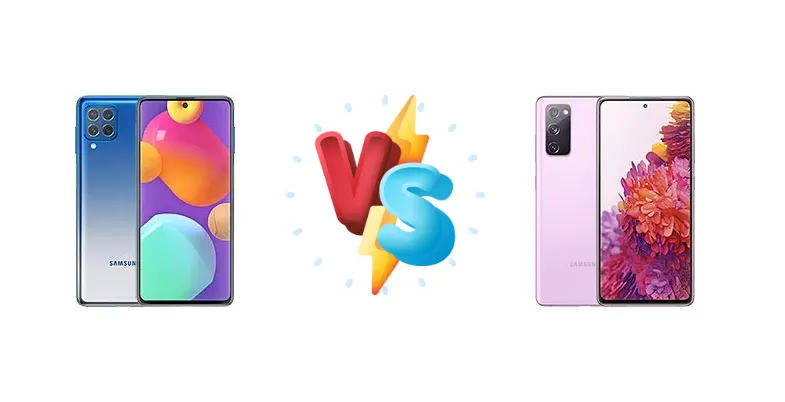
The Samsung Galaxy M62 and S20 FE 2022 represent distinct approaches to the mid-range market. The M62, released earlier, focuses on maximizing battery life and offering a large display at an accessible price. The S20 FE 2022, a refresh of a popular model, brings a more powerful Snapdragon processor to the table, aiming for a balance of performance and features. This comparison dissects the key differences to help you determine which device best suits your needs.
🏆 Quick Verdict
For most users, the Samsung Galaxy S20 FE 2022 is the superior choice. Its Snapdragon 865 5G chipset delivers significantly better performance for gaming and demanding applications, while still offering competitive battery life and the added convenience of wireless charging. The M62 remains a viable option for those prioritizing maximum battery endurance above all else.
| Network |
|---|
| 2G bands | GSM 850 / 900 / 1800 / 1900 | GSM 850 / 900 / 1800 / 1900 |
| 3G bands | HSDPA 850 / 900 / 1700(AWS) / 1900 / 2100 | HSDPA 850 / 900 / 1700(AWS) / 1900 / 2100 |
| 4G bands | 1, 2, 3, 4, 5, 7, 8, 12, 17, 20, 26, 28, 38, 40, 41, 66 | LTE |
| 5G bands | - | SA/NSA/Sub6 |
| Speed | HSPA, LTE | HSPA 42.2/5.76 Mbps, LTE (5CA) Cat19 1800/200 Mbps, 5G |
| Technology | GSM / HSPA / LTE | GSM / CDMA / HSPA / EVDO / LTE / 5G |
| | - | CDMA2000 1xEV-DO |
| Launch |
|---|
| Announced | 2021, February 24 | 2022, April 01 |
| Status | Available. Released 2021, March 03 | Available. Released 2022, April 01 |
| Body |
|---|
| Build | Glass front, plastic back, plastic frame | Glass front (Gorilla Glass 3), plastic back, aluminum frame |
| Dimensions | 163.9 x 76.3 x 9.5 mm (6.45 x 3.00 x 0.37 in) | 159.8 x 74.5 x 8.4 mm (6.29 x 2.93 x 0.33 in) |
| SIM | Nano-SIM + Nano-SIM | Nano-SIM + Nano-SIM |
| Weight | 218 g (7.69 oz) | 190 g (6.70 oz) |
| | - | IP68 dust/water resistant (up to 1.5m for 30 min) |
| Display |
|---|
| Protection | - | Corning Gorilla Glass 3 |
| Resolution | 1080 x 2400 pixels, 20:9 ratio (~393 ppi density) | 1080 x 2400 pixels, 20:9 ratio (~405 ppi density) |
| Size | 6.7 inches, 108.4 cm2 (~86.7% screen-to-body ratio) | 6.5 inches, 102.0 cm2 (~85.7% screen-to-body ratio) |
| Type | Super AMOLED Plus, 420 nits (peak) | Super AMOLED, 120Hz, HDR10+ |
| | - | Always-on display |
| Platform |
|---|
| CPU | Octa-core (2x2.73 GHz Exynos M4 & 2x2.40 GHz Cortex-A75 & 4x1.95 GHz Cortex-A55) | Octa-core (1x2.84 GHz Cortex-A77 & 3x2.42 GHz Cortex-A77 & 4x1.80 GHz Cortex-A55) |
| Chipset | Exynos 9825 (7 nm) | Qualcomm SM8250 Snapdragon 865 5G (7 nm+) |
| GPU | Mali-G76 MP12 | Adreno 650 |
| OS | Android 11, upgradable to Android 13, One UI 5 | Android 12, One UI 4.1 |
| Memory |
|---|
| Card slot | microSDXC (dedicated slot) | microSDXC (uses shared SIM slot) |
| Internal | 128GB 8GB RAM, 256GB 8GB RAM | 128GB 6GB RAM |
| | - | UFS 3.1 |
| Main Camera |
|---|
| Features | LED flash, panorama, HDR | LED flash, auto-HDR, panorama |
| Quad | 64 MP, f/1.8, 26mm (wide), 1/1.73", 0.8µm, PDAF
12 MP, f/2.2, 123˚ (ultrawide)
5 MP (macro)
Auxiliary lens | - |
| Single | 32 MP, f/2.2, 26mm (wide), 1/2.8", 0.8µm | - |
| Triple | - | 12 MP, f/1.8, 26mm (wide), 1/1.76", 1.8µm, dual pixel PDAF, OIS
8 MP, f/2.4, 76mm (telephoto), 1/4.5", 1.0µm, PDAF, OIS, 3x optical zoom
12 MP, f/2.2, 13mm, 123˚ (ultrawide), 1/3.0", 1.12µm |
| Video | 4K@30fps, 1080p@30fps | 4K@30/60fps, 1080p@30/60fps, gyro-EIS |
| Selfie camera |
|---|
| Features | HDR | HDR |
| Single | 32 MP, f/2.2, 26mm (wide), 1/2.8", 0.8µm | 32 MP, f/2.2, 26mm (wide), 1/2.74", 0.8µm |
| Video | 4K@30fps, 1080p@30fps | 4K@30/60fps, 1080p@30/60fps, gyro-EIS |
| Sound |
|---|
| 3.5mm jack | Yes | No |
| 35mm jack | Yes | No |
| Loudspeaker | Yes | Yes, with stereo speakers |
| | - | 32-bit/384kHz audio
Tuned by AKG |
| Comms |
|---|
| Bluetooth | 5.0, A2DP, LE | 5.0, A2DP, LE |
| NFC | Yes | Yes |
| Positioning | GPS, GLONASS, GALILEO, BDS | GPS, GLONASS, BDS, GALILEO |
| Radio | FM radio, recording | No |
| USB | USB Type-C 2.0, OTG | USB Type-C 3.2, OTG |
| WLAN | Wi-Fi 802.11 a/b/g/n/ac, dual-band, Wi-Fi Direct | Wi-Fi 802.11 a/b/g/n/ac/6, dual-band, Wi-Fi Direct |
| Features |
|---|
| Sensors | Fingerprint (side-mounted), accelerometer, gyro, proximity, compass | Fingerprint (under display, optical), accelerometer, gyro, compass |
| | - | Virtual proximity sensing
Bixby natural language commands and dictation
Samsung Pay (Visa, MasterCard certified) |
| Battery |
|---|
| Charging | 25W wired
4.5W reverse wired | 25W wired, PD3.0
15W wireless (Qi)
4.5W reverse wireless |
| Type | Li-Po 7000 mAh | Li-Ion 4500 mAh |
| Misc |
|---|
| Colors | Laser Green, Laser Gray, Laser Blue | Cloud White, Cloud Lavender, Cloud Navy |
| Models | SM-M625F, SM-M625F/DS | SM-G781NK, SM-G781NK22 |
| Price | - | About 520 EUR |
| SAR EU | 0.68 W/kg (head) 1.17 W/kg (body) | - |
Samsung Galaxy M62
- Exceptional battery life due to larger capacity.
- Large display for immersive media consumption.
- More affordable price point.
- Less powerful processor compared to the Snapdragon 865.
- No wireless charging support.
- Potential for thermal throttling during intensive tasks.
Samsung Galaxy S20 FE 2022
- Significantly faster performance with the Snapdragon 865 5G.
- Wireless charging support for added convenience.
- Potentially smoother display with a higher refresh rate.
- Slightly shorter battery life compared to the M62.
- Generally a higher price tag.
- May run warmer under sustained load.
Display Comparison
While both devices likely feature Super AMOLED panels – a Samsung staple – specific details like peak brightness and color accuracy aren't provided. However, the S20 FE 2022 benefits from a higher refresh rate (typically 120Hz, though not confirmed in the provided data) compared to the M62’s standard 60Hz, resulting in smoother scrolling and animations. The S20 FE’s smaller size (typically 6.4” vs M62’s 6.6”) may appeal to users preferring a more manageable form factor.
Camera Comparison
Without detailed sensor specifications, a direct comparison is challenging. However, the S20 FE 2022, being a flagship-adjacent device, likely features a more sophisticated camera system with a larger primary sensor and improved image processing algorithms. The inclusion of OIS (Optical Image Stabilization) in the S20 FE is highly probable, leading to sharper images and smoother videos, especially in low-light conditions. The 2MP macro cameras on both devices are likely of limited utility, offering minimal detail compared to the main sensors.
Performance
The core difference lies in the chipsets. The Snapdragon 865 5G in the S20 FE 2022, built on a 7nm+ process, demonstrably outperforms the Exynos 9825 (7nm) in the M62. The Snapdragon’s Cortex-A77 cores, particularly the prime core clocked at 2.84 GHz, offer a significant architectural advantage over the Exynos’ M4 cores. While both have Cortex-A55 efficiency cores, the Snapdragon’s superior GPU will translate to a better gaming experience. The M62’s Exynos 9825 may exhibit more thermal throttling under sustained load, impacting long gaming sessions. The S20 FE’s likely use of LPDDR5 RAM further enhances performance.
Battery Life
The Galaxy M62 boasts a larger battery capacity, but the Snapdragon 865 in the S20 FE 2022 is more power-efficient. The S20 FE 2022 also supports 25W fast charging with Power Delivery 3.0, potentially optimizing charging speeds. The addition of 15W wireless charging (Qi standard) on the S20 FE 2022 is a significant convenience feature absent on the M62. While the M62’s larger battery provides longer screen-on time, the S20 FE’s efficiency and faster charging mitigate the difference.
Buying Guide
Buy the Samsung Galaxy M62 if you absolutely need the longest possible battery life and a large screen are your top priorities, and you're willing to compromise on processing power. Buy the Samsung Galaxy S20 FE 2022 if you value a smoother, more responsive user experience, better gaming performance, and the convenience of wireless charging, even if it means slightly shorter battery life.
Frequently Asked Questions
❓ Does the Exynos 9825 in the Galaxy M62 overheat during prolonged gaming sessions?
The Exynos 9825 is known to generate more heat than the Snapdragon 865, especially under sustained load. While it won't necessarily shut down, you may experience noticeable thermal throttling, leading to reduced performance and frame rates during extended gaming sessions. The S20 FE 2022's Snapdragon 865 is better equipped to handle heat.
❓ Is the 2MP macro camera on either phone worth using?
Generally, 2MP macro cameras on budget and mid-range phones offer limited detail and image quality. They are often included for marketing purposes but don't provide a significant improvement over using the main camera in close-up mode. Don't base your purchasing decision on the macro camera alone.
❓ Can the Galaxy S20 FE 2022 handle demanding games like PUBG at 90fps?
The Snapdragon 865 in the S20 FE 2022 is capable of running PUBG at high frame rates, potentially up to 90fps depending on the graphics settings and the specific game version. However, achieving a stable 90fps may require lowering the graphics settings to balance performance and thermal management. The M62 will struggle to maintain such high frame rates.
❓ How long does it take to fully charge each phone from 0%?
Both phones support 25W fast charging. While the M62 lacks Power Delivery 3.0, it should still reach a full charge in approximately 1 hour and 45 minutes to 2 hours. The S20 FE 2022, with PD3.0, may charge slightly faster, potentially around 1 hour and 30 minutes to 1 hour and 45 minutes. The S20 FE also offers 15W wireless charging, a feature the M62 lacks.