
Samsung Galaxy M62 vs M54: Which Exynos Phone Reigns Supreme?
| Phones Images | |||||
|---|---|---|---|---|---|
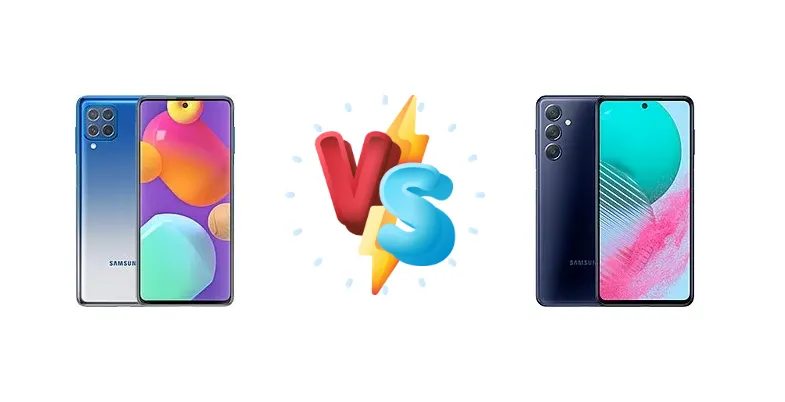
|
🏆 Quick Verdict
For most users, the Samsung Galaxy M54 is the better choice. Its Exynos 1380, built on a more efficient 5nm process, provides a noticeable performance uplift and improved power efficiency compared to the M62’s 7nm Exynos 9825. While the M62 remains a capable device, the M54 offers a more modern experience.
| PHONES | ||
|---|---|---|
| Phone Names | Samsung Galaxy M62 | Samsung Galaxy M54 |
| Network | ||
|---|---|---|
| 2G bands | GSM 850 / 900 / 1800 / 1900 | GSM 850 / 900 / 1800 / 1900 |
| 3G bands | HSDPA 850 / 900 / 1700(AWS) / 1900 / 2100 | HSDPA 850 / 900 / 1700(AWS) / 1900 / 2100 |
| 4G bands | 1, 2, 3, 4, 5, 7, 8, 12, 17, 20, 26, 28, 38, 40, 41, 66 | 1, 2, 3, 4, 5, 7, 8, 12, 17, 20, 26, 28, 38, 40, 41, 66 |
| 5G bands | - | 1, 3, 5, 7, 8, 28, 40, 41, 66, 77, 78 SA/NSA/Sub6 |
| Speed | HSPA, LTE | HSPA, LTE, 5G |
| Technology | GSM / HSPA / LTE | GSM / HSPA / LTE / 5G |
| Launch | ||
|---|---|---|
| Announced | 2021, February 24 | 2023, March 22 |
| Status | Available. Released 2021, March 03 | Available. Released 2023, April 11 |
| Body | ||
|---|---|---|
| Build | Glass front, plastic back, plastic frame | Glass front (Gorilla Glass 5), plastic back, plastic frame |
| Dimensions | 163.9 x 76.3 x 9.5 mm (6.45 x 3.00 x 0.37 in) | 164.9 x 77.3 x 8.4 mm (6.49 x 3.04 x 0.33 in) |
| SIM | Nano-SIM + Nano-SIM | Nano-SIM + Nano-SIM |
| Weight | 218 g (7.69 oz) | 199 g (7.02 oz) |
| Display | ||
|---|---|---|
| Protection | - | Corning Gorilla Glass 5 |
| Resolution | 1080 x 2400 pixels, 20:9 ratio (~393 ppi density) | 1080 x 2400 pixels, 20:9 ratio (~393 ppi density) |
| Size | 6.7 inches, 108.4 cm2 (~86.7% screen-to-body ratio) | 6.7 inches, 108.4 cm2 (~85.0% screen-to-body ratio) |
| Type | Super AMOLED Plus, 420 nits (peak) | Super AMOLED Plus, 120Hz |
| Platform | ||
|---|---|---|
| CPU | Octa-core (2x2.73 GHz Exynos M4 & 2x2.40 GHz Cortex-A75 & 4x1.95 GHz Cortex-A55) | Octa-core (4x2.4 GHz Cortex-A78 & 4x2.0 GHz Cortex-A55) |
| Chipset | Exynos 9825 (7 nm) | Exynos 1380 (5 nm) |
| GPU | Mali-G76 MP12 | Mali-G68 MP5 |
| OS | Android 11, upgradable to Android 13, One UI 5 | Android 13, upgradable to Android 16, One UI 8 |
| Memory | ||
|---|---|---|
| Card slot | microSDXC (dedicated slot) | microSDXC (uses shared SIM slot) |
| Internal | 128GB 8GB RAM, 256GB 8GB RAM | 128GB 8GB RAM, 256GB 8GB RAM |
| Main Camera | ||
|---|---|---|
| Features | LED flash, panorama, HDR | LED flash, panorama, HDR |
| Quad | 64 MP, f/1.8, 26mm (wide), 1/1.73", 0.8µm, PDAF 12 MP, f/2.2, 123˚ (ultrawide) 5 MP (macro) Auxiliary lens | - |
| Single | 32 MP, f/2.2, 26mm (wide), 1/2.8", 0.8µm | - |
| Triple | - | 108 MP, f/1.8, (wide), PDAF, OIS 8 MP, f/2.2, (ultrawide), 1/4.0", 1.12µm 2 MP (macro) |
| Video | 4K@30fps, 1080p@30fps | 4K@30fps, 1080p@30/60fps |
| Selfie camera | ||
|---|---|---|
| Features | HDR | - |
| Single | 32 MP, f/2.2, 26mm (wide), 1/2.8", 0.8µm | 32 MP, f/2.2, 26mm (wide), 1/2.8", 0.8µm |
| Video | 4K@30fps, 1080p@30fps | 4K@30fps, 1080p@30fps |
| Sound | ||
|---|---|---|
| 3.5mm jack | Yes | No |
| 35mm jack | Yes | No |
| Loudspeaker | Yes | Yes |
| Comms | ||
|---|---|---|
| Bluetooth | 5.0, A2DP, LE | 5.3, A2DP, LE |
| NFC | Yes | Yes (market/region dependent) |
| Positioning | GPS, GLONASS, GALILEO, BDS | GPS, GLONASS, GALILEO, BDS, QZSS, NavIC |
| Radio | FM radio, recording | No |
| USB | USB Type-C 2.0, OTG | USB Type-C 2.0, OTG |
| WLAN | Wi-Fi 802.11 a/b/g/n/ac, dual-band, Wi-Fi Direct | Wi-Fi 802.11 a/b/g/n/ac/6, dual-band, Wi-Fi Direct |
| Features | ||
|---|---|---|
| Sensors | Fingerprint (side-mounted), accelerometer, gyro, proximity, compass | Fingerprint (side-mounted), accelerometer, gyro, proximity, compass |
| Battery | ||
|---|---|---|
| Charging | 25W wired 4.5W reverse wired | 25W wired |
| Type | Li-Po 7000 mAh | Li-Po 6000 mAh |
| Misc | ||
|---|---|---|
| Colors | Laser Green, Laser Gray, Laser Blue | Dark Blue, Silver |
| Models | SM-M625F, SM-M625F/DS | SM-M546B, SM-M546B/DS |
| Price | - | About 190 EUR |
| SAR EU | 0.68 W/kg (head) 1.17 W/kg (body) | 0.49 W/kg (head) 1.20 W/kg (body) |
Samsung Galaxy M62
- Potentially lower price point due to age.
- Capable performance for everyday tasks.
- Solid battery life (depending on actual capacity).
- Older, less efficient Exynos 9825 chipset.
- Likely slower app loading and multitasking.
- May exhibit more thermal throttling during gaming.
Samsung Galaxy M54
- More efficient Exynos 1380 chipset (5nm).
- Improved CPU architecture for smoother performance.
- Better thermal management for sustained tasks.
- Likely benefits from newer image processing algorithms.
- Potentially higher price than the M62.
- Battery life may be slightly shorter under heavy load (though efficiency offsets this).
Display Comparison
Both devices lack detailed display specifications in the provided data, but given their market positioning, we can assume both utilize AMOLED panels. The key difference lies in the underlying technology. The M54 likely benefits from advancements in panel calibration and potentially higher peak brightness compared to the M62. The M54’s newer chipset may also support higher refresh rates, though this isn’t confirmed. Bezels are likely comparable, reflecting the iterative design improvements typical within the M series.
Camera Comparison
Without detailed camera specs, a direct comparison is limited. However, Samsung’s image processing algorithms have evolved between the release of these two devices. The M54 likely benefits from improved noise reduction, dynamic range, and overall image quality, even if the sensor sizes are similar. The M54’s ISP (Image Signal Processor), integrated within the Exynos 1380, is more advanced, enabling faster processing and potentially better low-light performance. The presence of a 2MP macro camera on both devices is largely a marketing feature with limited practical utility.
Performance
The core of this comparison is the chipset. The M62’s Exynos 9825, while powerful for its time, is built on a 7nm process. The M54’s Exynos 1380, fabricated on a 5nm node, represents a significant leap in efficiency. The CPU architecture also differs: the M62 uses a mix of Cortex-A75 and A55 cores, while the M54 employs the newer Cortex-A78 and A55. The A78 cores in the M54 offer superior single-core performance, translating to snappier app launches and smoother multitasking. While the M62 has a higher clock speed on its primary cores (2.73 GHz vs 2.4 GHz), the architectural improvements and process node shrink of the 1380 outweigh this difference. The M54 will exhibit less thermal throttling under sustained load, making it the better choice for gamers.
Battery Life
Both phones feature 25W wired charging, suggesting similar charging speeds. The impact of battery size isn’t provided, but the M54’s more efficient Exynos 1380 will likely deliver comparable or even better real-world battery life despite potentially having a similar capacity. The 5nm process node significantly reduces power consumption, especially during demanding tasks. This efficiency gain translates to longer screen-on time and reduced standby drain.
Buying Guide
Buy the Samsung Galaxy M62 if you prioritize maximizing battery life and can find it at a significantly discounted price. It’s a solid option for users who primarily browse, consume media, and don’t demand peak gaming performance. Buy the Samsung Galaxy M54 if you value a smoother, more responsive user experience, better performance for demanding apps and games, and a more future-proof chipset, even if it means a slightly shorter battery runtime.