
Samsung Galaxy M62 vs. M53: A Deep Dive into Samsung's Mid-Range Contenders
| Phones Images | |||||
|---|---|---|---|---|---|
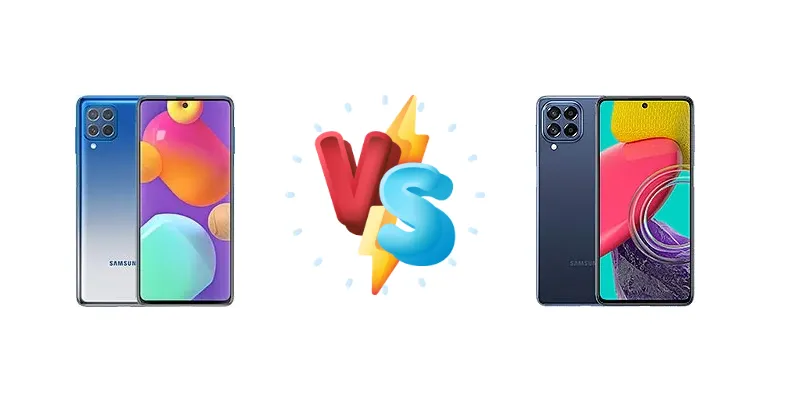
|
🏆 Quick Verdict
For most users, the Samsung Galaxy M53 emerges as the better choice. While the M62’s Exynos 9825 offers raw power, the M53’s Dimensity 900 provides a more efficient experience, coupled with a brighter display and comparable battery life, making it a more well-rounded device.
| PHONES | ||
|---|---|---|
| Phone Names | Samsung Galaxy M62 | Samsung Galaxy M53 |
| Network | ||
|---|---|---|
| 2G bands | GSM 850 / 900 / 1800 / 1900 | GSM 850 / 900 / 1800 / 1900 |
| 3G bands | HSDPA 850 / 900 / 1700(AWS) / 1900 / 2100 | HSDPA 850 / 900 / 1700(AWS) / 1900 / 2100 |
| 4G bands | 1, 2, 3, 4, 5, 7, 8, 12, 17, 20, 26, 28, 38, 40, 41, 66 | 1, 2, 3, 4, 5, 7, 8, 12, 17, 20, 26, 28, 38, 40, 41, 66 |
| 5G bands | - | 1, 3, 5, 7, 8, 20, 28, 38, 40, 41, 66, 78 SA/NSA/Sub6 |
| Speed | HSPA, LTE | HSPA, LTE, 5G |
| Technology | GSM / HSPA / LTE | GSM / HSPA / LTE / 5G |
| Launch | ||
|---|---|---|
| Announced | 2021, February 24 | 2022, April 07 |
| Status | Available. Released 2021, March 03 | Available. Released 2022, April 22 |
| Body | ||
|---|---|---|
| Build | Glass front, plastic back, plastic frame | Glass front (Gorilla Glass 5), plastic back, plastic frame |
| Dimensions | 163.9 x 76.3 x 9.5 mm (6.45 x 3.00 x 0.37 in) | 164.7 x 77 x 7.4 mm (6.48 x 3.03 x 0.29 in) |
| SIM | Nano-SIM + Nano-SIM | Nano-SIM + Nano-SIM |
| Weight | 218 g (7.69 oz) | 176 g (6.21 oz) |
| Display | ||
|---|---|---|
| Protection | - | Corning Gorilla Glass 5 |
| Resolution | 1080 x 2400 pixels, 20:9 ratio (~393 ppi density) | 1080 x 2408 pixels, 20:9 ratio (~394 ppi density) |
| Size | 6.7 inches, 108.4 cm2 (~86.7% screen-to-body ratio) | 6.7 inches, 108.1 cm2 (~85.3% screen-to-body ratio) |
| Type | Super AMOLED Plus, 420 nits (peak) | Super AMOLED Plus, 120Hz |
| Platform | ||
|---|---|---|
| CPU | Octa-core (2x2.73 GHz Exynos M4 & 2x2.40 GHz Cortex-A75 & 4x1.95 GHz Cortex-A55) | Octa-core (2x2.4 GHz Cortex-A78 & 6x2.0 GHz Cortex-A55) |
| Chipset | Exynos 9825 (7 nm) | Mediatek Dimensity 900 (6 nm) |
| GPU | Mali-G76 MP12 | Mali-G68 MC4 |
| OS | Android 11, upgradable to Android 13, One UI 5 | Android 12, upgradable to Android 13, One UI 5.1 |
| Memory | ||
|---|---|---|
| Card slot | microSDXC (dedicated slot) | microSDXC (uses shared SIM slot) |
| Internal | 128GB 8GB RAM, 256GB 8GB RAM | 128GB 6GB RAM, 128GB 8GB RAM, 256GB 8GB RAM |
| Main Camera | ||
|---|---|---|
| Features | LED flash, panorama, HDR | LED flash, panorama, HDR |
| Quad | 64 MP, f/1.8, 26mm (wide), 1/1.73", 0.8µm, PDAF 12 MP, f/2.2, 123˚ (ultrawide) 5 MP (macro) Auxiliary lens | 108 MP, f/1.8, (wide), PDAF 8 MP, f/2.2, (ultrawide), 1/4.0", 1.12µm 2 MP (macro) Auxiliary lens |
| Single | 32 MP, f/2.2, 26mm (wide), 1/2.8", 0.8µm | - |
| Video | 4K@30fps, 1080p@30fps | 4K@30fps, 1080p@30/60fps |
| Selfie camera | ||
|---|---|---|
| Features | HDR | - |
| Single | 32 MP, f/2.2, 26mm (wide), 1/2.8", 0.8µm | 32 MP, f/2.2, 26mm (wide) |
| Video | 4K@30fps, 1080p@30fps | 4K@30fps, 1080p@30fps |
| Sound | ||
|---|---|---|
| 3.5mm jack | Yes | No |
| 35mm jack | Yes | No |
| Loudspeaker | Yes | Yes |
| Comms | ||
|---|---|---|
| Bluetooth | 5.0, A2DP, LE | 5.2, A2DP, LE |
| NFC | Yes | Yes (market/region dependent) |
| Positioning | GPS, GLONASS, GALILEO, BDS | GPS, GLONASS, GALILEO, BDS, QZSS |
| Radio | FM radio, recording | No |
| USB | USB Type-C 2.0, OTG | USB Type-C 2.0, OTG |
| WLAN | Wi-Fi 802.11 a/b/g/n/ac, dual-band, Wi-Fi Direct | Wi-Fi 802.11 a/b/g/n/ac, dual-band, Wi-Fi Direct |
| Features | ||
|---|---|---|
| Sensors | Fingerprint (side-mounted), accelerometer, gyro, proximity, compass | Fingerprint (side-mounted), accelerometer, gyro, proximity, compass |
| Battery | ||
|---|---|---|
| Charging | 25W wired 4.5W reverse wired | 25W wired |
| Type | Li-Po 7000 mAh | Li-Ion 5000 mAh |
| Misc | ||
|---|---|---|
| Colors | Laser Green, Laser Gray, Laser Blue | Green, Blue, Brown |
| Models | SM-M625F, SM-M625F/DS | SM-M536B, SM-M536B/DS, SM-M536B/DSN |
| Price | - | € 249.98 |
| SAR | - | 1.31 W/kg (head) |
| SAR EU | 0.68 W/kg (head) 1.17 W/kg (body) | 0.60 W/kg (head) 1.53 W/kg (body) |
| Tests | ||
|---|---|---|
| Battery life | - | Endurance rating 114h |
| Camera | - | Photo / Video |
| Display | - | Contrast ratio: Infinite (nominal) |
| Loudspeaker | - | -29.3 LUFS (Average) |
Samsung Galaxy M62
- Potentially higher peak CPU performance for short bursts.
- 4.5W reverse wired charging for accessory top-ups.
- May be available at a lower price point due to its age.
- Less efficient Exynos 9825 chipset leads to potential throttling.
- Likely lower display brightness for outdoor visibility.
- Older architecture may struggle with newer software optimizations.
Samsung Galaxy M53
- More efficient Dimensity 900 chipset for sustained performance.
- Brighter display (802 nits) for better outdoor visibility.
- Modern 6nm process for improved thermal management.
- Potentially better image processing thanks to the newer ISP.
- Lacks reverse wireless charging.
- May be slightly more expensive than the older M62.
- Camera performance relies heavily on software optimization.
Display Comparison
The Galaxy M53’s display boasts a measured peak brightness of 802 nits, significantly exceeding what’s likely available on the M62 (Samsung doesn’t publish official peak brightness for the M62). This translates to better outdoor visibility. While both displays have an 'Infinite' contrast ratio (a marketing term), the M53’s higher brightness is a tangible advantage. The M62’s display tech is not specified, but given its release date, it likely lacks the advancements found in the M53’s panel.
Camera Comparison
Both devices offer photo and video capabilities, but detailed camera specs are limited. Without specific sensor details, it’s difficult to make a definitive judgment. However, the M53 benefits from the newer image signal processor (ISP) within the Dimensity 900, potentially leading to improved image processing and noise reduction. The inclusion of OIS (Optical Image Stabilization) on the M53, if present (not specified in data), would further enhance low-light photography and video stability. The presence of a 2MP macro camera on both devices is largely a marketing feature with limited practical benefit.
Performance
The core difference lies in the chipsets. The M62’s Exynos 9825, built on a 7nm process, features a more aggressive CPU core configuration (2x2.73 GHz Exynos M4, 2x2.40 GHz Cortex-A75, 4x1.95 GHz Cortex-A55) aimed at peak performance. However, the M53’s Dimensity 900, fabricated on a more efficient 6nm node, utilizes a Cortex-A78 based CPU (2x2.4 GHz Cortex-A78 & 6x2.0 GHz Cortex-A55). The 6nm process and A78 cores provide better sustained performance and thermal management, meaning the M53 is less likely to throttle under prolonged gaming or heavy multitasking. The M62’s older architecture will likely show its age in optimized applications.
Battery Life
Both the M62 and M53 achieve an endurance rating of 114 hours, suggesting comparable real-world battery life. However, the Dimensity 900’s superior power efficiency in the M53 means it achieves this endurance with potentially less battery capacity (capacity not specified for M62). Both support 25W wired charging, offering similar 0-100% charge times. The M62 also offers 4.5W reverse wired charging, a feature absent in the M53, allowing it to top up accessories.
Buying Guide
Buy the Samsung Galaxy M62 if you prioritize maximum CPU performance for demanding tasks and don't mind potentially shorter battery life under heavy load. Buy the Samsung Galaxy M53 if you value a brighter, more efficient display, a more modern chipset for sustained performance, and a balanced overall experience without sacrificing battery endurance.