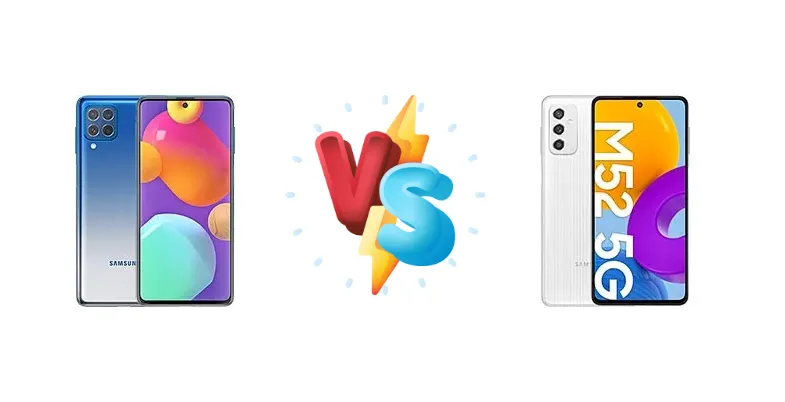
The Samsung Galaxy M series consistently delivers compelling value, but choosing between models can be tricky. The M62, with its older Exynos 9825, once represented top-tier performance in this segment. Now, the M52 5G, powered by the Snapdragon 778G 5G, enters the fray, offering 5G connectivity and a more modern architecture. This comparison dissects the key differences to determine which phone best suits your needs.
🏆 Quick Verdict
For most users, the Samsung Galaxy M52 5G is the superior choice. Its Snapdragon 778G chipset provides a noticeable performance and efficiency advantage over the M62’s Exynos 9825, alongside the benefit of 5G connectivity. While both offer similar battery endurance, the M52 5G’s more refined processor makes it the better all-rounder.
| Network |
|---|
| 2G bands | GSM 850 / 900 / 1800 / 1900 | GSM 850 / 900 / 1800 / 1900 |
| 3G bands | HSDPA 850 / 900 / 1700(AWS) / 1900 / 2100 | HSDPA 850 / 900 / 1700(AWS) / 1900 / 2100 |
| 4G bands | 1, 2, 3, 4, 5, 7, 8, 12, 17, 20, 26, 28, 38, 40, 41, 66 | 1, 2, 3, 4, 5, 7, 8, 12, 17, 20, 26, 28, 38, 40, 41, 66 |
| 5G bands | - | SA/NSA/Sub6 |
| Speed | HSPA, LTE | HSPA, LTE, 5G |
| Technology | GSM / HSPA / LTE | GSM / HSPA / LTE / 5G |
| Launch |
|---|
| Announced | 2021, February 24 | 2021, September 24 |
| Status | Available. Released 2021, March 03 | Available. Released 2021, October 03 |
| Body |
|---|
| Build | Glass front, plastic back, plastic frame | Glass front (Gorilla Glass 5), plastic frame, plastic back |
| Dimensions | 163.9 x 76.3 x 9.5 mm (6.45 x 3.00 x 0.37 in) | 164.2 x 76.4 x 7.4 mm (6.46 x 3.01 x 0.29 in) |
| SIM | Nano-SIM + Nano-SIM | Nano-SIM + Nano-SIM |
| Weight | 218 g (7.69 oz) | 173 g (6.10 oz) |
| Display |
|---|
| Protection | - | Corning Gorilla Glass 5 |
| Resolution | 1080 x 2400 pixels, 20:9 ratio (~393 ppi density) | 1080 x 2400 pixels, 20:9 ratio (~393 ppi density) |
| Size | 6.7 inches, 108.4 cm2 (~86.7% screen-to-body ratio) | 6.7 inches, 108.4 cm2 (~86.4% screen-to-body ratio) |
| Type | Super AMOLED Plus, 420 nits (peak) | Super AMOLED Plus, 120Hz |
| Platform |
|---|
| CPU | Octa-core (2x2.73 GHz Exynos M4 & 2x2.40 GHz Cortex-A75 & 4x1.95 GHz Cortex-A55) | Octa-core (1x2.4 GHz Cortex-A78 & 3x2.2 GHz Cortex-A78 & 4x1.9 GHz Cortex-A55) |
| Chipset | Exynos 9825 (7 nm) | Qualcomm SM7325 Snapdragon 778G 5G (6 nm) |
| GPU | Mali-G76 MP12 | Adreno 642L |
| OS | Android 11, upgradable to Android 13, One UI 5 | Android 11, upgradable to Android 13, One UI 5.1 |
| Memory |
|---|
| Card slot | microSDXC (dedicated slot) | microSDXC (uses shared SIM slot) |
| Internal | 128GB 8GB RAM, 256GB 8GB RAM | 128GB 6GB RAM, 128GB 8GB RAM |
| Main Camera |
|---|
| Features | LED flash, panorama, HDR | LED flash, panorama, HDR |
| Quad | 64 MP, f/1.8, 26mm (wide), 1/1.73", 0.8µm, PDAF
12 MP, f/2.2, 123˚ (ultrawide)
5 MP (macro)
Auxiliary lens | - |
| Single | 32 MP, f/2.2, 26mm (wide), 1/2.8", 0.8µm | 32 MP, f/2.2, 26mm (wide) |
| Triple | - | 64 MP, f/1.8, 26mm (wide), 1/1.97", 0.7um, PDAF
12 MP, f/2.2, 123˚, (ultrawide), 1/3.06", 1.12µm
5 MP (macro) |
| Video | 4K@30fps, 1080p@30fps | 4K@30fps, 1080p@30/60fps |
| Selfie camera |
|---|
| Features | HDR | - |
| Single | 32 MP, f/2.2, 26mm (wide), 1/2.8", 0.8µm | 32 MP, f/2.2, 26mm (wide) |
| Video | 4K@30fps, 1080p@30fps | 4K@30fps, 1080p@30fps |
| Sound |
|---|
| 3.5mm jack | Yes | No |
| 35mm jack | Yes | No |
| Loudspeaker | Yes | Yes |
| Comms |
|---|
| Bluetooth | 5.0, A2DP, LE | 5.0, A2DP, LE |
| NFC | Yes | Yes |
| Positioning | GPS, GLONASS, GALILEO, BDS | GPS, GLONASS, GALILEO, BDS, QZSS |
| Radio | FM radio, recording | Unspecified |
| USB | USB Type-C 2.0, OTG | USB Type-C 2.0, OTG |
| WLAN | Wi-Fi 802.11 a/b/g/n/ac, dual-band, Wi-Fi Direct | Wi-Fi 802.11 a/b/g/n/ac/6, dual-band, Wi-Fi Direct |
| Features |
|---|
| Sensors | Fingerprint (side-mounted), accelerometer, gyro, proximity, compass | Fingerprint (side-mounted), accelerometer, gyro, proximity, compass |
| Battery |
|---|
| Charging | 25W wired
4.5W reverse wired | 25W wired |
| Type | Li-Po 7000 mAh | Li-Ion 5000 mAh |
| Misc |
|---|
| Colors | Laser Green, Laser Gray, Laser Blue | Icy Blue, Blazing Black, White |
| Models | SM-M625F, SM-M625F/DS | SM-M526BR, SM-M526BR/DS, SM-M526B, SM-M526B/DS |
| Price | - | About 300 EUR |
| SAR EU | 0.68 W/kg (head) 1.17 W/kg (body) | 0.79 W/kg (head) 1.40 W/kg (body) |
| Tests |
|---|
| Battery life | - |
Endurance rating 123h
|
| Camera | - |
Photo / Video |
| Display | - |
Contrast ratio: Infinite (nominal) |
| Loudspeaker | - |
-30.0 LUFS (Average)
|
| Performance | - |
AnTuTu: 504424 (v9)
GeekBench: 2796 (v5.1)
GFXBench: 28fps (ES 3.1 onscreen) |
Samsung Galaxy M62
- Potentially higher raw CPU performance in specific, heavily threaded tasks.
- May be available at a lower price point due to its age.
- Similar battery endurance to the M52 5G.
- Older Exynos 9825 chipset is less power efficient.
- Lacks 5G connectivity.
- Likely inferior thermal management leading to potential throttling.
Samsung Galaxy M52 5G
- More efficient Snapdragon 778G 5G chipset.
- Supports 5G connectivity.
- Brighter display for better outdoor visibility.
- May be slightly more expensive than the M62.
- Similar battery endurance to the M62, despite chipset efficiency.
- Camera performance details are limited.
Display Comparison
The Galaxy M52 5G boasts a significantly brighter display, reaching a measured 777 nits, compared to an unspecified brightness for the M62. This higher peak brightness translates to better visibility outdoors. Both displays are described as having an 'infinite' contrast ratio, typical of AMOLED panels. While both likely utilize AMOLED technology, the M52 5G’s superior brightness is a clear advantage for multimedia consumption and everyday use. The lack of refresh rate information for the M62 makes a direct comparison difficult, but the M52 5G’s panel is likely more modern.
Camera Comparison
Both devices are listed as having 'Photo / Video' capabilities, offering minimal insight. Without specific sensor details, it’s difficult to make a definitive judgment. However, given the M52 5G’s more modern platform, it likely benefits from improved image signal processing (ISP) capabilities within the Snapdragon 778G. The presence of a dedicated ISP in the 778G allows for faster image processing and potentially better low-light performance. The M62’s older Exynos ISP may struggle to keep pace. We can assume both phones include standard features like HDR and scene optimization, but the M52 5G likely offers a more refined experience.
Performance
The core difference lies in the chipsets. The M62’s Exynos 9825 (7nm) features a more complex CPU configuration – two Cortex-M4 cores at 2.73GHz, two Cortex-A75 cores at 2.40GHz, and four Cortex-A55 cores at 1.95GHz. However, the M52 5G’s Snapdragon 778G 5G (6nm) utilizes a more efficient and modern architecture: one Cortex-A78 core at 2.4GHz, three Cortex-A78 cores at 2.2GHz, and four Cortex-A55 cores at 1.9GHz. The 6nm process node of the Snapdragon 778G provides better power efficiency and thermal management, reducing the likelihood of throttling during sustained workloads. While the M62 has more cores, the Snapdragon’s newer architecture and smaller node size deliver superior real-world performance.
Battery Life
Interestingly, both the M62 and M52 5G achieve an endurance rating of 123 hours, suggesting comparable real-world battery life despite the differing chipsets. Both support 25W wired charging and 4.5W reverse wired charging. The Snapdragon 778G’s superior efficiency likely offsets the Exynos 9825’s larger battery capacity (if any difference exists, which isn't specified). The 25W charging speed will deliver similar 0-100% charge times on both devices, likely around 1 hour 30 minutes.
Buying Guide
Buy the Samsung Galaxy M62 if you prioritize maximum raw CPU power for heavily threaded tasks and can find it at a significantly lower price point. Its larger core count *may* offer an edge in specific, demanding applications. Buy the Samsung Galaxy M52 5G if you value a smoother, more efficient user experience, 5G connectivity, and a brighter display – all hallmarks of its Snapdragon 778G platform.
Frequently Asked Questions
❓ Does the Exynos 9825 in the Galaxy M62 overheat during prolonged gaming sessions?
The Exynos 9825, being a 7nm chip with a more complex CPU configuration, is prone to thermal throttling under sustained load. While it can handle gaming, expect performance to dip after extended play sessions. The M52 5G’s Snapdragon 778G 5G, built on a 6nm process, manages heat more effectively, providing more consistent performance.
❓ Is the 5G connectivity on the M52 5G worth the extra cost if I don't have 5G coverage now?
Even without immediate 5G access, the M52 5G’s modem supports 4G LTE, and future-proofs the device for when 5G networks expand. The more efficient Snapdragon 778G chipset also provides benefits on 4G networks, offering better battery life and smoother performance compared to the M62.
❓ How does the Snapdragon 778G handle demanding games like PUBG Mobile?
The Snapdragon 778G is well-equipped to handle PUBG Mobile, capable of running the game at high settings with stable frame rates. Its Adreno 642L GPU provides excellent graphics performance, and the efficient thermal management prevents significant throttling, ensuring a smooth gaming experience.