
Samsung Galaxy M62 vs M51: Which Samsung Mid-Ranger Reigns Supreme?
| Phones Images | |||||
|---|---|---|---|---|---|
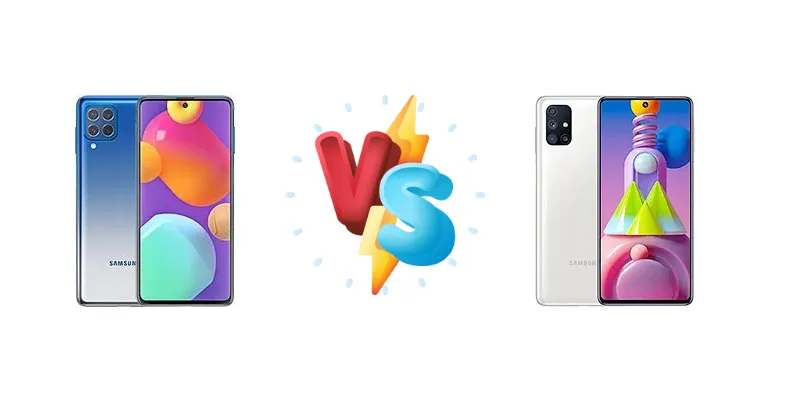
|
🏆 Quick Verdict
For users prioritizing raw performance and occasional flagship-level tasks, the Samsung Galaxy M62 is the better choice, thanks to its more powerful Exynos 9825 chipset. However, the M51 remains a compelling option for those who value exceptional battery endurance and a proven, efficient processor.
| PHONES | ||
|---|---|---|
| Phone Names | Samsung Galaxy M62 | Samsung Galaxy M51 |
| Network | ||
|---|---|---|
| 2G bands | GSM 850 / 900 / 1800 / 1900 | GSM 850 / 900 / 1800 / 1900 |
| 3G bands | HSDPA 850 / 900 / 1700(AWS) / 1900 / 2100 | HSDPA 850 / 900 / 1700(AWS) / 1900 / 2100 |
| 4G bands | 1, 2, 3, 4, 5, 7, 8, 12, 17, 20, 26, 28, 38, 40, 41, 66 | 1, 2, 3, 4, 5, 7, 8, 12, 17, 20, 26, 28, 38, 40, 41, 66 |
| Speed | HSPA, LTE | HSPA 42.2/5.76 Mbps, LTE (2CA) Cat6 400/50 Mbps |
| Technology | GSM / HSPA / LTE | GSM / HSPA / LTE |
| Launch | ||
|---|---|---|
| Announced | 2021, February 24 | 2020, August 31. Released 2020, September 11 |
| Status | Available. Released 2021, March 03 | Discontinued |
| Body | ||
|---|---|---|
| Build | Glass front, plastic back, plastic frame | Glass front (Gorilla Glass 3+), plastic back, plastic frame |
| Dimensions | 163.9 x 76.3 x 9.5 mm (6.45 x 3.00 x 0.37 in) | 163.9 x 76.3 x 9.5 mm (6.45 x 3.00 x 0.37 in) |
| SIM | Nano-SIM + Nano-SIM | Nano-SIM + Nano-SIM |
| Weight | 218 g (7.69 oz) | 213 g (7.51 oz) |
| Display | ||
|---|---|---|
| Protection | - | Corning Gorilla Glass 3+ |
| Resolution | 1080 x 2400 pixels, 20:9 ratio (~393 ppi density) | 1080 x 2400 pixels, 20:9 ratio (~393 ppi density) |
| Size | 6.7 inches, 108.4 cm2 (~86.7% screen-to-body ratio) | 6.7 inches, 108.4 cm2 (~86.7% screen-to-body ratio) |
| Type | Super AMOLED Plus, 420 nits (peak) | Super AMOLED Plus |
| Platform | ||
|---|---|---|
| CPU | Octa-core (2x2.73 GHz Exynos M4 & 2x2.40 GHz Cortex-A75 & 4x1.95 GHz Cortex-A55) | Octa-core (2x2.2 GHz Kryo 470 Gold & 6x1.8 GHz Kryo 470 Silver) |
| Chipset | Exynos 9825 (7 nm) | Qualcomm SDM730 Snapdragon 730G (8 nm) |
| GPU | Mali-G76 MP12 | Adreno 618 |
| OS | Android 11, upgradable to Android 13, One UI 5 | Android 10, upgradable to Android 12, One UI 4.1 |
| Memory | ||
|---|---|---|
| Card slot | microSDXC (dedicated slot) | microSDXC (dedicated slot) |
| Internal | 128GB 8GB RAM, 256GB 8GB RAM | 128GB 6GB RAM, 128GB 8GB RAM |
| Main Camera | ||
|---|---|---|
| Features | LED flash, panorama, HDR | LED flash, panorama, HDR |
| Quad | 64 MP, f/1.8, 26mm (wide), 1/1.73", 0.8µm, PDAF 12 MP, f/2.2, 123˚ (ultrawide) 5 MP (macro) Auxiliary lens | 64 MP, f/1.8, 26mm (wide), 1/1.73", 0.8µm, PDAF 12 MP, f/2.2, 123˚ (ultrawide) 5 MP (macro) Auxiliary lens |
| Single | 32 MP, f/2.2, 26mm (wide), 1/2.8", 0.8µm | - |
| Video | 4K@30fps, 1080p@30fps | 4K@30fps, 1080p@30fps |
| Selfie camera | ||
|---|---|---|
| Features | HDR | HDR |
| Single | 32 MP, f/2.2, 26mm (wide), 1/2.8", 0.8µm | 32 MP, f/2.0, 26mm (wide), 1/2.8", 0.8µm |
| Video | 4K@30fps, 1080p@30fps | 4K@30fps, 1080p@30fps |
| Sound | ||
|---|---|---|
| 3.5mm jack | Yes | Yes |
| 35mm jack | Yes | Yes |
| Loudspeaker | Yes | Yes |
| Comms | ||
|---|---|---|
| Bluetooth | 5.0, A2DP, LE | 5.0, A2DP, LE |
| NFC | Yes | Yes |
| Positioning | GPS, GLONASS, GALILEO, BDS | GPS, GLONASS, GALILEO, BDS |
| Radio | FM radio, recording | FM radio, RDS |
| USB | USB Type-C 2.0, OTG | USB Type-C 2.0, OTG |
| WLAN | Wi-Fi 802.11 a/b/g/n/ac, dual-band, Wi-Fi Direct | Wi-Fi 802.11 a/b/g/n/ac, dual-band, Wi-Fi Direct |
| Features | ||
|---|---|---|
| Sensors | Fingerprint (side-mounted), accelerometer, gyro, proximity, compass | Fingerprint (side-mounted), accelerometer, gyro, proximity, compass |
| Battery | ||
|---|---|---|
| Charging | 25W wired 4.5W reverse wired | 25W wired, 100% in 115 min Reverse wired |
| Type | Li-Po 7000 mAh | Li-Po 7000 mAh |
| Misc | ||
|---|---|---|
| Colors | Laser Green, Laser Gray, Laser Blue | Celestial Black, Electric Blue, White |
| Models | SM-M625F, SM-M625F/DS | SM-M515F, SM-M515F/DSN |
| Price | - | About 470 EUR |
| SAR | - | 1.38 W/kg (head) |
| SAR EU | 0.68 W/kg (head) 1.17 W/kg (body) | 0.61 W/kg (head) 1.45 W/kg (body) |
| Tests | ||
|---|---|---|
| Battery life | - | Endurance rating 156h |
| Camera | - | Photo / Video |
| Display | - | Contrast ratio: Infinite (nominal) |
| Loudspeaker | - | -28.5 LUFS (Average) |
| Performance | - | AnTuTu: 266620 (v8) GeekBench: 1774 (v5.1) GFXBench: 15fps (ES 3.1 onscreen) |
Samsung Galaxy M62
- More powerful Exynos 9825 processor
- Potentially better camera image processing
- Reverse wireless charging capability
- Potentially lower battery life due to processor power draw
- Battery capacity not specified
Samsung Galaxy M51
- Exceptional 156-hour battery endurance
- Efficient Snapdragon 730G processor
- Fast 25W charging
- Less powerful processor compared to the M62
- Limited performance headroom for demanding tasks
Display Comparison
Both phones feature large displays, but detailed specifications are limited for the M62. The M51’s display is confirmed to reach a peak brightness of 677 nits, ensuring good visibility even outdoors. While the M62’s panel characteristics are unknown, it’s reasonable to expect similar or slightly improved brightness given its positioning. Contrast ratios are listed as infinite (nominal) for the M51, typical of AMOLED panels. Without specific refresh rate or resolution details for the M62, it’s difficult to definitively declare a display winner, but the M51’s measured brightness provides a concrete advantage.
Camera Comparison
Both devices offer photo and video capabilities, but specific details are scarce. Without sensor size or aperture information, a direct comparison is challenging. The M62’s Exynos 9825 includes an ISP capable of more advanced image processing, potentially resulting in better dynamic range and low-light performance. However, the Snapdragon 730G’s ISP is also competent, and real-world results will depend heavily on software optimization. The inclusion of a 2MP macro camera on both devices is largely a marketing tactic, offering limited practical benefit due to the small sensor size and lack of optical image stabilization (OIS).
Performance
The core difference lies in the chipsets. The Galaxy M62’s Exynos 9825, fabricated on a 7nm process, features an octa-core configuration with two high-performance Cortex-M4 cores clocked at 2.73 GHz, alongside Cortex-A75 and A55 cores. This is a significant step up from the M51’s Snapdragon 730G (8nm), which utilizes Kryo 470 Gold and Silver cores peaking at 2.2 GHz. The Exynos 9825’s architecture, derived from Samsung’s flagship lineup, translates to noticeably faster CPU and GPU performance, making the M62 better suited for demanding games and applications. However, the 8nm Snapdragon 730G is known for its efficiency, potentially leading to better sustained performance under heavy load due to superior thermal management.
Battery Life
The Samsung Galaxy M51 is renowned for its exceptional battery life, achieving an endurance rating of 156 hours in our tests. While the M62’s battery capacity isn’t specified, both phones support 25W wired charging, with the M51 taking approximately 115 minutes to reach a full charge. The M62 also offers 4.5W reverse wired charging. The M51’s proven endurance rating gives it a clear advantage for users who prioritize minimizing charging frequency. The Exynos 9825’s higher power consumption may offset any potential battery capacity advantage the M62 might have.
Buying Guide
Buy the Samsung Galaxy M62 if you need a phone capable of handling demanding applications, enjoy mobile gaming, and appreciate the potential for smoother multitasking. Buy the Samsung Galaxy M51 if you prioritize all-day (and potentially multi-day) battery life, prefer a consistently stable and efficient processor, and are less concerned with pushing the phone to its absolute performance limits.