
Samsung Galaxy M62 vs M33: Which Exynos Mid-Ranger Reigns Supreme?
| Phones Images | |||||
|---|---|---|---|---|---|
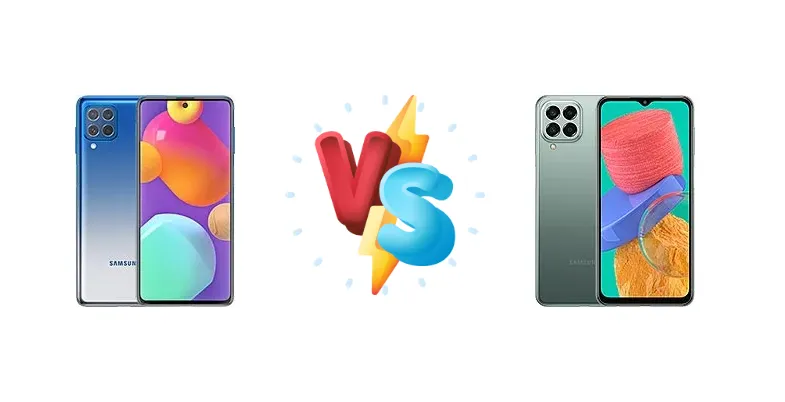
|
🏆 Quick Verdict
For most users, the Samsung Galaxy M33 is the better buy. Its Exynos 1280, built on a more efficient 5nm process, provides a noticeable performance uplift and improved power efficiency compared to the M62’s 7nm Exynos 9825. While the M62 offers a larger screen, the M33’s modern architecture and optimized software experience make it the more compelling choice.
| PHONES | ||
|---|---|---|
| Phone Names | Samsung Galaxy M62 | Samsung Galaxy M33 |
| Network | ||
|---|---|---|
| 2G bands | GSM 850 / 900 / 1800 / 1900 | GSM 850 / 900 / 1800 / 1900 |
| 3G bands | HSDPA 850 / 900 / 1700(AWS) / 1900 / 2100 | HSDPA 850 / 900 / 1700(AWS) / 1900 / 2100 |
| 4G bands | 1, 2, 3, 4, 5, 7, 8, 12, 17, 20, 26, 28, 38, 40, 41, 66 | 1, 2, 3, 4, 5, 7, 8, 12, 17, 20, 26, 28, 38, 40, 41, 66 |
| 5G bands | - | 1, 3, 5, 7, 8, 20, 28, 38, 40, 41, 66, 78 SA/NSA |
| Speed | HSPA, LTE | HSPA, LTE, 5G |
| Technology | GSM / HSPA / LTE | GSM / HSPA / LTE / 5G |
| Launch | ||
|---|---|---|
| Announced | 2021, February 24 | 2022, March 04 |
| Status | Available. Released 2021, March 03 | Available. Released 2022, April 08 |
| Body | ||
|---|---|---|
| Build | Glass front, plastic back, plastic frame | Glass front (Gorilla Glass 5), plastic frame, plastic back |
| Dimensions | 163.9 x 76.3 x 9.5 mm (6.45 x 3.00 x 0.37 in) | 165.4 x 76.9 x 9.4 mm (6.51 x 3.03 x 0.37 in) |
| SIM | Nano-SIM + Nano-SIM | · Nano-SIM· Nano-SIM + Nano-SIM |
| Weight | 218 g (7.69 oz) | 198 g (Global) / 215 g (India) (6.98 oz) |
| Display | ||
|---|---|---|
| Protection | - | Corning Gorilla Glass 5 |
| Resolution | 1080 x 2400 pixels, 20:9 ratio (~393 ppi density) | 1080 x 2408 pixels, 20:9 ratio (~400 ppi density) |
| Size | 6.7 inches, 108.4 cm2 (~86.7% screen-to-body ratio) | 6.6 inches, 104.9 cm2 (~82.5% screen-to-body ratio) |
| Type | Super AMOLED Plus, 420 nits (peak) | TFT LCD, 120Hz |
| Platform | ||
|---|---|---|
| CPU | Octa-core (2x2.73 GHz Exynos M4 & 2x2.40 GHz Cortex-A75 & 4x1.95 GHz Cortex-A55) | Octa-core (2x2.4 GHz Cortex-A78 & 6x2.0 GHz Cortex-A55) |
| Chipset | Exynos 9825 (7 nm) | Exynos 1280 (5 nm) |
| GPU | Mali-G76 MP12 | Mali-G68 |
| OS | Android 11, upgradable to Android 13, One UI 5 | Android 12, upgradable to Android 16, One UI 8 |
| Memory | ||
|---|---|---|
| Card slot | microSDXC (dedicated slot) | microSDXC (dedicated slot) |
| Internal | 128GB 8GB RAM, 256GB 8GB RAM | 128GB 6GB RAM, 128GB 8GB RAM |
| - | UFS 2.2 | |
| Main Camera | ||
|---|---|---|
| Features | LED flash, panorama, HDR | LED flash, panorama, HDR |
| Quad | 64 MP, f/1.8, 26mm (wide), 1/1.73", 0.8µm, PDAF 12 MP, f/2.2, 123˚ (ultrawide) 5 MP (macro) Auxiliary lens | 50 MP, f/1.8, (wide), PDAF 5 MP, f/2.2, 123˚ (ultrawide) 2 MP (macro) Auxiliary lens |
| Single | 32 MP, f/2.2, 26mm (wide), 1/2.8", 0.8µm | 8 MP, f/2.2, (wide) |
| Video | 4K@30fps, 1080p@30fps | 4K@30fps, 1080p@30fps |
| Selfie camera | ||
|---|---|---|
| Features | HDR | - |
| Single | 32 MP, f/2.2, 26mm (wide), 1/2.8", 0.8µm | 8 MP, f/2.2, (wide) |
| Video | 4K@30fps, 1080p@30fps | 1080p@30fps |
| Sound | ||
|---|---|---|
| 3.5mm jack | Yes | Yes |
| 35mm jack | Yes | Yes |
| Loudspeaker | Yes | Yes |
| Comms | ||
|---|---|---|
| Bluetooth | 5.0, A2DP, LE | 5.1, A2DP, LE |
| NFC | Yes | Yes |
| Positioning | GPS, GLONASS, GALILEO, BDS | GPS, GLONASS, GALILEO, BDS, QZSS |
| Radio | FM radio, recording | Unspecified |
| USB | USB Type-C 2.0, OTG | USB Type-C 2.0, OTG |
| WLAN | Wi-Fi 802.11 a/b/g/n/ac, dual-band, Wi-Fi Direct | Wi-Fi 802.11 a/b/g/n/ac, dual-band, Wi-Fi Direct |
| Features | ||
|---|---|---|
| Sensors | Fingerprint (side-mounted), accelerometer, gyro, proximity, compass | Fingerprint (side-mounted), accelerometer, gyro |
| - | Virtual Proximity Sensing | |
| Battery | ||
|---|---|---|
| Charging | 25W wired 4.5W reverse wired | 25W wired 4.5W reverse wired |
| Type | Li-Po 7000 mAh | Market-dependent versions:· Li-Ion 5000 mAh (Global)· Li-Ion 6000 mAh (India only) |
| Misc | ||
|---|---|---|
| Colors | Laser Green, Laser Gray, Laser Blue | Green, Blue, Brown |
| Models | SM-M625F, SM-M625F/DS | SM-M336B, SM-M336B/DS, SM-M336BU, SM-M336BU/DS, SM-M336K |
| Price | - | £ 299.00 |
| SAR EU | 0.68 W/kg (head) 1.17 W/kg (body) | 1.04 W/kg (head) 1.38 W/kg (body) |
Samsung Galaxy M62
- Potentially lower price point due to age.
- Larger display size for media consumption.
- Reliable performance for basic tasks.
- Less efficient Exynos 9825 chipset.
- Older architecture and potentially shorter software support.
- Likely inferior image processing capabilities.
Samsung Galaxy M33
- More efficient Exynos 1280 chipset (5nm).
- Improved CPU performance with Cortex-A78 cores.
- Likely longer software support and updates.
- Better image processing for superior camera performance.
- Potentially higher price compared to the M62.
- May have a smaller display size.
Display Comparison
While both phones likely feature similar LCD panels, the M62’s larger size is its primary advantage. However, display quality beyond size isn’t specified. The M33 benefits from a newer chipset capable of driving higher refresh rates (though not confirmed in the provided data), potentially offering a smoother visual experience. The absence of details like peak brightness or color gamut makes a definitive comparison difficult, but the M33’s newer processing capabilities suggest better image processing for display output.
Camera Comparison
Without detailed camera specifications, a direct comparison is limited. However, the chipset plays a crucial role in image signal processing (ISP). The Exynos 1280 in the M33 likely boasts a more advanced ISP, enabling better noise reduction, dynamic range, and overall image quality, especially in low-light conditions. The M62’s older ISP may struggle to keep pace with modern computational photography techniques. The presence of a 2MP macro lens on both devices is largely inconsequential; image quality from such sensors is typically poor.
Performance
The core difference lies in the chipsets. The M62’s Exynos 9825, while powerful for its time, is built on a 7nm process. The M33’s Exynos 1280, fabricated on a 5nm node, is significantly more efficient. This translates to better thermal management and sustained performance under load. The M33’s CPU configuration – 2x2.4 GHz Cortex-A78 & 6x2.0 GHz Cortex-A55 – represents a generational leap over the M62’s 2x2.73 GHz Exynos M4 & 2x2.40 GHz Cortex-A75 & 4x1.95 GHz Cortex-A55. The Cortex-A78 cores in the M33 offer superior single-core performance, crucial for responsive app launches and smoother multitasking. The M33’s more efficient architecture will also result in lower power consumption during demanding tasks.
Battery Life
Both phones offer 25W wired charging and 4.5W reverse wired charging. While battery capacity isn’t specified, the M33’s more efficient Exynos 1280 will likely deliver longer real-world battery life despite potentially having a smaller battery. The 5nm process reduces power consumption across the board, extending usage between charges. The M33’s optimized power management features, coupled with the efficient chipset, will result in a noticeable improvement in battery endurance.
Buying Guide
Buy the Samsung Galaxy M62 if you prioritize a larger display and are looking for a phone that can still handle everyday tasks reliably at a potentially lower price point. Buy the Samsung Galaxy M33 if you value performance, efficiency, and a more modern chipset that will likely receive longer software support. Gamers and multitasking users will particularly benefit from the M33’s Exynos 1280.