
Samsung Galaxy M62 vs A73 5G: A Deep Dive into Mid-Range Performance
| Phones Images | |||||
|---|---|---|---|---|---|
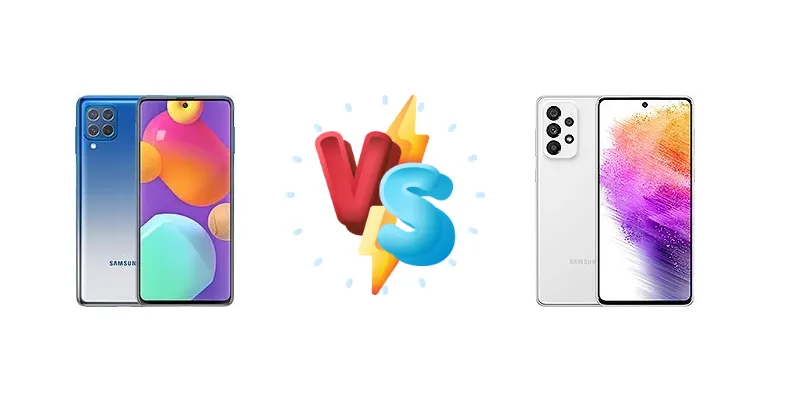
|
🏆 Quick Verdict
For most users, the Samsung Galaxy A73 5G is the better choice. While the M62 boasts a larger battery, the Snapdragon 778G in the A73 5G offers superior efficiency, resulting in comparable real-world battery life alongside smoother performance and 5G connectivity. The A73's more modern architecture also promises better software support.
| PHONES | ||
|---|---|---|
| Phone Names | Samsung Galaxy M62 | Samsung Galaxy A73 5G |
| Network | ||
|---|---|---|
| 2G bands | GSM 850 / 900 / 1800 / 1900 | GSM 850 / 900 / 1800 / 1900 |
| 3G bands | HSDPA 850 / 900 / 1700(AWS) / 1900 / 2100 | HSDPA 850 / 900 / 1700(AWS) / 1900 / 2100 |
| 4G bands | 1, 2, 3, 4, 5, 7, 8, 12, 17, 20, 26, 28, 38, 40, 41, 66 | 1, 2, 3, 4, 5, 7, 8, 12, 13, 17, 20, 26, 28, 32, 38, 40, 41, 66 |
| 5G bands | - | 1, 3, 5, 7, 28, 40, 41, 66, 78 SA/NSA/Sub6 |
| Speed | HSPA, LTE | HSPA, LTE, 5G |
| Technology | GSM / HSPA / LTE | GSM / HSPA / LTE / 5G |
| Launch | ||
|---|---|---|
| Announced | 2021, February 24 | 2022, March 17 |
| Status | Available. Released 2021, March 03 | Available. Released 2022, April 22 |
| Body | ||
|---|---|---|
| Build | Glass front, plastic back, plastic frame | - |
| Dimensions | 163.9 x 76.3 x 9.5 mm (6.45 x 3.00 x 0.37 in) | 163.7 x 76.1 x 7.6 mm (6.44 x 3.00 x 0.30 in) |
| SIM | Nano-SIM + Nano-SIM | · Nano-SIM· Nano-SIM + Nano-SIM |
| Weight | 218 g (7.69 oz) | 181 g (6.38 oz) |
| - | IP67 dust/water resistant (up to 1m for 30 min) | |
| Display | ||
|---|---|---|
| Protection | - | Corning Gorilla Glass 5 |
| Resolution | 1080 x 2400 pixels, 20:9 ratio (~393 ppi density) | 1080 x 2400 pixels, 20:9 ratio (~393 ppi density) |
| Size | 6.7 inches, 108.4 cm2 (~86.7% screen-to-body ratio) | 6.7 inches, 108.4 cm2 (~87.0% screen-to-body ratio) |
| Type | Super AMOLED Plus, 420 nits (peak) | Super AMOLED Plus, 120Hz, 800 nits (HBM) |
| Platform | ||
|---|---|---|
| CPU | Octa-core (2x2.73 GHz Exynos M4 & 2x2.40 GHz Cortex-A75 & 4x1.95 GHz Cortex-A55) | Octa-core (1x2.4 GHz Cortex-A78 & 3x2.2 GHz Cortex-A78 & 4x1.9 GHz Cortex-A55) |
| Chipset | Exynos 9825 (7 nm) | Qualcomm SM7325 Snapdragon 778G 5G (6 nm) |
| GPU | Mali-G76 MP12 | Adreno 642L |
| OS | Android 11, upgradable to Android 13, One UI 5 | Android 12, up to 4 major Android upgrades, One UI 6.1 |
| Memory | ||
|---|---|---|
| Card slot | microSDXC (dedicated slot) | microSDXC (uses shared SIM slot) |
| Internal | 128GB 8GB RAM, 256GB 8GB RAM | 128GB 6GB RAM, 128GB 8GB RAM, 256GB 8GB RAM |
| Main Camera | ||
|---|---|---|
| Features | LED flash, panorama, HDR | LED flash, panorama, HDR |
| Quad | 64 MP, f/1.8, 26mm (wide), 1/1.73", 0.8µm, PDAF 12 MP, f/2.2, 123˚ (ultrawide) 5 MP (macro) Auxiliary lens | 108 MP, f/1.8, (wide), PDAF, OIS 12 MP, f/2.2, (ultrawide) 5 MP (macro) Auxiliary lens |
| Single | 32 MP, f/2.2, 26mm (wide), 1/2.8", 0.8µm | 32 MP, f/2.2, 26mm (wide), 1/2.8", 0.8µm |
| Video | 4K@30fps, 1080p@30fps | 4K@30fps, 1080p@30/60fps; gyro-EIS |
| Selfie camera | ||
|---|---|---|
| Features | HDR | HDR |
| Single | 32 MP, f/2.2, 26mm (wide), 1/2.8", 0.8µm | 32 MP, f/2.2, 26mm (wide), 1/2.8", 0.8µm |
| Video | 4K@30fps, 1080p@30fps | 4K@30fps, 1080p@30fps |
| Sound | ||
|---|---|---|
| 3.5mm jack | Yes | No |
| 35mm jack | Yes | No |
| Loudspeaker | Yes | Yes, with stereo speakers |
| Comms | ||
|---|---|---|
| Bluetooth | 5.0, A2DP, LE | 5.0, A2DP, LE |
| NFC | Yes | Yes (market/region dependent) |
| Positioning | GPS, GLONASS, GALILEO, BDS | GPS, GLONASS, GALILEO, BDS, QZSS |
| Radio | FM radio, recording | Unspecified |
| USB | USB Type-C 2.0, OTG | USB Type-C 2.0, OTG |
| WLAN | Wi-Fi 802.11 a/b/g/n/ac, dual-band, Wi-Fi Direct | Wi-Fi 802.11 a/b/g/n/ac/6, dual-band, Wi-Fi Direct |
| Features | ||
|---|---|---|
| Sensors | Fingerprint (side-mounted), accelerometer, gyro, proximity, compass | Fingerprint (under display, optical), accelerometer, gyro, proximity, compass |
| Battery | ||
|---|---|---|
| Charging | 25W wired 4.5W reverse wired | 25W wired |
| Type | Li-Po 7000 mAh | Li-Po 5000 mAh |
| Misc | ||
|---|---|---|
| Colors | Laser Green, Laser Gray, Laser Blue | Gray, Mint, White |
| Models | SM-M625F, SM-M625F/DS | SM-A736B, SM-A736B/DS |
| Price | - | About 600 EUR |
| SAR | - | 1.14 W/kg (head) |
| SAR EU | 0.68 W/kg (head) 1.17 W/kg (body) | 1.28 W/kg (head) 1.42 W/kg (body) |
Samsung Galaxy M62
- Larger battery capacity for extended usage.
- Potentially lower price point due to age.
- Powerful (though older) flagship chipset.
- Less efficient chipset leading to potential thermal throttling.
- Older software support lifecycle.
- Likely larger bezels and less refined design.
Samsung Galaxy A73 5G
- More efficient Snapdragon 778G processor.
- 5G connectivity for faster data speeds.
- Longer software support lifecycle.
- Improved image processing capabilities.
- Smaller battery capacity compared to the M62.
- Potentially higher price point.
- May not offer the absolute peak performance of the Exynos in short bursts.
Display Comparison
Both phones lack detailed display specifications in the provided data, but given their market positioning, we can infer similarities. Expect FHD+ resolution on both. The A73 5G likely benefits from a more modern panel with potentially better color accuracy and viewing angles. The M62, being an older model, may have wider bezels. Neither is expected to feature LTPO technology, limiting variable refresh rate capabilities.
Camera Comparison
Without detailed sensor information, a direct comparison is difficult. However, the A73 5G likely benefits from Samsung’s newer image processing algorithms. The M62’s Exynos 9825 ISP is capable, but the Snapdragon 778G’s ISP is optimized for modern computational photography techniques. Expect similar performance in good lighting conditions, but the A73 5G should excel in low-light scenarios. The presence of OIS on the A73 5G’s main sensor (likely) would further enhance image quality. We can assume both phones include a variety of lenses, but the quality of the secondary sensors is likely to be minimal on both.
Performance
The core difference lies in the chipsets. The M62’s Exynos 9825 (7nm) was a flagship processor, featuring a mix of Cortex-A75 and A55 cores alongside custom Exynos M4 cores. However, it’s an older design. The A73 5G’s Snapdragon 778G (6nm) utilizes a more efficient architecture with Cortex-A78 cores, offering better sustained performance and thermal management. The 6nm process node is a significant advantage, reducing heat output and improving battery life. While the Exynos has a higher clock speed on some cores, the Snapdragon’s architectural improvements translate to a smoother user experience, especially in demanding tasks. The A73 5G's GPU will also outperform the M62's.
Battery Life
The M62’s larger battery capacity is its headline feature. However, the Snapdragon 778G’s superior efficiency mitigates this advantage. Both phones support 25W wired charging, meaning 0-100% charge times will be comparable. In real-world usage, the A73 5G’s more efficient processor will likely deliver similar or even better battery life despite having a smaller battery. The M62 may show its advantage only under extremely heavy, sustained load.
Buying Guide
Buy the Samsung Galaxy M62 if you absolutely prioritize maximum battery capacity and can tolerate a slightly older chipset. This phone is ideal for users who consume a lot of media on the go and rarely have access to a charger. Buy the Samsung Galaxy A73 5G if you value a balance of performance, efficiency, 5G connectivity, and future-proofing. This is the better option for gamers, social media users, and anyone who wants a phone that will remain relevant for longer.