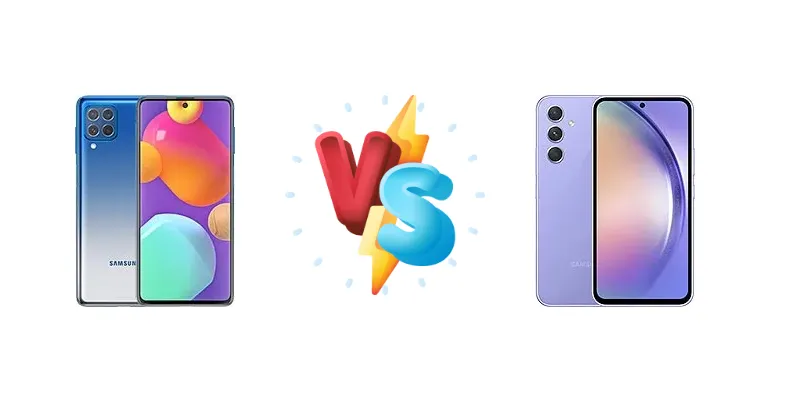
The Samsung Galaxy M62 and A54 represent different approaches to the mid-range market. The M62, released earlier, prioritizes a massive battery and older, but still capable, flagship chipset. The A54, a more recent release, focuses on a refined design, a newer and more efficient processor, and a brighter display. This comparison will dissect the key differences to help you determine which device best suits your needs.
🏆 Quick Verdict
For most users, the Samsung Galaxy A54 is the better choice. While the M62 boasts a larger battery capacity, the A54’s more efficient Exynos 1380 chipset and brighter display deliver a superior overall experience, offering comparable endurance with improved performance and a more modern feature set.
| Network |
|---|
| 2G bands | GSM 850 / 900 / 1800 / 1900 | GSM 850 / 900 / 1800 / 1900 |
| 3G bands | HSDPA 850 / 900 / 1700(AWS) / 1900 / 2100 | HSDPA 850 / 900 / 1700(AWS) / 1900 / 2100 |
| 4G bands | 1, 2, 3, 4, 5, 7, 8, 12, 17, 20, 26, 28, 38, 40, 41, 66 | 1, 2, 3, 4, 5, 7, 8, 12, 17, 20, 26, 28, 32, 38, 40, 41, 66 - International |
| 5G bands | - | 1, 3, 7, 8, 20, 28, 38, 40, 41, 77, 78 SA/NSA/Sub6 - International |
| Speed | HSPA, LTE | HSPA, LTE, 5G |
| Technology | GSM / HSPA / LTE | GSM / HSPA / LTE / 5G |
| | - | 25, 41, 66, 71 SA/NSA/Sub6/mmWave - USA |
| Launch |
|---|
| Announced | 2021, February 24 | 2023, March 15 |
| Status | Available. Released 2021, March 03 | Available. Released 2023, March 24 |
| Body |
|---|
| Build | Glass front, plastic back, plastic frame | Glass front (Gorilla Glass 5), glass back (Gorilla Glass 5), plastic frame |
| Dimensions | 163.9 x 76.3 x 9.5 mm (6.45 x 3.00 x 0.37 in) | 158.2 x 76.7 x 8.2 mm (6.23 x 3.02 x 0.32 in) |
| SIM | Nano-SIM + Nano-SIM | · Nano-SIM + eSIM· Nano-SIM + Nano-SIM |
| Weight | 218 g (7.69 oz) | 202 g (7.13 oz) |
| | - | IP67 dust/water resistant (up to 1m for 30 min) |
| Display |
|---|
| Protection | - | Corning Gorilla Glass 5 |
| Resolution | 1080 x 2400 pixels, 20:9 ratio (~393 ppi density) | 1080 x 2340 pixels, 19.5:9 ratio (~403 ppi density) |
| Size | 6.7 inches, 108.4 cm2 (~86.7% screen-to-body ratio) | 6.4 inches, 100.5 cm2 (~82.9% screen-to-body ratio) |
| Type | Super AMOLED Plus, 420 nits (peak) | Super AMOLED, 120Hz, HDR10+, 1000 nits (HBM) |
| Platform |
|---|
| CPU | Octa-core (2x2.73 GHz Exynos M4 & 2x2.40 GHz Cortex-A75 & 4x1.95 GHz Cortex-A55) | Octa-core (4x2.4 GHz Cortex-A78 & 4x2.0 GHz Cortex-A55) |
| Chipset | Exynos 9825 (7 nm) | Exynos 1380 (5 nm) |
| GPU | Mali-G76 MP12 | Mali-G68 MP5 |
| OS | Android 11, upgradable to Android 13, One UI 5 | Android 13, up to 4 major Android upgrades, One UI 7 |
| Memory |
|---|
| Card slot | microSDXC (dedicated slot) | microSDXC (uses shared SIM slot) |
| Internal | 128GB 8GB RAM, 256GB 8GB RAM | 128GB 4GB RAM, 128GB 6GB RAM, 128GB 8GB RAM, 256GB 6GB RAM, 256GB 8GB RAM |
| Main Camera |
|---|
| Features | LED flash, panorama, HDR | LED flash, panorama, HDR |
| Quad | 64 MP, f/1.8, 26mm (wide), 1/1.73", 0.8µm, PDAF
12 MP, f/2.2, 123˚ (ultrawide)
5 MP (macro)
Auxiliary lens | - |
| Single | 32 MP, f/2.2, 26mm (wide), 1/2.8", 0.8µm | 32 MP, f/2.2, 26mm (wide), 1/2.8", 0.8µm |
| Triple | - | 50 MP, f/1.8, 23mm (wide), 1/1.56", 1.0µm, PDAF, OIS
12 MP, f/2.2, 13mm, 123˚ (ultrawide), 1/3.X", 1.12µm
5 MP (macro) |
| Video | 4K@30fps, 1080p@30fps | 4K@30fps, 1080p@30/60fps, 720p@480fps, gyro-EIS |
| Selfie camera |
|---|
| Features | HDR | - |
| Single | 32 MP, f/2.2, 26mm (wide), 1/2.8", 0.8µm | 32 MP, f/2.2, 26mm (wide), 1/2.8", 0.8µm |
| Video | 4K@30fps, 1080p@30fps | 4K@30fps, 1080p@30/60fps |
| Sound |
|---|
| 3.5mm jack | Yes | No |
| 35mm jack | Yes | No |
| Loudspeaker | Yes | Yes, with stereo speakers |
| Comms |
|---|
| Bluetooth | 5.0, A2DP, LE | 5.3, A2DP, LE |
| NFC | Yes | Yes (market/region dependent) |
| Positioning | GPS, GLONASS, GALILEO, BDS | GPS, GLONASS, GALILEO, BDS |
| Radio | FM radio, recording | No |
| USB | USB Type-C 2.0, OTG | USB Type-C 2.0, OTG |
| WLAN | Wi-Fi 802.11 a/b/g/n/ac, dual-band, Wi-Fi Direct | Wi-Fi 802.11 a/b/g/n/ac/6, dual-band, Wi-Fi Direct |
| Features |
|---|
| Sensors | Fingerprint (side-mounted), accelerometer, gyro, proximity, compass | Fingerprint (under display, optical), accelerometer, gyro, compass, barometer (USA only) |
| | - | Virtual proximity sensing |
| Battery |
|---|
| Charging | 25W wired
4.5W reverse wired | 25W wired |
| Type | Li-Po 7000 mAh | 5000 mAh |
| Misc |
|---|
| Colors | Laser Green, Laser Gray, Laser Blue | Lime, Graphite, Violet, White |
| Models | SM-M625F, SM-M625F/DS | SM-A546V, SM-A546U, SM-A546U1, SM-A546B, SM-A546B/DS, SM-A546E, SM-A546E/DS, SM-A5460, SM-A546M, SM-A546M/DS, SM-A546W |
| Price | - | € 210.00 / $ 119.11 / £ 169.95 / ₹ 28,999 |
| SAR | - | 0.81 W/kg (head) 0.67 W/kg (body) |
| SAR EU | 0.68 W/kg (head) 1.17 W/kg (body) | 0.69 W/kg (head) 1.34 W/kg (body) |
| Tests |
|---|
| Battery life | - |
Endurance rating 119h
|
| Camera | - |
Photo / Video |
| Display | - |
Contrast ratio: Infinite (nominal) |
| Loudspeaker | - |
-26.6 LUFS (Good)
|
| Performance | - |
AnTuTu: 506678 (v9)
GeekBench: 2703 (v5.1), 2797 (v6)
GFXBench: 25fps (ES 3.1 onscreen) |
Samsung Galaxy M62
- Potentially longer battery life for extremely heavy users.
- May be available at a lower price point due to its age.
- Older flagship chipset still offers decent performance.
- Older chipset is less power efficient.
- Display likely lacks the brightness and color accuracy of the A54.
- Camera system is likely less advanced.
Samsung Galaxy A54
- More efficient Exynos 1380 chipset.
- Brighter and more vibrant display.
- Modern design and features.
- Improved camera performance with OIS.
- May be slightly more expensive.
- Battery life, while excellent, may not exceed the M62 for extreme usage.
Display Comparison
The Samsung Galaxy A54 boasts a significantly brighter display, reaching a measured peak brightness of 980 nits, compared to an unspecified brightness for the M62. This makes the A54 far more usable outdoors under direct sunlight. While both displays have an 'Infinite' contrast ratio (nominal), the A54’s Super AMOLED panel likely benefits from improved color accuracy and viewing angles. The M62’s display technology is not specified, suggesting it may be an older generation AMOLED panel. The A54’s display is a clear upgrade for media consumption and everyday use.
Camera Comparison
Both devices offer photo and video capabilities, but detailed sensor information is lacking for the M62. The A54’s camera system is expected to benefit from Samsung’s latest image processing algorithms. While megapixel counts aren’t specified, the A54 likely features a more advanced main sensor with Optical Image Stabilization (OIS), crucial for low-light photography and stable video recording. The M62’s camera system, being older, may struggle in challenging lighting conditions. The inclusion of a 2MP macro camera on both devices is largely a marketing gimmick and offers limited practical benefit.
Performance
The core difference lies in the chipsets. The M62 utilizes the Exynos 9825 (7nm), a flagship chip from 2019, featuring a heterogeneous core configuration with 2x2.73 GHz Exynos M4 cores, 2x2.40 GHz Cortex-A75 cores, and 4x1.95 GHz Cortex-A55 cores. The A54, however, employs the Exynos 1380 (5nm). The move to a 5nm process node is crucial, offering improved power efficiency and thermal performance. The A54’s CPU configuration – 4x2.4 GHz Cortex-A78 and 4x2.0 GHz Cortex-A55 – while different, delivers comparable, and in many cases superior, performance due to architectural improvements and the smaller fabrication process. The A54 will likely exhibit less throttling under sustained loads.
Battery Life
The Galaxy M62’s battery capacity isn’t specified, but it’s known for its exceptional endurance. However, the A54 achieves a comparable endurance rating of 119 hours and an active use score of 11:15h, demonstrating the efficiency gains of the Exynos 1380. Both phones support 25W wired charging, and 4.5W reverse wired charging. The A54’s efficiency means it can deliver similar real-world battery life despite potentially having a smaller battery capacity. The M62’s larger battery is beneficial for extremely heavy users, but the A54 offers a more balanced approach.
Buying Guide
Buy the Samsung Galaxy M62 if you absolutely prioritize maximum battery life above all else and are comfortable with a slightly older chipset. This phone is ideal for users who frequently find themselves away from a charger and primarily use their phone for basic tasks. Buy the Samsung Galaxy A54 if you prefer a more balanced experience with a brighter, more vibrant display, a more efficient processor for smoother multitasking and gaming, and a more modern design aesthetic.
Frequently Asked Questions
❓ Does the Exynos 9825 in the M62 overheat during prolonged gaming sessions?
The Exynos 9825, being a 7nm chip, can experience thermal throttling during extended gaming. While capable, it won't maintain peak performance as consistently as the more efficient 5nm Exynos 1380 in the A54. Expect some frame drops in demanding titles after prolonged play.
❓ Is the 25W charging on both phones equally fast in practice?
While both support 25W charging, the A54’s more efficient power management system may result in slightly faster overall charging times, even though the wattage is the same. The M62’s larger battery may take longer to fully charge despite the 25W support.
❓ How does the A54's camera perform in low-light conditions compared to the M62?
The A54 is expected to perform significantly better in low-light scenarios. The likely inclusion of OIS and a more advanced image sensor will capture more detail and reduce noise compared to the M62’s older camera system.
❓ Will the A54 receive more software updates and security patches than the M62?
Yes. As a newer device, the Samsung Galaxy A54 is guaranteed to receive more years of software updates and security patches than the Galaxy M62, ensuring a longer lifespan and continued protection against vulnerabilities.