
Samsung Galaxy M56 vs A73 5G: A Deep Dive into Mid-Range Performance
| Phones Images | |||||
|---|---|---|---|---|---|
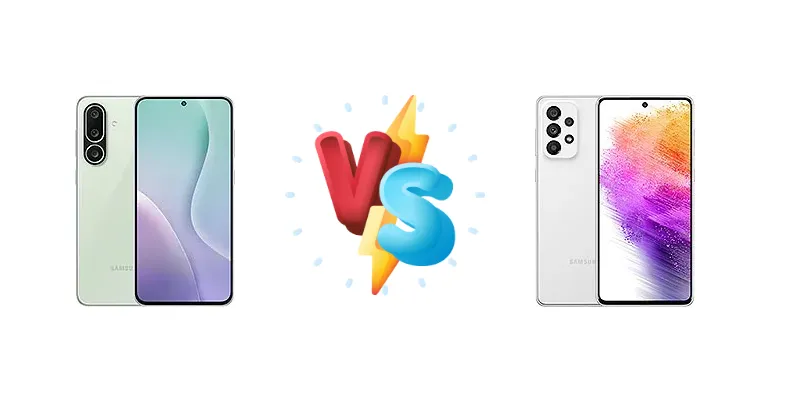
|
🏆 Quick Verdict
For the average user prioritizing sustained performance and a proven track record, the Samsung Galaxy A73 5G is the better choice. While the M56's 45W charging is appealing, the Snapdragon 778G 5G's 6nm process and optimized architecture provide a smoother, more consistent experience, especially during demanding tasks.
| PHONES | ||
|---|---|---|
| Phone Names | Samsung Galaxy M56 | Samsung Galaxy A73 5G |
| Network | ||
|---|---|---|
| 2G bands | GSM 850 / 900 / 1800 / 1900 | GSM 850 / 900 / 1800 / 1900 |
| 3G bands | HSDPA 850 / 900 / 1700(AWS) / 1900 / 2100 | HSDPA 850 / 900 / 1700(AWS) / 1900 / 2100 |
| 4G bands | 1, 2, 3, 4, 5, 7, 8, 12, 17, 20, 26, 28, 38, 40, 41, 66 | 1, 2, 3, 4, 5, 7, 8, 12, 13, 17, 20, 26, 28, 32, 38, 40, 41, 66 |
| 5G bands | 1, 3, 5, 8, 28, 40, 41, 78 SA/NSA/Sub6 | 1, 3, 5, 7, 28, 40, 41, 66, 78 SA/NSA/Sub6 |
| Speed | HSPA, LTE, 5G | HSPA, LTE, 5G |
| Technology | GSM / HSPA / LTE / 5G | GSM / HSPA / LTE / 5G |
| Launch | ||
|---|---|---|
| Announced | 2025, April 17 | 2022, March 17 |
| Status | Available. Released 2025, April 17 | Available. Released 2022, April 22 |
| Body | ||
|---|---|---|
| Build | Glass front (Gorilla Glass Victus+), plastic frame, glass back (Gorilla Glass Victus+) | - |
| Dimensions | 162 x 77.3 x 7.2 mm (6.38 x 3.04 x 0.28 in) | 163.7 x 76.1 x 7.6 mm (6.44 x 3.00 x 0.30 in) |
| SIM | Nano-SIM + Nano-SIM | · Nano-SIM· Nano-SIM + Nano-SIM |
| Weight | 180 g (6.35 oz) | 181 g (6.38 oz) |
| - | IP67 dust/water resistant (up to 1m for 30 min) | |
| Display | ||
|---|---|---|
| Protection | Corning Gorilla Glass Victus+ | Corning Gorilla Glass 5 |
| Resolution | 1080 x 2340 pixels, 19.5:9 ratio (~382 ppi density) | 1080 x 2400 pixels, 20:9 ratio (~393 ppi density) |
| Size | 6.74 inches, 111.5 cm2 (~89.0% screen-to-body ratio) | 6.7 inches, 108.4 cm2 (~87.0% screen-to-body ratio) |
| Type | Super AMOLED+, 120Hz | Super AMOLED Plus, 120Hz, 800 nits (HBM) |
| Platform | ||
|---|---|---|
| CPU | Octa-core (4x2.75 GHz Cortex-A78 & 4x2.0 GHz Cortex-A55) | Octa-core (1x2.4 GHz Cortex-A78 & 3x2.2 GHz Cortex-A78 & 4x1.9 GHz Cortex-A55) |
| Chipset | Exynos 1480 (4 nm) | Qualcomm SM7325 Snapdragon 778G 5G (6 nm) |
| GPU | Xclipse 530 | Adreno 642L |
| OS | Android 15, up to 6 major Android upgrades, One UI 7 | Android 12, up to 4 major Android upgrades, One UI 6.1 |
| Memory | ||
|---|---|---|
| Card slot | No | microSDXC (uses shared SIM slot) |
| Internal | 128GB 8GB RAM, 256GB 8GB RAM | 128GB 6GB RAM, 128GB 8GB RAM, 256GB 8GB RAM |
| Main Camera | ||
|---|---|---|
| Features | LED flash, panorama, HDR | LED flash, panorama, HDR |
| Quad | - | 108 MP, f/1.8, (wide), PDAF, OIS 12 MP, f/2.2, (ultrawide) 5 MP (macro) Auxiliary lens |
| Single | - | 32 MP, f/2.2, 26mm (wide), 1/2.8", 0.8µm |
| Triple | 50 MP, f/1.8, (wide), PDAF, OIS 8 MP, f/2.2, (ultrawide) 2 MP (macro) | - |
| Video | 4K@30fps, 1080p@30/60fps, gyro-EIS, OIS, 10-bit HDR | 4K@30fps, 1080p@30/60fps; gyro-EIS |
| Selfie camera | ||
|---|---|---|
| Features | - | HDR |
| Single | 12 MP, f/2.2, (wide) | 32 MP, f/2.2, 26mm (wide), 1/2.8", 0.8µm |
| Video | Yes | 4K@30fps, 1080p@30fps |
| Sound | ||
|---|---|---|
| 3.5mm jack | - | No |
| 35mm jack | No | No |
| Loudspeaker | Yes | Yes, with stereo speakers |
| Comms | ||
|---|---|---|
| Bluetooth | 5.3, A2DP, LE | 5.0, A2DP, LE |
| NFC | No | Yes (market/region dependent) |
| Positioning | GPS, GALILEO, GLONASS, BDS, QZSS | GPS, GLONASS, GALILEO, BDS, QZSS |
| Radio | No | Unspecified |
| USB | USB Type-C 2.0, OTG | USB Type-C 2.0, OTG |
| WLAN | Wi-Fi 802.11 a/b/g/n/ac/6, dual-band, Wi-Fi Direct | Wi-Fi 802.11 a/b/g/n/ac/6, dual-band, Wi-Fi Direct |
| Features | ||
|---|---|---|
| Sensors | Fingerprint (under display, optical), accelerometer, gyro, proximity, compass | Fingerprint (under display, optical), accelerometer, gyro, proximity, compass |
| Battery | ||
|---|---|---|
| Charging | 45W wired | 25W wired |
| Type | 5000 mAh | Li-Po 5000 mAh |
| Misc | ||
|---|---|---|
| Colors | Black, Light Green | Gray, Mint, White |
| Models | SM-M566B, SM-M566B/DS | SM-A736B, SM-A736B/DS |
| Price | About 260 EUR | About 600 EUR |
| SAR | 0.71 W/kg (head) | 1.14 W/kg (head) |
| SAR EU | - | 1.28 W/kg (head) 1.42 W/kg (body) |
Samsung Galaxy M56
- 45W fast charging for rapid top-ups
- Newer Exynos 1480 chipset (potential for future software optimizations)
- Potentially lower price point
- Snapdragon 778G 5G offers better sustained performance
- Exynos 1480 may exhibit more thermal throttling
- Software experience may be less refined
Samsung Galaxy A73 5G
- Efficient Snapdragon 778G 5G chipset
- Mature software experience with One UI
- Potentially better camera image processing
- Slower 25W charging
- May be slightly more expensive
- Older chipset architecture
Display Comparison
Neither device boasts a flagship-level display, but details are missing to make a direct comparison. However, given the M56's positioning, it likely utilizes a standard AMOLED panel. The A73 5G, being a slightly higher-tier model, *may* have a marginally brighter panel and potentially better color calibration. Both are expected to feature FHD+ resolution, but the absence of refresh rate data prevents a complete assessment. Bezels are likely comparable, typical of this price segment.
Camera Comparison
Without detailed camera specs, a definitive comparison is difficult. However, the Snapdragon 778G 5G's ISP is well-regarded for its image processing capabilities. Both phones likely feature a similar primary sensor resolution, but the A73 5G's image processing pipeline is likely more refined. The M56's Exynos 1480 ISP is newer, but its performance is unproven. The presence of Optical Image Stabilization (OIS) on the A73 5G's main camera (assuming it follows Samsung's typical configuration) would be a significant advantage for low-light photography and video recording. We can safely assume both phones include a suite of auxiliary cameras, but their quality is likely to be limited.
Performance
The core difference lies in the chipsets. The Galaxy M56's Exynos 1480 (4nm) features a mix of Cortex-A78 and A55 cores, while the A73 5G utilizes the Snapdragon 778G 5G (6nm). While the Exynos 1480 has a higher peak clock speed on its A78 cores (2.75 GHz vs 2.4 GHz), the Snapdragon 778G 5G's 6nm process offers superior power efficiency. The A73's CPU configuration, with three A78 cores, provides a more consistent performance advantage in multi-threaded tasks. The 6nm process also translates to better thermal management, reducing the likelihood of throttling during extended gaming sessions. The M56's 4nm node *should* improve efficiency, but the architectural differences favor the Snapdragon.
Battery Life
The Galaxy M56's 45W wired charging is a clear advantage over the A73 5G's 25W charging. This translates to significantly faster top-up times. However, battery life is a more complex equation. While the M56's battery capacity is unknown, the Snapdragon 778G 5G's superior power efficiency in the A73 5G could offset a potentially smaller battery. The A73 5G is likely to offer all-day battery life for moderate users, while the M56's faster charging allows for quick boosts throughout the day.
Buying Guide
Buy the Samsung Galaxy M56 if you absolutely need the fastest possible charging speeds and are comfortable with a potentially less refined software experience. It's ideal for users who frequently top up their phones throughout the day. Buy the Samsung Galaxy A73 5G if you prioritize consistent performance, a more mature software experience, and efficient power management for all-day use. It's the better option for gamers and power users.