
Samsung Galaxy M55 vs Motorola Edge 50 Fusion: A Deep Dive into Mid-Range Power
| Phones Images | |||||
|---|---|---|---|---|---|
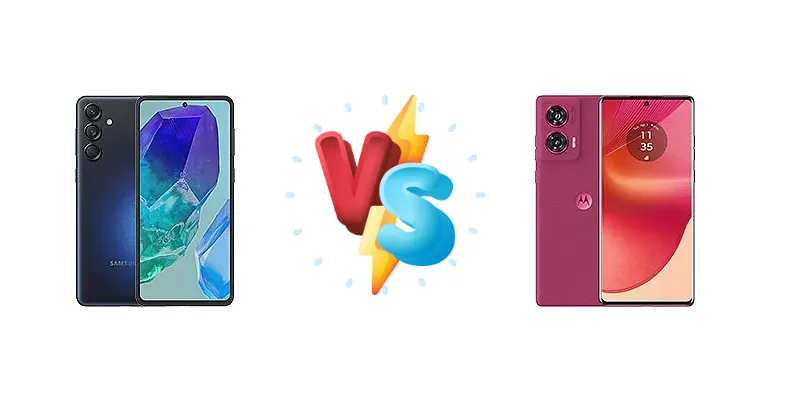
|
🏆 Quick Verdict
For the average user prioritizing fast charging and a brighter display, the Motorola Edge 50 Fusion is the stronger choice. Its 68W charging significantly outperforms the M55’s 45W, and the 1322 nits peak brightness provides superior outdoor visibility. However, the M55’s Snapdragon 7 Gen 1 offers a slight edge in raw CPU performance.
| PHONES | ||
|---|---|---|
| Phone Names | Samsung Galaxy M55 | Motorola Edge 50 Fusion |
| Network | ||
|---|---|---|
| 2G bands | GSM 850 / 900 / 1800 / 1900 | GSM 850 / 900 / 1800 / 1900 |
| 3G bands | HSDPA 850 / 900 / 1700(AWS) / 1900 / 2100 | HSDPA 850 / 900 / 1900 / 2100 |
| 4G bands | 1, 2, 3, 4, 5, 7, 8, 12, 17, 20, 25, 26, 28, 38, 40, 41, 66 | 1, 2, 3, 5, 7, 8, 18, 19, 20, 26, 28, 32, 38, 40, 41, 42, 71 - International |
| 5G bands | 1, 3, 5, 7, 8, 20, 28, 38, 40, 41, 66, 77, 78 SA/NSA/Sub6 | 1, 3, 5, 7, 8, 20, 26, 28, 38, 40, 41, 77, 78 SA/NSA |
| Speed | HSPA, LTE, 5G | HSPA, LTE, 5G |
| Technology | GSM / HSPA / LTE / 5G | GSM / HSPA / LTE / 5G |
| Launch | ||
|---|---|---|
| Announced | 2024, March 28 | 2024, April 16 |
| Status | Available. Released 2024, March 28 | Available. Released 2024, May 15 |
| Body | ||
|---|---|---|
| Build | - | Glass front, silicone polymer back (eco leather), plastic frame |
| Dimensions | 163.9 x 76.5 x 7.8 mm (6.45 x 3.01 x 0.31 in) | 161.9 x 73.1 x 7.9 mm (6.37 x 2.88 x 0.31 in) |
| SIM | Nano-SIM + Nano-SIM | · Nano-SIM + eSIM· Nano-SIM + Nano-SIM |
| Weight | 180 g (6.35 oz) | 174.9 g (6.17 oz) |
| Display | ||
|---|---|---|
| Protection | - | Corning Gorilla Glass 5 |
| Resolution | 1080 x 2400 pixels, 20:9 ratio (~393 ppi density) | 1080 x 2400 pixels, 20:9 ratio (~393 ppi density) |
| Size | 6.7 inches, 108.4 cm2 (~86.4% screen-to-body ratio) | 6.7 inches, 108.4 cm2 (~91.6% screen-to-body ratio) |
| Type | Super AMOLED+, 120Hz, 1000 nits (HBM) | P-OLED, 1B colors, 120Hz (LATAM), 144Hz (INT), 1600 nits (peak) |
| Platform | ||
|---|---|---|
| CPU | Octa-core (1x2.4 GHz Cortex-A710 & 3x2.36 GHz Cortex-A710 & 4x1.8 GHz Cortex-A510) | Octa-core (4x2.40 GHz Cortex-A78 & 4x1.95 GHz Cortex-A55) - InternationalOcta-core (4x2.2 GHz Cortex-A78 & 4x1.8 GHz Cortex-A55) - LATAM |
| Chipset | Qualcomm SM7450-AB Snapdragon 7 Gen 1 (4 nm) | Qualcomm SM7435-AB Snapdragon 7s Gen 2 (4 nm) - InternationalQualcomm SM6450 Snapdragon 6 Gen 1 (4 nm) - LATAM |
| GPU | Adreno 644 | Adreno 710 |
| OS | Android 14, upgradable to Android 16, One UI 8.0 | Android 14, upgradable to Android 15, up to 3 major Android upgrades |
| Memory | ||
|---|---|---|
| Card slot | microSDXC (uses shared SIM slot) | No |
| Internal | 128GB 8GB RAM, 256GB 8GB RAM, 256GB 12GB RAM | 128GB 8GB RAM, 256GB 8GB RAM, 256GB 12GB RAM, 512GB 8GB RAM, 512GB 12GB RAM |
| Main Camera | ||
|---|---|---|
| Dual | - | 50 MP, f/1.9, (wide), 1/1.56", 1.0µm, multi-directional PDAF, OIS 13 MP, f/2.2, 120˚ (ultrawide), 1/3.0", 1.12µm, AF |
| Features | LED flash, panorama, HDR | LED flash, HDR, panorama |
| Triple | 50 MP, f/1.8, (wide), 1/1.56", 1.0µm, PDAF, OIS 8 MP, f/2.2, 123˚ (ultrawide) 2 MP (macro) | - |
| Video | 4K@30fps, 1080p@30/60fps, gyro-EIS, OIS | 4K@30fps, 1080p@30/60/120fps, gyro-EIS |
| Selfie camera | ||
|---|---|---|
| Features | - | HDR |
| Single | 50 MP, f/2.4, (wide) | 32 MP, f/2.5, (wide), 1/3.14", 0.7µm |
| Video | 4K@30fps, 1080p@30/60fps | 4K@30fps, 1080p@30fps |
| Sound | ||
|---|---|---|
| 35mm jack | No | No |
| Loudspeaker | Yes, with stereo speakers | Yes, with stereo speakers |
| Comms | ||
|---|---|---|
| Bluetooth | 5.2, A2DP, LE | 5.2, A2DP, LE |
| NFC | Yes (market/region dependent) | Yes |
| Positioning | GPS, GALILEO, GLONASS, BDS, QZSS | GPS, GLONASS, GALILEO |
| Radio | No | No |
| USB | USB Type-C 2.0, OTG | USB Type-C 2.0, OTG |
| WLAN | Wi-Fi 802.11 a/b/g/n/ac/6, dual-band, Wi-Fi Direct | Wi-Fi 802.11 a/b/g/n/ac, dual-band |
| Features | ||
|---|---|---|
| Sensors | Fingerprint (under display, optical), accelerometer, gyro, proximity, compass | Fingerprint (under display, optical), accelerometer, gyro, proximity, compass |
| Battery | ||
|---|---|---|
| Charging | 45W wired | 68W wired, 50% in 15 min |
| Type | 5000 mAh | 5000 mAh |
| Misc | ||
|---|---|---|
| Colors | Dark Blue, Light Green | Forest Blue, Marshmallow Blue, Hot Pink |
| Models | SM-M556B, SM-M556B/DS | XT2429-1 |
| Price | € 272.94 / $ 265.00 / £ 251.97 / ₹ 20,999 | € 208.99 / $ 245.00 / ₹ 18,667 |
| SAR | 0.93 W/kg (head) | - |
| SAR EU | 0.96 W/kg (head) 0.98 W/kg (body) | - |
Samsung Galaxy M55
- Stronger CPU performance with Snapdragon 7 Gen 1
- Potentially better image processing due to ISP capabilities
- Established Samsung software ecosystem
- Slower 45W charging
- Display brightness data unavailable, potentially lower than Fusion
- Limited information on battery capacity
Motorola Edge 50 Fusion
- Significantly faster 68W charging (50% in 15 min)
- Brighter 1322 nits display for outdoor visibility
- Cleaner, near-stock Android experience
- Snapdragon 7s Gen 2 (or 6 Gen 1 in LATAM) offers slightly lower peak CPU performance
- Camera performance dependent on software optimization
- LATAM variant uses a less powerful Snapdragon 6 Gen 1
Display Comparison
The Motorola Edge 50 Fusion boasts a significantly brighter display, reaching a measured 1322 nits peak brightness, making it far more usable in direct sunlight compared to the Galaxy M55 (brightness data unavailable). While both utilize LCD panels, the Fusion’s higher peak brightness is a clear advantage. We lack PWM frequency data for both, but the panel technology itself is a key differentiator. The M55’s display specs are currently limited, making a detailed comparison of color accuracy and resolution difficult, but the Fusion’s brightness is a standout feature.
Camera Comparison
Detailed camera specifications are lacking for both devices, hindering a thorough comparison. However, focusing on the chipsets, the Snapdragon 7 Gen 1 in the M55 generally offers slightly better ISP capabilities than the Snapdragon 7s Gen 2. This translates to potentially better image processing, especially in low-light conditions. Without knowing sensor sizes and lens apertures, it’s difficult to definitively declare a winner, but the M55’s chipset provides a slight advantage in image quality potential. We can assume both phones will include standard features like HDR and portrait modes, but the quality of these will depend heavily on software optimization.
Performance
The performance landscape is more nuanced. The Motorola Edge 50 Fusion utilizes the Snapdragon 7s Gen 2 (International) or Snapdragon 6 Gen 1 (LATAM), while the Samsung Galaxy M55 features the Snapdragon 7 Gen 1. The 7 Gen 1, with its Cortex-A710 prime core clocked at 2.4 GHz, generally offers higher peak CPU performance than the 7s Gen 2’s Cortex-A78 cores at 2.40 GHz. However, the 7s Gen 2’s architecture is newer and potentially more efficient. The LATAM variant of the Edge 50 Fusion with the Snapdragon 6 Gen 1 will experience a noticeable performance deficit compared to both the M55 and the International 7s Gen 2 version. Both phones likely utilize LPDDR5 RAM, but the M55’s stronger CPU gives it an edge in demanding tasks.
Battery Life
The Motorola Edge 50 Fusion shines in the battery and charging department. Its 68W wired charging can deliver a 50% charge in just 15 minutes, a significant advantage over the Samsung Galaxy M55’s 45W charging. While the M55’s battery capacity is not specified, the Fusion’s active use score of 12:40h demonstrates solid endurance. The faster charging speed of the Fusion mitigates any potential disadvantage from a slightly smaller battery capacity, making it more convenient for users who need to quickly replenish their power.
Buying Guide
Buy the Samsung Galaxy M55 if you need sustained CPU performance for demanding multitasking or light gaming, and prefer a brand with a well-established software ecosystem. Buy the Motorola Edge 50 Fusion if you prioritize rapid charging, a vibrant and bright display for media consumption, and a cleaner, near-stock Android experience. The Fusion is ideal for users who frequently find themselves needing to top up their battery quickly.