
OnePlus Nord 2T vs Samsung Galaxy M53: Which Mid-Range Phone Reigns Supreme?
| Phones Images | |||||
|---|---|---|---|---|---|
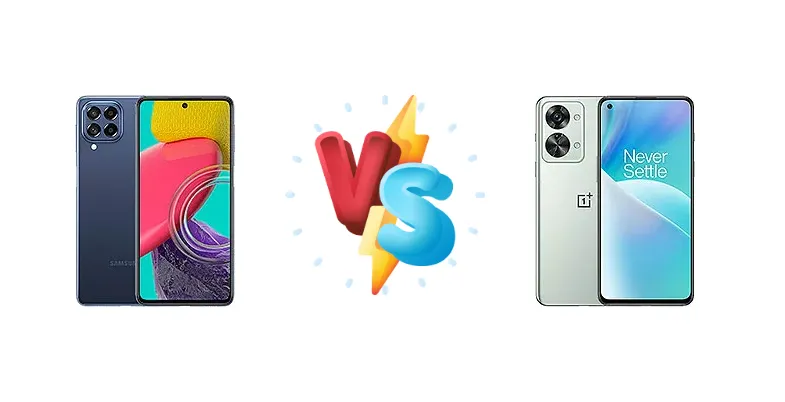
|
🏆 Quick Verdict
For most users, the OnePlus Nord 2T emerges as the superior choice. Its significantly faster 80W charging and more powerful CPU configuration, featuring a higher-clocked Cortex-A78 core, provide a smoother and more convenient daily experience. While the M53 boasts slightly better battery endurance, the Nord 2T’s charging speed mitigates this difference.
| PHONES | ||
|---|---|---|
| Phone Names | Samsung Galaxy M53 | OnePlus Nord 2T |
| Network | ||
|---|---|---|
| 2G bands | GSM 850 / 900 / 1800 / 1900 | GSM 850 / 900 / 1800 / 1900 |
| 3G bands | HSDPA 850 / 900 / 1700(AWS) / 1900 / 2100 | HSDPA 800 / 850 / 900 / 1700(AWS) / 1800 / 1900 / 2100 |
| 4G bands | 1, 2, 3, 4, 5, 7, 8, 12, 17, 20, 26, 28, 38, 40, 41, 66 | 1, 2, 3, 4, 5, 7, 8, 12, 17, 18, 19, 20, 26, 28, 32, 34, 38, 39, 40, 41, 66 |
| 5G bands | 1, 3, 5, 7, 8, 20, 28, 38, 40, 41, 66, 78 SA/NSA/Sub6 | 1, 3, 7, 8, 20, 28, 38, 41, 78 SA/NSA |
| Speed | HSPA, LTE, 5G | HSPA 42.2/5.76 Mbps, LTE Cat18 1200/150 Mbps, 5G |
| Technology | GSM / HSPA / LTE / 5G | GSM / HSPA / LTE / 5G |
| Launch | ||
|---|---|---|
| Announced | 2022, April 07 | 2022, May 19 |
| Status | Available. Released 2022, April 22 | Available. Released 2022, May 21 |
| Body | ||
|---|---|---|
| Build | Glass front (Gorilla Glass 5), plastic back, plastic frame | Glass front (Gorilla Glass 5), plastic frame |
| Dimensions | 164.7 x 77 x 7.4 mm (6.48 x 3.03 x 0.29 in) | 159.1 x 73.2 x 8.2 mm (6.26 x 2.88 x 0.32 in) |
| SIM | Nano-SIM + Nano-SIM | Nano-SIM + Nano-SIM |
| Weight | 176 g (6.21 oz) | 190 g (6.70 oz) |
| Display | ||
|---|---|---|
| Protection | Corning Gorilla Glass 5 | Corning Gorilla Glass 5 |
| Resolution | 1080 x 2408 pixels, 20:9 ratio (~394 ppi density) | 1080 x 2400 pixels, 20:9 ratio (~409 ppi density) |
| Size | 6.7 inches, 108.1 cm2 (~85.3% screen-to-body ratio) | 6.43 inches, 99.8 cm2 (~85.7% screen-to-body ratio) |
| Type | Super AMOLED Plus, 120Hz | AMOLED, 90Hz, HDR10+ |
| Platform | ||
|---|---|---|
| CPU | Octa-core (2x2.4 GHz Cortex-A78 & 6x2.0 GHz Cortex-A55) | Octa-core (1x3.0 GHz Cortex-A78 & 3x2.6 GHz Cortex-A78 & 4x2.0 GHz Cortex-A55) |
| Chipset | Mediatek Dimensity 900 (6 nm) | Mediatek Dimensity 1300 (6 nm) |
| GPU | Mali-G68 MC4 | Mali-G77 MC9 |
| OS | Android 12, upgradable to Android 13, One UI 5.1 | Android 12, upgradable to Android 14, OxygenOS 14 |
| Memory | ||
|---|---|---|
| Card slot | microSDXC (uses shared SIM slot) | No |
| Internal | 128GB 6GB RAM, 128GB 8GB RAM, 256GB 8GB RAM | 128GB 8GB RAM, 256GB 12GB RAM |
| - | UFS 3.1 | |
| Main Camera | ||
|---|---|---|
| Features | LED flash, panorama, HDR | Dual-LED flash, HDR, panorama |
| Quad | 108 MP, f/1.8, (wide), PDAF 8 MP, f/2.2, (ultrawide), 1/4.0", 1.12µm 2 MP (macro) Auxiliary lens | - |
| Single | - | 32 MP, f/2.4, (wide), 1/2.8", 0.8µm |
| Triple | - | 50 MP, f/1.9, 24mm (wide), 1/1.56", 1.0µm, PDAF, OIS 8 MP, f/2.2, 120˚ (ultrawide) Auxiliary lens |
| Video | 4K@30fps, 1080p@30/60fps | 4K@30fps, 1080p@30/60/120/480fps, gyro-EIS |
| Selfie camera | ||
|---|---|---|
| Features | - | Auto HDR |
| Single | 32 MP, f/2.2, 26mm (wide) | 32 MP, f/2.4, (wide), 1/2.8", 0.8µm |
| Video | 4K@30fps, 1080p@30fps | 1080p@30fps, gyro-EIS |
| Sound | ||
|---|---|---|
| 3.5mm jack | No | No |
| 35mm jack | No | No |
| Loudspeaker | Yes | Yes, with stereo speakers |
| Comms | ||
|---|---|---|
| Bluetooth | 5.2, A2DP, LE | 5.2, A2DP, LE, aptX HD |
| NFC | Yes (market/region dependent) | Yes |
| Positioning | GPS, GLONASS, GALILEO, BDS, QZSS | GPS, GLONASS, GALILEO, BDS, NavIC |
| Radio | No | No |
| USB | USB Type-C 2.0, OTG | USB Type-C 2.0, OTG |
| WLAN | Wi-Fi 802.11 a/b/g/n/ac, dual-band, Wi-Fi Direct | Wi-Fi 802.11 a/b/g/n/ac/6, dual-band, Wi-Fi Direct |
| Features | ||
|---|---|---|
| Sensors | Fingerprint (side-mounted), accelerometer, gyro, proximity, compass | Fingerprint (under display, optical), accelerometer, gyro, proximity, compass |
| Battery | ||
|---|---|---|
| Charging | 25W wired | 80W wired, PD |
| Type | Li-Ion 5000 mAh | Li-Po 4500 mAh |
| Misc | ||
|---|---|---|
| Colors | Green, Blue, Brown | Gray Shadow, Jade Fog |
| Models | SM-M536B, SM-M536B/DS, SM-M536B/DSN | CPH2399, CPH2401 |
| Price | € 249.98 | € 144.39 / $ 169.99 / ₹ 31,490 |
| SAR | 1.31 W/kg (head) | - |
| SAR EU | 0.60 W/kg (head) 1.53 W/kg (body) | - |
| Tests | ||
|---|---|---|
| Battery life | Endurance rating 114h | Endurance rating 100h |
| Camera | Photo / Video | Photo / Video |
| Display | Contrast ratio: Infinite (nominal) | Contrast ratio: Infinite (nominal) |
| Loudspeaker | -29.3 LUFS (Average) | -25.6 LUFS (Very good) |
| Performance | - | AnTuTu: 490545 (v8) | 604467 (v9) GeekBench: 2790 (v5.1) GFXBench: 40fps (ES 3.1 onscreen) |
Samsung Galaxy M53
- Longer battery life (114h endurance)
- Brighter display for outdoor visibility
- Potentially lower price point
- Slower charging speed (25W)
- Less powerful CPU for demanding tasks
OnePlus Nord 2T
- Significantly faster 80W charging with PD
- More powerful CPU for smoother performance
- Likely better image processing
- Shorter battery life (100h endurance)
- Dimmer display compared to the M53
Display Comparison
The Samsung Galaxy M53 boasts a brighter display, reaching a measured peak of 802 nits, compared to the Nord 2T’s 636 nits. This translates to better visibility under direct sunlight. Both displays share an 'Infinite' contrast ratio, a marketing term indicating deep blacks, but the M53’s higher brightness provides a more vibrant and punchy image overall. While neither phone specifies refresh rate or panel type, the brightness difference is the key differentiator for outdoor use.
Camera Comparison
Both phones feature 'Photo / Video' capabilities, but detailed sensor information is lacking. Without specifics, it’s difficult to make a definitive judgment. However, given OnePlus’s generally strong image processing algorithms and the Nord 2T’s overall performance focus, it’s likely to deliver more consistent and refined image quality. The absence of details regarding OIS or sensor size makes a precise comparison impossible, but the Nord 2T’s faster processing power could aid in post-processing and noise reduction.
Performance
The OnePlus Nord 2T’s Mediatek Dimensity 1300 chipset represents a clear performance advantage over the M53’s Dimensity 900. The Nord 2T features a 1x3.0 GHz Cortex-A78 core alongside three additional 2.6 GHz Cortex-A78 cores, while the M53 has 2x2.4 GHz Cortex-A78 cores and 6x2.0 GHz Cortex-A55 cores. This architectural difference, coupled with the higher clock speeds, results in noticeably faster application loading and smoother multitasking on the Nord 2T. Both chipsets are fabricated on a 6nm process, but the Nord 2T’s CPU configuration provides a tangible performance boost.
Battery Life
The Samsung Galaxy M53 holds a slight edge in endurance, achieving a 114-hour rating compared to the Nord 2T’s 100-hour rating. However, this difference is largely offset by the Nord 2T’s dramatically faster 80W wired charging, which supports Power Delivery (PD). The M53 is limited to 25W charging. This means the Nord 2T can replenish its battery from 0-100% in a fraction of the time, minimizing the impact of its slightly smaller battery capacity. The convenience of rapid charging significantly enhances the Nord 2T’s usability.
Buying Guide
Buy the Samsung Galaxy M53 if you prioritize maximum battery life above all else and frequently engage in extended usage scenarios away from a power source. Buy the OnePlus Nord 2T if you value faster performance for multitasking and gaming, and appreciate the convenience of incredibly rapid 80W charging, minimizing downtime and maximizing usability.