
Samsung Galaxy M42 5G vs. Galaxy M51: A Deep Dive into Performance and Battery Life
| Phones Images | |||||
|---|---|---|---|---|---|
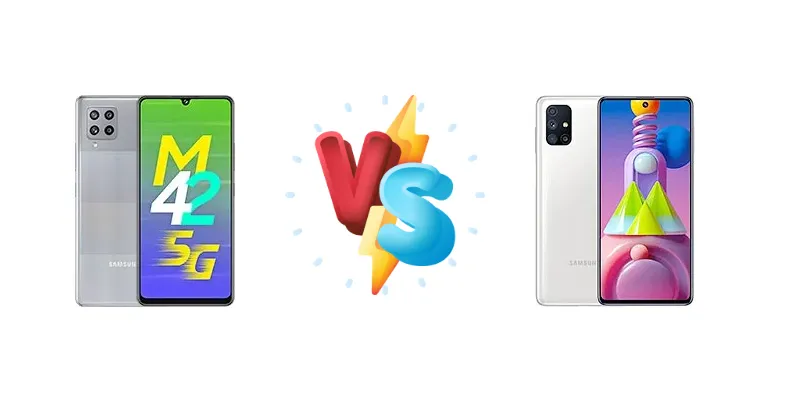
|
🏆 Quick Verdict
For the average user prioritizing future-proofing and occasional 5G access, the Samsung Galaxy M42 5G is the better choice. Its Snapdragon 750G offers a slight performance edge and 5G capability. However, users who absolutely demand maximum battery life and don't need 5G will find the M51's endurance unmatched.
| PHONES | ||
|---|---|---|
| Phone Names | Samsung Galaxy M42 5G | Samsung Galaxy M51 |
| Network | ||
|---|---|---|
| 2G bands | GSM 850 / 900 / 1800 / 1900 | GSM 850 / 900 / 1800 / 1900 |
| 3G bands | HSDPA 850 / 900 / 1700(AWS) / 1900 / 2100 | HSDPA 850 / 900 / 1700(AWS) / 1900 / 2100 |
| 4G bands | 1, 2, 3, 4, 5, 7, 8, 12, 17, 20, 28, 38, 40, 41 | 1, 2, 3, 4, 5, 7, 8, 12, 17, 20, 26, 28, 38, 40, 41, 66 |
| 5G bands | 1, 3, 5, 7, 8, 28, 40, 41, 78 SA/NSA/Sub6 | - |
| Speed | HSPA, LTE, 5G | HSPA 42.2/5.76 Mbps, LTE (2CA) Cat6 400/50 Mbps |
| Technology | GSM / HSPA / LTE / 5G | GSM / HSPA / LTE |
| Launch | ||
|---|---|---|
| Announced | 2021, April 28 | 2020, August 31. Released 2020, September 11 |
| Status | Available. Released 2021, May 01 | Discontinued |
| Body | ||
|---|---|---|
| Build | - | Glass front (Gorilla Glass 3+), plastic back, plastic frame |
| Dimensions | 164.4 x 75.9 x 8.6 mm (6.47 x 2.99 x 0.34 in) | 163.9 x 76.3 x 9.5 mm (6.45 x 3.00 x 0.37 in) |
| SIM | Nano-SIM + Nano-SIM | Nano-SIM + Nano-SIM |
| Weight | 190 g (6.70 oz) | 213 g (7.51 oz) |
| Display | ||
|---|---|---|
| Protection | - | Corning Gorilla Glass 3+ |
| Resolution | 720 x 1600 pixels, 20:9 ratio (~266 ppi density) | 1080 x 2400 pixels, 20:9 ratio (~393 ppi density) |
| Size | 6.6 inches, 105.2 cm2 (~84.3% screen-to-body ratio) | 6.7 inches, 108.4 cm2 (~86.7% screen-to-body ratio) |
| Type | Super AMOLED | Super AMOLED Plus |
| Platform | ||
|---|---|---|
| CPU | Octa-core (2x2.2 GHz Kryo 570 & 6x1.8 GHz Kryo 570) | Octa-core (2x2.2 GHz Kryo 470 Gold & 6x1.8 GHz Kryo 470 Silver) |
| Chipset | Qualcomm SM7225 Snapdragon 750G 5G (8 nm) | Qualcomm SDM730 Snapdragon 730G (8 nm) |
| GPU | Adreno 619 | Adreno 618 |
| OS | Android 11, upgradable to Android 13, One UI 5.1 | Android 10, upgradable to Android 12, One UI 4.1 |
| Memory | ||
|---|---|---|
| Card slot | microSDXC (uses shared SIM slot) | microSDXC (dedicated slot) |
| Internal | 128GB 6GB RAM, 128GB 8GB RAM | 128GB 6GB RAM, 128GB 8GB RAM |
| UFS 2.1 | - | |
| Main Camera | ||
|---|---|---|
| Features | LED flash, panorama, HDR | LED flash, panorama, HDR |
| Quad | 48 MP, f/1.8, (wide), 1/2.0", 0.8µm, PDAF 8 MP, f/2.2, 123˚ (ultrawide) 5 MP (macro) Auxiliary lens | 64 MP, f/1.8, 26mm (wide), 1/1.73", 0.8µm, PDAF 12 MP, f/2.2, 123˚ (ultrawide) 5 MP (macro) Auxiliary lens |
| Single | 20 MP, f/2.2, (wide) | - |
| Video | 4K@30fps, 1080p@30fps, 720p@480fps | 4K@30fps, 1080p@30fps |
| Selfie camera | ||
|---|---|---|
| Features | HDR | HDR |
| Single | 20 MP, f/2.2, (wide) | 32 MP, f/2.0, 26mm (wide), 1/2.8", 0.8µm |
| Video | 1080p@30fps | 4K@30fps, 1080p@30fps |
| Sound | ||
|---|---|---|
| 3.5mm jack | Yes | Yes |
| 35mm jack | Yes | Yes |
| Loudspeaker | Yes | Yes |
| Comms | ||
|---|---|---|
| Bluetooth | 5.0, A2DP, LE | 5.0, A2DP, LE |
| NFC | Yes | Yes |
| Positioning | GPS, GLONASS, GALILEO, BDS | GPS, GLONASS, GALILEO, BDS |
| Radio | FM radio | FM radio, RDS |
| USB | USB Type-C 2.0, OTG | USB Type-C 2.0, OTG |
| WLAN | Wi-Fi 802.11 a/b/g/n/ac, dual-band, Wi-Fi Direct | Wi-Fi 802.11 a/b/g/n/ac, dual-band, Wi-Fi Direct |
| Features | ||
|---|---|---|
| Sensors | Fingerprint (under display, optical), accelerometer, gyro, compass | Fingerprint (side-mounted), accelerometer, gyro, proximity, compass |
| Virtual proximity sensing | - | |
| Battery | ||
|---|---|---|
| Charging | 15W wired | 25W wired, 100% in 115 min Reverse wired |
| Type | Li-Po 5000 mAh | Li-Po 7000 mAh |
| Misc | ||
|---|---|---|
| Colors | Prism Dot Black, Prism Dot Gray | Celestial Black, Electric Blue, White |
| Models | SM-M426B, SM-M426B/DS | SM-M515F, SM-M515F/DSN |
| Price | About 220 EUR | About 470 EUR |
| SAR | 0.69 W/kg (head) | 1.38 W/kg (head) |
| SAR EU | - | 0.61 W/kg (head) 1.45 W/kg (body) |
| Tests | ||
|---|---|---|
| Battery life | - | Endurance rating 156h |
| Camera | - | Photo / Video |
| Display | - | Contrast ratio: Infinite (nominal) |
| Loudspeaker | - | -28.5 LUFS (Average) |
| Performance | - | AnTuTu: 266620 (v8) GeekBench: 1774 (v5.1) GFXBench: 15fps (ES 3.1 onscreen) |
Samsung Galaxy M42 5G
- 5G Connectivity for faster data speeds
- Slightly more modern chipset (Snapdragon 750G)
- Potentially more efficient power management
- Slower 15W charging
- Likely smaller battery capacity
- No reverse wired charging
Samsung Galaxy M51
- Exceptional 156-hour battery life
- Faster 25W charging with 115-minute full charge
- Reverse wired charging for accessories
- Lacks 5G connectivity
- Older Snapdragon 730G chipset
- Larger and heavier form factor
Display Comparison
The Galaxy M51 boasts a measured peak brightness of 677 nits, providing excellent visibility outdoors. While the M42 5G’s display specifications aren’t explicitly provided, it’s reasonable to expect a similar level of brightness given its market positioning. Both phones likely utilize LCD panels, and the M51’s ‘Infinite’ contrast ratio is a marketing term typical of LCDs. The M42 5G’s display is likely optimized for power efficiency to complement its smaller battery, potentially at the expense of peak brightness compared to the M51.
Camera Comparison
Both devices feature a 'Photo / Video' camera system, but detailed specifications are lacking. Without sensor size or aperture information, a direct comparison is difficult. However, the M51’s longevity in the market suggests it likely received more software optimizations for its camera. The inclusion of a 2MP macro camera on both devices is largely a marketing tactic, offering limited practical benefit due to the small sensor size and lack of optical image stabilization (OIS). Image processing styles will likely differ, with Samsung’s tendency towards vibrant, saturated colors.
Performance
The core difference lies in the chipsets: the M42 5G features the Qualcomm SM7225 Snapdragon 750G 5G (8nm), while the M51 uses the SDM730 Snapdragon 730G (8nm). Both are 8nm chips, but the 750G benefits from newer Kryo 570 cores, offering a slight architectural advantage. The CPU configuration is identical (2x2.2 GHz & 6x1.8 GHz), but the 750G’s integrated 5G modem and potentially more efficient core design give it an edge in sustained performance and connectivity. The M42 5G’s 5G modem is a significant differentiator, enabling access to faster network speeds where available. The M51’s 730G is still a capable performer for everyday tasks, but will show its age more quickly with demanding applications.
Battery Life
The Galaxy M51 is renowned for its exceptional battery life, achieving an Endurance rating of 156 hours. This is matched by the M42 5G. However, the M51’s 25W charging capability, completing a full charge in 115 minutes, significantly outperforms the M42 5G’s slower 15W charging. The M51 also offers reverse wired charging, a convenient feature for topping up accessories. While the M42 5G’s battery capacity isn’t specified, it’s likely smaller to accommodate the 5G modem and maintain a reasonable form factor. The M51’s faster charging is a crucial advantage for users who frequently deplete their battery.
Buying Guide
Buy the Samsung Galaxy M42 5G if you need 5G connectivity for faster data speeds and anticipate using your phone for several years. It’s ideal for users who stream a lot of video or download large files on the go. Buy the Samsung Galaxy M51 if you prioritize all-day (and then some) battery life above all else, and are less concerned with having the latest cellular technology. This phone is perfect for travelers or those who frequently find themselves away from a power source.