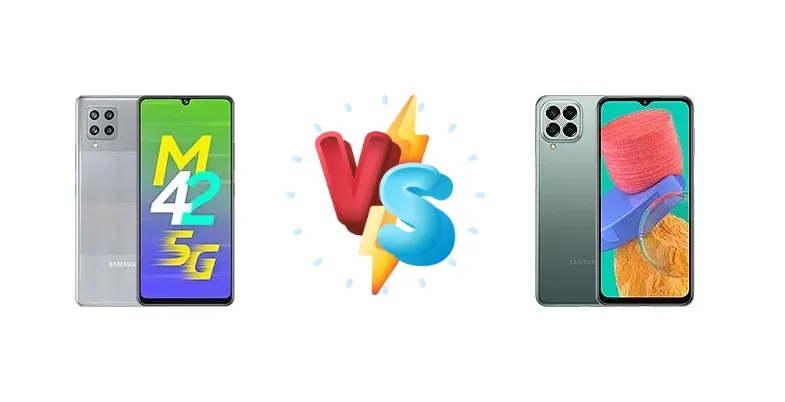
The Samsung Galaxy M33 and M42 5G represent Samsung’s approach to delivering 5G connectivity at accessible price points. While both aim for the mid-range market, they diverge significantly in their core components, particularly the chipset and charging capabilities. This comparison dissects these differences to determine which device offers the best overall experience for various user needs.
🏆 Quick Verdict
For most users, the Samsung Galaxy M33 emerges as the better choice. Its Exynos 1280 chipset, built on a more efficient 5nm process, provides a noticeable performance uplift and faster charging capabilities. While the M42 5G offers 5G connectivity, the M33’s overall package delivers a more refined and future-proof experience.
| Network |
|---|
| 2G bands | GSM 850 / 900 / 1800 / 1900 | GSM 850 / 900 / 1800 / 1900 |
| 3G bands | HSDPA 850 / 900 / 1700(AWS) / 1900 / 2100 | HSDPA 850 / 900 / 1700(AWS) / 1900 / 2100 |
| 4G bands | 1, 2, 3, 4, 5, 7, 8, 12, 17, 20, 28, 38, 40, 41 | 1, 2, 3, 4, 5, 7, 8, 12, 17, 20, 26, 28, 38, 40, 41, 66 |
| 5G bands | 1, 3, 5, 7, 8, 28, 40, 41, 78 SA/NSA/Sub6 | 1, 3, 5, 7, 8, 20, 28, 38, 40, 41, 66, 78 SA/NSA |
| Speed | HSPA, LTE, 5G | HSPA, LTE, 5G |
| Technology | GSM / HSPA / LTE / 5G | GSM / HSPA / LTE / 5G |
| Launch |
|---|
| Announced | 2021, April 28 | 2022, March 04 |
| Status | Available. Released 2021, May 01 | Available. Released 2022, April 08 |
| Body |
|---|
| Build | - | Glass front (Gorilla Glass 5), plastic frame, plastic back |
| Dimensions | 164.4 x 75.9 x 8.6 mm (6.47 x 2.99 x 0.34 in) | 165.4 x 76.9 x 9.4 mm (6.51 x 3.03 x 0.37 in) |
| SIM | Nano-SIM + Nano-SIM | · Nano-SIM· Nano-SIM + Nano-SIM |
| Weight | 190 g (6.70 oz) | 198 g (Global) / 215 g (India) (6.98 oz) |
| Display |
|---|
| Protection | - | Corning Gorilla Glass 5 |
| Resolution | 720 x 1600 pixels, 20:9 ratio (~266 ppi density) | 1080 x 2408 pixels, 20:9 ratio (~400 ppi density) |
| Size | 6.6 inches, 105.2 cm2 (~84.3% screen-to-body ratio) | 6.6 inches, 104.9 cm2 (~82.5% screen-to-body ratio) |
| Type | Super AMOLED | TFT LCD, 120Hz |
| Platform |
|---|
| CPU | Octa-core (2x2.2 GHz Kryo 570 & 6x1.8 GHz Kryo 570) | Octa-core (2x2.4 GHz Cortex-A78 & 6x2.0 GHz Cortex-A55) |
| Chipset | Qualcomm SM7225 Snapdragon 750G 5G (8 nm) | Exynos 1280 (5 nm) |
| GPU | Adreno 619 | Mali-G68 |
| OS | Android 11, upgradable to Android 13, One UI 5.1 | Android 12, upgradable to Android 16, One UI 8 |
| Memory |
|---|
| Card slot | microSDXC (uses shared SIM slot) | microSDXC (dedicated slot) |
| Internal | 128GB 6GB RAM, 128GB 8GB RAM | 128GB 6GB RAM, 128GB 8GB RAM |
| | UFS 2.1 | UFS 2.2 |
| Main Camera |
|---|
| Features | LED flash, panorama, HDR | LED flash, panorama, HDR |
| Quad | 48 MP, f/1.8, (wide), 1/2.0", 0.8µm, PDAF
8 MP, f/2.2, 123˚ (ultrawide)
5 MP (macro)
Auxiliary lens | 50 MP, f/1.8, (wide), PDAF
5 MP, f/2.2, 123˚ (ultrawide)
2 MP (macro)
Auxiliary lens |
| Single | 20 MP, f/2.2, (wide) | 8 MP, f/2.2, (wide) |
| Video | 4K@30fps, 1080p@30fps, 720p@480fps | 4K@30fps, 1080p@30fps |
| Selfie camera |
|---|
| Features | HDR | - |
| Single | 20 MP, f/2.2, (wide) | 8 MP, f/2.2, (wide) |
| Video | 1080p@30fps | 1080p@30fps |
| Sound |
|---|
| 3.5mm jack | Yes | Yes |
| 35mm jack | Yes | Yes |
| Loudspeaker | Yes | Yes |
| Comms |
|---|
| Bluetooth | 5.0, A2DP, LE | 5.1, A2DP, LE |
| NFC | Yes | Yes |
| Positioning | GPS, GLONASS, GALILEO, BDS | GPS, GLONASS, GALILEO, BDS, QZSS |
| Radio | FM radio | Unspecified |
| USB | USB Type-C 2.0, OTG | USB Type-C 2.0, OTG |
| WLAN | Wi-Fi 802.11 a/b/g/n/ac, dual-band, Wi-Fi Direct | Wi-Fi 802.11 a/b/g/n/ac, dual-band, Wi-Fi Direct |
| Features |
|---|
| Sensors | Fingerprint (under display, optical), accelerometer, gyro, compass | Fingerprint (side-mounted), accelerometer, gyro |
| | Virtual proximity sensing | Virtual Proximity Sensing |
| Battery |
|---|
| Charging | 15W wired | 25W wired
4.5W reverse wired |
| Type | Li-Po 5000 mAh | Market-dependent versions:· Li-Ion 5000 mAh (Global)· Li-Ion 6000 mAh (India only) |
| Misc |
|---|
| Colors | Prism Dot Black, Prism Dot Gray | Green, Blue, Brown |
| Models | SM-M426B, SM-M426B/DS | SM-M336B, SM-M336B/DS, SM-M336BU, SM-M336BU/DS, SM-M336K |
| Price | About 220 EUR | £ 299.00 |
| SAR | 0.69 W/kg (head) | - |
| SAR EU | - | 1.04 W/kg (head) 1.38 W/kg (body) |
Samsung Galaxy M42 5G
- Access to 5G connectivity at a lower price point.
- Potentially simpler software experience (depending on One UI version).
- Established Snapdragon chipset with known performance characteristics.
- Slower 15W charging.
- Less efficient 8nm Snapdragon 750G chipset.
- Older chipset architecture.
Samsung Galaxy M33
- Faster 25W charging with reverse wired charging.
- More efficient 5nm Exynos 1280 chipset.
- Improved CPU performance with Cortex-A78 cores.
- Likely better long-term software support.
- May be slightly more expensive than the M42 5G.
- Exynos chipsets sometimes face scrutiny regarding thermal management (though 5nm helps).
Display Comparison
Context data lacks display specifics, but given the M series positioning, both likely feature LCD panels. The M33, being a newer model, *may* benefit from slightly improved color calibration and viewing angles. However, without detailed specs like peak brightness (nits) and color gamut coverage, a definitive comparison is impossible. Bezels are likely comparable, reflecting the budget-conscious design of both devices.
Camera Comparison
Without detailed camera sensor information, a precise comparison is limited. However, the M33, being a newer device, likely benefits from improved image processing algorithms. The presence of a 2MP macro camera on both devices suggests a similar approach to offering versatility, but these sensors typically deliver limited image quality. The focus should be on the main sensor performance, which is not specified in the provided data. The Exynos 1280’s ISP (Image Signal Processor) is likely more advanced, potentially leading to better dynamic range and low-light performance on the M33.
Performance
The core difference lies in the chipsets. The Galaxy M33’s Exynos 1280 (5nm) boasts a significant architectural advantage over the M42 5G’s Snapdragon 750G (8nm). The Exynos 1280 utilizes Cortex-A78 performance cores clocked at 2.4 GHz, offering a substantial CPU performance boost compared to the Snapdragon 750G’s 2.2 GHz Kryo 570 cores. The 5nm fabrication process of the Exynos 1280 also translates to improved thermal efficiency, potentially reducing throttling during sustained workloads like gaming. While both are octa-core CPUs, the Exynos 1280’s core design and process node give it a clear edge in both single-core and multi-core performance.
Battery Life
The M42 5G’s 15W charging is significantly slower than the M33’s 25W wired charging. This translates to a considerably faster 0-100% charge time on the M33. While battery capacity isn’t specified, the faster charging speed is a major advantage for users who prioritize convenience. The M33 also includes 4.5W reverse wired charging, allowing it to top up accessories like earbuds, a feature absent on the M42 5G. The Exynos 1280’s 5nm efficiency also contributes to potentially better battery life under load.
Buying Guide
Buy the Samsung Galaxy M42 5G if your primary concern is accessing 5G networks on a budget and you prioritize a slightly simpler software experience. Buy the Samsung Galaxy M33 if you value faster processing speeds for multitasking and gaming, quicker charging, and a more modern chipset architecture that promises better long-term software support.
Frequently Asked Questions
❓ Does the Exynos 1280 in the Galaxy M33 overheat during prolonged gaming sessions?
The Exynos 1280’s 5nm fabrication process significantly improves thermal efficiency compared to the Snapdragon 750G. While some throttling is inevitable during extended gaming, the M33 is less likely to experience severe overheating and performance drops than the M42 5G, especially in warmer environments.
❓ Is the 2MP macro camera on either phone actually useful for taking detailed close-up photos?
Generally, 2MP macro cameras on budget phones offer limited detail and image quality. They are often included for marketing purposes but rarely deliver truly impressive macro photography. Expect soft images and limited dynamic range. The primary camera on either device will likely produce better results even when digitally zoomed in.
❓ Can the Galaxy M33 maintain a stable 60fps in demanding games like PUBG Mobile?
The Exynos 1280 should be capable of maintaining a stable 60fps in PUBG Mobile at medium to high graphics settings. However, achieving consistently high frame rates will depend on the specific game settings and the intensity of the gameplay. The 5nm process and improved GPU performance give the M33 an advantage over the M42 5G in this regard.
❓ How long does it take to fully charge the Galaxy M33 with the 25W charger?
While the exact 0-100% charge time depends on various factors, the Galaxy M33 with its 25W charging should fully charge in approximately 1 hour and 30 minutes to 2 hours. This is significantly faster than the M42 5G’s 15W charging, which could take over 3 hours for a full charge.