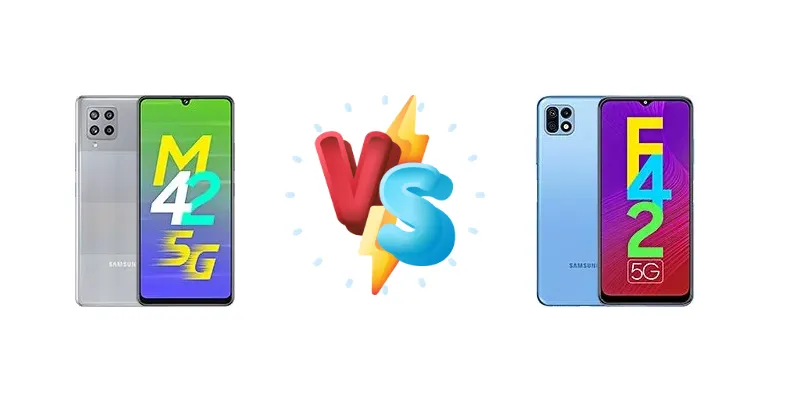
Samsung's M and F series consistently deliver compelling value in the mid-range 5G space. The Galaxy M42 5G and F42 5G represent two distinct approaches to achieving this, differing primarily in their core chipsets. This comparison dissects the Qualcomm Snapdragon 750G-powered M42 5G against the MediaTek Dimensity 700-equipped F42 5G, revealing which device offers the best balance of performance, efficiency, and features.
🏆 Quick Verdict
For the average user prioritizing consistent performance and potentially better long-term software support, the Samsung Galaxy M42 5G emerges as the stronger choice. Its Snapdragon 750G chipset, built on a smaller 8nm process, offers a slight edge in efficiency and sustained performance compared to the F42 5G's Dimensity 700.
| Network |
|---|
| 2G bands | GSM 850 / 900 / 1800 / 1900 | GSM 850 / 900 / 1800 / 1900 |
| 3G bands | HSDPA 850 / 900 / 1700(AWS) / 1900 / 2100 | HSDPA 850 / 900 / 1900 / 2100 |
| 4G bands | 1, 2, 3, 4, 5, 7, 8, 12, 17, 20, 28, 38, 40, 41 | 1, 2, 3, 5, 7, 8, 20, 28, 38, 40, 41 |
| 5G bands | 1, 3, 5, 7, 8, 28, 40, 41, 78 SA/NSA/Sub6 | 1, 3, 5, 7, 8, 20, 28, 38, 41, 78, 79 SA/NSA/Sub6 |
| Speed | HSPA, LTE, 5G | HSPA, LTE, 5G |
| Technology | GSM / HSPA / LTE / 5G | GSM / HSPA / LTE / 5G |
| Launch |
|---|
| Announced | 2021, April 28 | 2021, September 29 |
| Status | Available. Released 2021, May 01 | Available. Released 2021, October 03 |
| Body |
|---|
| Build | - | Glass front, plastic frame, plastic back |
| Dimensions | 164.4 x 75.9 x 8.6 mm (6.47 x 2.99 x 0.34 in) | 167.2 x 76.4 x 9 mm (6.58 x 3.01 x 0.35 in) |
| SIM | Nano-SIM + Nano-SIM | Nano-SIM + Nano-SIM |
| Weight | 190 g (6.70 oz) | 203 g (7.16 oz) |
| Display |
|---|
| Resolution | 720 x 1600 pixels, 20:9 ratio (~266 ppi density) | 1080 x 2408 pixels, 20:9 ratio (~400 ppi density) |
| Size | 6.6 inches, 105.2 cm2 (~84.3% screen-to-body ratio) | 6.6 inches, 104.9 cm2 (~82.1% screen-to-body ratio) |
| Type | Super AMOLED | TFT LCD, 90Hz |
| Platform |
|---|
| CPU | Octa-core (2x2.2 GHz Kryo 570 & 6x1.8 GHz Kryo 570) | Octa-core (2x2.2 GHz Cortex-A76 & 6x2.0 GHz Cortex-A55) |
| Chipset | Qualcomm SM7225 Snapdragon 750G 5G (8 nm) | Mediatek Dimensity 700 (7 nm) |
| GPU | Adreno 619 | Mali-G57 MC2 |
| OS | Android 11, upgradable to Android 13, One UI 5.1 | Android 11, upgradable to Android 13, One UI core 5 |
| Memory |
|---|
| Card slot | microSDXC (uses shared SIM slot) | microSDXC (dedicated slot) |
| Internal | 128GB 6GB RAM, 128GB 8GB RAM | 128GB 6GB RAM, 128GB 8GB RAM |
| | UFS 2.1 | - |
| Main Camera |
|---|
| Features | LED flash, panorama, HDR | LED flash, panorama, HDR |
| Quad | 48 MP, f/1.8, (wide), 1/2.0", 0.8µm, PDAF
8 MP, f/2.2, 123˚ (ultrawide)
5 MP (macro)
Auxiliary lens | - |
| Single | 20 MP, f/2.2, (wide) | - |
| Triple | - | 64 MP, f/1.8, (wide), PDAF
5 MP, f/2.2, 115˚ (ultrawide), 1/5.0", 1.12µm
Auxiliary lens |
| Video | 4K@30fps, 1080p@30fps, 720p@480fps | 1152p@30fps |
| Selfie camera |
|---|
| Features | HDR | - |
| Single | 20 MP, f/2.2, (wide) | 8 MP, f/2.0, (wide) |
| Video | 1080p@30fps | 1080p@30fps |
| Sound |
|---|
| 3.5mm jack | Yes | Yes |
| 35mm jack | Yes | Yes |
| Loudspeaker | Yes | Yes |
| Comms |
|---|
| Bluetooth | 5.0, A2DP, LE | 5.0, A2DP, LE |
| NFC | Yes | No |
| Positioning | GPS, GLONASS, GALILEO, BDS | GPS, GLONASS, GALILEO, BDS |
| Radio | FM radio | FM radio, recording |
| USB | USB Type-C 2.0, OTG | USB Type-C 2.0, OTG |
| WLAN | Wi-Fi 802.11 a/b/g/n/ac, dual-band, Wi-Fi Direct | Wi-Fi 802.11 a/b/g/n/ac, dual-band, Wi-Fi Direct |
| Features |
|---|
| Sensors | Fingerprint (under display, optical), accelerometer, gyro, compass | Fingerprint (side-mounted), accelerometer, gyro, proximity, compass |
| | Virtual proximity sensing | - |
| Battery |
|---|
| Charging | 15W wired | 15W wired |
| Type | Li-Po 5000 mAh | Li-Po 5000 mAh |
| Misc |
|---|
| Colors | Prism Dot Black, Prism Dot Gray | Matte Aqua, Matte Black |
| Models | SM-M426B, SM-M426B/DS | SM-E426B, SM-E426B/DS |
| Price | About 220 EUR | About 240 EUR |
| SAR | 0.69 W/kg (head) | 0.47 W/kg (head) |
| SAR EU | - | 0.94 W/kg (head) 1.23 W/kg (body) |
Samsung Galaxy M42 5G
- More efficient Snapdragon 750G chipset
- Potentially better sustained performance
- Qualcomm's established 5G modem technology
- May be slightly more expensive
- 15W charging is relatively slow
Samsung Galaxy F42 5G
- Potentially lower price point
- MediaTek Dimensity 700 offers solid performance
- 15W charging is standard for the segment
- Dimensity 700 may throttle under sustained load
- MediaTek's software support can be less consistent
Display Comparison
Both devices are expected to feature similar LCD panels, though specific details like peak brightness and color gamut coverage are not provided. The focus here is on the internal hardware. The absence of high refresh rate panels on either device suggests a cost-saving measure, impacting smoothness during scrolling and animations. Bezels are likely comparable, typical of this price segment.
Camera Comparison
Without detailed sensor information, a direct camera comparison is difficult. However, given the market positioning, both phones likely feature a primary sensor around the 48MP-64MP range. The image processing algorithms will differ between Samsung's software and MediaTek's ISP, potentially leading to variations in color science and dynamic range. The inclusion of 2MP macro lenses on both devices is largely a marketing tactic, offering limited practical benefit due to their low resolution and lack of optical image stabilization (OIS).
Performance
The core difference lies in the chipsets. The Samsung Galaxy M42 5G utilizes the Qualcomm SM7225 Snapdragon 750G 5G (8nm), featuring an octa-core CPU with 2x2.2 GHz Kryo 570 prime cores and 6x1.8 GHz Kryo 570 efficiency cores. The Galaxy F42 5G, conversely, employs the MediaTek Dimensity 700 (7nm) with an octa-core configuration of 2x2.2 GHz Cortex-A76 performance cores and 6x2.0 GHz Cortex-A55 efficiency cores. While both CPUs boast similar peak clock speeds, the Snapdragon 750G's 8nm fabrication process generally translates to better thermal efficiency, reducing the likelihood of performance throttling during extended gaming sessions. The Snapdragon also benefits from Qualcomm's optimized software and modem integration.
Battery Life
Both devices feature 15W wired charging, indicating a similar charging experience – expect around 2-2.5 hours for a full charge. Battery capacity is not specified, but given the similar form factors and target price points, they are likely in the 5000-6000 mAh range. The Snapdragon 750G's superior efficiency in the M42 5G could translate to slightly longer battery life under similar usage conditions, offsetting any potential capacity differences.
Buying Guide
Buy the Samsung Galaxy M42 5G if you need a phone that can handle moderate gaming and multitasking without significant throttling, and if you value Qualcomm's established ecosystem and potential for quicker software updates. Buy the Samsung Galaxy F42 5G if you prioritize a potentially lower price point and are comfortable with MediaTek's Dimensity platform, understanding that sustained performance might be slightly less consistent under heavy load.
Frequently Asked Questions
❓ Will the Dimensity 700 in the F42 5G overheat during prolonged gaming sessions like PUBG?
The Dimensity 700 is a capable chipset, but its 7nm process is less efficient than the Snapdragon 750G's 8nm process. This means the F42 5G is more likely to experience thermal throttling during extended gaming, potentially leading to frame rate drops and a less smooth experience. While playable, it won't maintain peak performance as consistently as the M42 5G.
❓ Does the Snapdragon 750G in the M42 5G support carrier aggregation for faster 5G speeds?
Yes, the Snapdragon 750G is known for its robust 5G modem capabilities, including support for carrier aggregation. This allows the M42 5G to combine multiple 5G channels for significantly faster download and upload speeds, provided your carrier supports it. The Dimensity 700 also supports carrier aggregation, but Qualcomm's modem technology is generally considered more mature and widely compatible.
❓ How significant is the difference in real-world performance between the two devices for everyday tasks like browsing and social media?
For typical daily usage – browsing, social media, video streaming – the performance difference between the two devices will be minimal and largely imperceptible. Both chipsets are more than capable of handling these tasks smoothly. The difference becomes more noticeable during demanding applications like gaming or video editing.