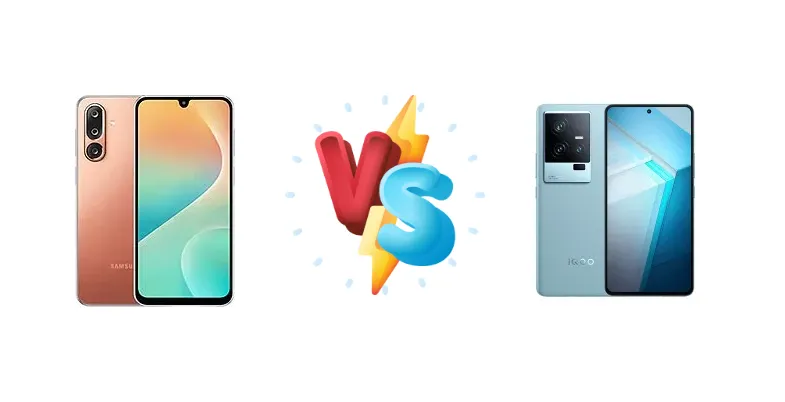
The Samsung Galaxy M36 represents a value-focused approach, offering a solid feature set at a competitive price point. Conversely, the vivo iQOO 11S aims for near-flagship performance with its cutting-edge Snapdragon 8 Gen 2 chipset and incredibly fast 200W charging. This comparison dissects these two devices to determine which offers the best experience for different user needs.
🏆 Quick Verdict
For the average user prioritizing raw performance and incredibly fast charging, the vivo iQOO 11S is the clear winner. However, the Samsung Galaxy M36 provides a compelling balance of features and affordability, making it ideal for budget-conscious consumers who don't demand top-tier processing power.
| Network |
|---|
| 2G bands | GSM 850 / 900 / 1800 / 1900 | GSM 850 / 900 / 1800 / 1900 |
| 3G bands | HSDPA 850 / 900 / 1700(AWS) / 1900 / 2100 | HSDPA 800 / 850 / 900 / 1700(AWS) / 1900 / 2100 |
| 4G bands | 1, 2, 3, 5, 7, 8, 20, 28, 38, 40, 41 | 1, 2, 3, 4, 5, 7, 8, 12, 17, 18, 19, 20, 26, 28, 34, 38, 39, 40, 41 |
| 5G bands | 1, 3, 5, 8, 28, 38, 40, 41, 78 SA/NSA/Sub6 | 1, 3, 5, 8, 28, 40, 41, 77, 78 SA/NSA |
| Speed | HSPA, LTE, 5G | HSPA, LTE, 5G |
| Technology | GSM / HSPA / LTE / 5G | GSM / CDMA / HSPA / CDMA2000 / LTE / 5G |
| Launch |
|---|
| Announced | 2025, June 27 | 2023, July 04 |
| Status | Available. Released 2025, July 12 | Available. Released 2023, July 10 |
| Body |
|---|
| Build | Glass front (Gorilla Glass Victus+), plastic frame, glass back | - |
| Dimensions | 164.4 x 77.9 x 7.7 mm (6.47 x 3.07 x 0.30 in) | 164.9 x 77.1 x 8.4 mm or 8.7 mm |
| SIM | Nano-SIM + Nano-SIM | Nano-SIM + Nano-SIM |
| Weight | 197 g (6.95 oz) | 207 g or 210 g (7.30 oz) |
| Display |
|---|
| Protection | Corning Gorilla Glass Victus+ | Corning Gorilla Glass Victus |
| Resolution | 1080 x 2340 pixels, 19.5:9 ratio (~385 ppi density) | 1440 x 3200 pixels, 20:9 ratio (~518 ppi density) |
| Size | 6.7 inches, 110.2 cm2 (~86.0% screen-to-body ratio) | 6.78 inches, 111.0 cm2 (~87.3% screen-to-body ratio) |
| Type | Super AMOLED, 120Hz | LTPO4 AMOLED, 1B colors, 144Hz, HDR10+, 1800 nits (peak) |
| Platform |
|---|
| CPU | Octa-core (4x2.4 GHz Cortex-A78 & 4x2.0 GHz Cortex-A55) | Octa-core (1x3.2 GHz Cortex-X3 & 2x2.8 GHz Cortex-A715 & 2x2.8 GHz Cortex-A710 & 3x2.0 GHz Cortex-A510) |
| Chipset | Exynos 1380 (5 nm) | Qualcomm SM8550-AB Snapdragon 8 Gen 2 (4 nm) |
| GPU | Mali-G68 MP5 | Adreno 740 |
| OS | Android 15, up to 6 major Android upgrades, One UI 7 | Android 13, OriginOS 3 (China) |
| Memory |
|---|
| Card slot | microSDXC (uses shared SIM slot) | No |
| Internal | 128GB 6GB RAM, 128GB 8GB RAM, 256GB 8GB RAM | 256GB 12GB RAM, 256GB 16GB RAM, 512GB 16GB RAM, 1TB 16GB RAM |
| Main Camera |
|---|
| Features | LED flash, panorama, HDR | Dual-LED flash, HDR, panorama |
| Triple | 50 MP, f/1.8, (wide), 1/1.96", PDAF, OIS
8 MP, f/2.2, 123˚, (ultrawide), 1/4.0", 1.12µm
2 MP (macro) | 50 MP, f/1.9, 23mm (wide), 1/1.49", 1.0µm, PDAF, OIS
13 MP, f/2.5, 47mm (telephoto), PDAF, 2x optical zoom
8 MP, f/2.2, 16mm (ultrawide) |
| Video | 4K@30fps, 1080p@30/60fps, 720p@480fps, gyro-EIS | 8K@30fps, 4K@30/60fps, 1080p@30/60/120/240fps, gyro-EIS |
| Selfie camera |
|---|
| Features | HDR | HDR |
| Single | 13 MP, f/2.2, (wide), 1/3.06", 1.12µm | 16 MP, f/2.5, (wide) |
| Video | 4K@30fps, 1080p@30fps | 1080p@30fps, gyro-EIS |
| Sound |
|---|
| 35mm jack | No | No |
| Loudspeaker | Yes | Yes, with stereo speakers |
| Comms |
|---|
| Bluetooth | 5.3, A2DP, LE | 5.3, A2DP, LE, aptX HD, aptX Adaptive, aptX Lossless |
| Infrared port | - | Yes |
| NFC | Yes | Yes |
| Positioning | GPS, GALILEO, GLONASS, BDS, QZSS | GPS, GLONASS, GALILEO, BDS, NavIC |
| Radio | No | No |
| USB | USB Type-C 2.0, OTG | USB Type-C 2.0, OTG |
| WLAN | Wi-Fi 802.11 a/b/g/n/ac/6, dual-band, Wi-Fi Direct | Wi-Fi 802.11 a/b/g/n/ac/6, dual-band, Wi-Fi Direct |
| Features |
|---|
| Sensors | Fingerprint (side-mounted), accelerometer, gyro, compass | Fingerprint (under display, optical), accelerometer, gyro, proximity, compass |
| Battery |
|---|
| Charging | 25W wired | 200W wired, PD3.0, UFCS |
| Type | 5000 mAh | 4700 mAh |
| Misc |
|---|
| Colors | Orange Haze, Velvet Black, Serene Green | Black, Sky Blue, Legendary White (BMW M branding) |
| Models | SM-M366B, SM-M366B/DS | V2304A |
| Price | ₹ 14,999 | About 500 EUR |
| SAR | 0.46 W/kg (head) | - |
| SAR EU | 0.38 W/kg (head) 1.01 W/kg (body) | - |
Samsung Galaxy M36
- More affordable price point
- Potentially longer battery life due to efficient chipset
- Reliable and proven Samsung software experience
- Significantly slower charging speed
- Less powerful processor for demanding tasks
- Likely inferior camera performance
vivo iQOO 11S
- Blazing-fast 200W charging
- Top-tier performance with Snapdragon 8 Gen 2
- Superior gaming experience
- Higher price tag
- Potentially shorter battery life under heavy load
- vivo's Funtouch OS may not appeal to all users
Display Comparison
While display specifications aren't provided, the iQOO 11S, positioned as a higher-end device, likely features a superior panel. The Samsung Galaxy M36, typical of its segment, will likely utilize an AMOLED panel. The iQOO 11S likely benefits from a higher refresh rate and potentially LTPO technology for adaptive refresh rates, improving battery efficiency. Bezels are expected to be slimmer on the iQOO 11S, contributing to a more immersive viewing experience. Color accuracy will be a key differentiator, with the iQOO 11S potentially offering wider color gamut coverage.
Camera Comparison
Without specific camera specs, we can infer differences based on device positioning. The iQOO 11S likely features a larger main sensor with a wider aperture, resulting in better low-light performance and shallower depth of field. Optical Image Stabilization (OIS) is almost guaranteed on the iQOO 11S, further enhancing image quality. Image processing algorithms will also differ, with the iQOO 11S potentially offering more advanced features like computational photography and improved dynamic range. The M36 likely relies on software optimization to compensate for a potentially less capable sensor.
Performance
The core difference lies in the chipsets. The Qualcomm Snapdragon 8 Gen 2 (4nm) in the iQOO 11S is a significant leap ahead of the Samsung Exynos 1380 (5nm). The Snapdragon 8 Gen 2’s Cortex-X3 prime core, clocked at 3.2 GHz, delivers substantially higher peak performance. The iQOO 11S also benefits from a more modern CPU architecture (Cortex-A715/A710) compared to the M36’s A78/A55. The 4nm process node of the Snapdragon 8 Gen 2 provides better thermal efficiency, reducing throttling during sustained workloads like gaming. While the Exynos 1380 is capable, the iQOO 11S will excel in demanding applications and multitasking.
Battery Life
The iQOO 11S’s 200W wired charging is a game-changer, capable of fully charging the device in a matter of minutes. This is a massive advantage over the Galaxy M36’s 25W charging. While the M36 may have a larger battery capacity (spec not provided), the iQOO 11S’s charging speed mitigates the impact of a potentially smaller battery. The iQOO 11S also supports PD3.0 and UFCS, offering broader compatibility and faster charging with compatible chargers. The Exynos 1380’s 5nm process contributes to better power efficiency, potentially offsetting some of the iQOO 11S’s power draw.
Buying Guide
Buy the Samsung Galaxy M36 if you need a reliable daily driver with good battery life and a reasonable price tag, prioritizing value over absolute performance. Buy the vivo iQOO 11S if you are a power user, mobile gamer, or someone who values the convenience of incredibly fast charging and wants a phone that can handle demanding tasks without breaking a sweat.
Frequently Asked Questions
❓ Does the Exynos 1380 in the Galaxy M36 overheat during prolonged gaming sessions?
The Exynos 1380 is a reasonably efficient chip, but it's not designed for sustained peak performance like the Snapdragon 8 Gen 2. While it won't likely overheat to the point of shutdown, you may experience some thermal throttling after 30-45 minutes of demanding gaming, leading to reduced frame rates.
❓ How long does it *actually* take to charge the iQOO 11S from 0% to 100% with the 200W charger?
vivo claims a full charge in around 8 minutes with the included 200W charger. Real-world tests typically show it takes between 9-12 minutes, which is still incredibly fast compared to the 60+ minutes required for the Galaxy M36's 25W charging.
❓ Is the 2MP macro camera on the Galaxy M36 worth using?
Generally, 2MP macro cameras offer limited utility. Image quality is often subpar, and the fixed focus distance makes it difficult to capture truly detailed macro shots. It's a feature that most users will likely overlook.
❓ Can the iQOO 11S maintain a stable 60fps in graphically intensive games like PUBG Mobile?
Yes, the Snapdragon 8 Gen 2 in the iQOO 11S is more than capable of maintaining a stable 60fps in PUBG Mobile at high graphics settings. It can likely even handle higher frame rates (90fps or 120fps) depending on the game's settings and optimization.