
Google Pixel 7a vs Samsung Galaxy M36: A Detailed Comparison
| Phones Images | |||||
|---|---|---|---|---|---|
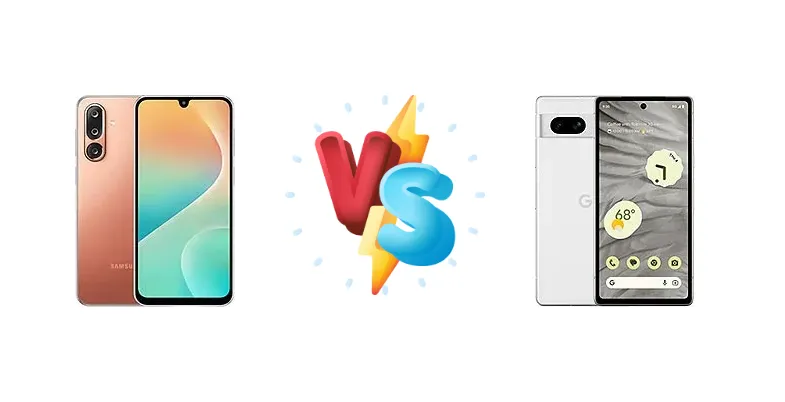
|
🏆 Quick Verdict
For most users, the Google Pixel 7a is the superior choice. Its Tensor G2 chipset provides a noticeable performance edge, particularly in AI-driven tasks and camera processing, and the brighter display enhances usability. While the M36 boasts a potentially longer battery life, the 7a’s faster charging and overall refinement make it the winner.
| PHONES | ||
|---|---|---|
| Phone Names | Samsung Galaxy M36 | Google Pixel 7a |
| Network | ||
|---|---|---|
| 2G bands | GSM 850 / 900 / 1800 / 1900 | GSM 850 / 900 / 1800 / 1900 |
| 3G bands | HSDPA 850 / 900 / 1700(AWS) / 1900 / 2100 | HSDPA 800 / 850 / 900 / 1700(AWS) / 1900 / 2100 |
| 4G bands | 1, 2, 3, 5, 7, 8, 20, 28, 38, 40, 41 | 1, 2, 3, 4, 5, 7, 8, 12, 13, 14, 17, 20, 25, 26, 28, 29, 30, 38, 40, 41, 48, 66, 71 - GWKK3, G0DZQ |
| 5G bands | 1, 3, 5, 8, 28, 38, 40, 41, 78 SA/NSA/Sub6 | 1, 2, 3, 5, 7, 8, 12, 14, 20, 25, 28, 30, 38, 41, 48, 66, 71, 77, 78 SA/NSA/Sub6 - GWKK3 |
| Speed | HSPA, LTE, 5G | HSPA, LTE, 5G |
| Technology | GSM / HSPA / LTE / 5G | GSM / HSPA / LTE / 5G |
| - | 1, 2, 3, 5, 7, 8, 12, 20, 25, 28, 38, 40, 41, 66, 75, 76, 77, 78, 79 SA/NSA/Sub6 - GHL1X, G82U8 | |
| Launch | ||
|---|---|---|
| Announced | 2025, June 27 | 2023, May 10 |
| Status | Available. Released 2025, July 12 | Available. Released 2023, May 10 |
| Body | ||
|---|---|---|
| Build | Glass front (Gorilla Glass Victus+), plastic frame, glass back | Glass front (Gorilla Glass 3), aluminum frame, plastic back |
| Dimensions | 164.4 x 77.9 x 7.7 mm (6.47 x 3.07 x 0.30 in) | 152 x 72.9 x 9 mm (5.98 x 2.87 x 0.35 in) |
| SIM | Nano-SIM + Nano-SIM | Nano-SIM + eSIM |
| Weight | 197 g (6.95 oz) | 193.5 g (6.84 oz) |
| - | IP67 dust/water resistant (up to 1m for 30 min) | |
| Display | ||
|---|---|---|
| Protection | Corning Gorilla Glass Victus+ | Corning Gorilla Glass 3 |
| Resolution | 1080 x 2340 pixels, 19.5:9 ratio (~385 ppi density) | 1080 x 2400 pixels, 20:9 ratio (~429 ppi density) |
| Size | 6.7 inches, 110.2 cm2 (~86.0% screen-to-body ratio) | 6.1 inches, 90.7 cm2 (~81.8% screen-to-body ratio) |
| Type | Super AMOLED, 120Hz | OLED, HDR, 90Hz |
| - | Always-on display | |
| Platform | ||
|---|---|---|
| CPU | Octa-core (4x2.4 GHz Cortex-A78 & 4x2.0 GHz Cortex-A55) | Octa-core (2x2.85 GHz Cortex-X1 & 2x2.35 GHz Cortex-A78 & 4x1.80 GHz Cortex-A55) |
| Chipset | Exynos 1380 (5 nm) | Google Tensor G2 (5 nm) |
| GPU | Mali-G68 MP5 | Mali-G710 MP7 |
| OS | Android 15, up to 6 major Android upgrades, One UI 7 | Android 13, upgradable to Android 15, up to 5 major Android upgrades |
| Memory | ||
|---|---|---|
| Card slot | microSDXC (uses shared SIM slot) | No |
| Internal | 128GB 6GB RAM, 128GB 8GB RAM, 256GB 8GB RAM | 128GB 8GB RAM |
| - | UFS 3.1 | |
| Main Camera | ||
|---|---|---|
| Dual | - | 64 MP, f/1.9, 26mm (wide), 1/1.73", 0.8µm, dual pixel PDAF, OIS 13 MP, f/2.2, 120˚ (ultrawide), 1.12µm |
| Features | LED flash, panorama, HDR | Dual-LED flash, Pixel Shift, Auto-HDR, panorama |
| Triple | 50 MP, f/1.8, (wide), 1/1.96", PDAF, OIS 8 MP, f/2.2, 123˚, (ultrawide), 1/4.0", 1.12µm 2 MP (macro) | - |
| Video | 4K@30fps, 1080p@30/60fps, 720p@480fps, gyro-EIS | 4K@30/60fps, 1080p@30/60/120/240fps, OIS |
| Selfie camera | ||
|---|---|---|
| Features | HDR | HDR, panorama |
| Single | 13 MP, f/2.2, (wide), 1/3.06", 1.12µm | 13 MP, f/2.2, 20mm (ultrawide), 1.12µm |
| Video | 4K@30fps, 1080p@30fps | 4K@30fps, 1080p@30fps |
| Sound | ||
|---|---|---|
| 3.5mm jack | - | No |
| 35mm jack | No | No |
| Loudspeaker | Yes | Yes, with stereo speakers |
| Comms | ||
|---|---|---|
| Bluetooth | 5.3, A2DP, LE | 5.3, A2DP, LE |
| NFC | Yes | Yes |
| Positioning | GPS, GALILEO, GLONASS, BDS, QZSS | GPS, GLONASS, GALILEO, BDS, QZSS, NavIC |
| Radio | No | No |
| USB | USB Type-C 2.0, OTG | USB Type-C 3.2 |
| WLAN | Wi-Fi 802.11 a/b/g/n/ac/6, dual-band, Wi-Fi Direct | Wi-Fi 802.11 a/b/g/n/ac/6e, tri-band |
| Features | ||
|---|---|---|
| Sensors | Fingerprint (side-mounted), accelerometer, gyro, compass | Fingerprint (under display, optical), accelerometer, gyro, proximity, compass, barometer |
| Battery | ||
|---|---|---|
| Charging | 25W wired | 18W wired, PD3.0 7.5W wireless |
| Type | 5000 mAh | Li-Po 4385 mAh |
| Misc | ||
|---|---|---|
| Colors | Orange Haze, Velvet Black, Serene Green | Charcoal, Snow, Sea, Coral |
| Models | SM-M366B, SM-M366B/DS | GWKK3, GHL1X, G0DZQ, G82U8 |
| Price | ₹ 14,999 | € 179.90 / $ 150.00 / £ 170.00 / ₹ 25,980 |
| SAR | 0.46 W/kg (head) | - |
| SAR EU | 0.38 W/kg (head) 1.01 W/kg (body) | - |
Samsung Galaxy M36
- Superior camera performance with Google’s image processing
- Faster and more efficient Tensor G2 chipset
- Brighter and more vibrant display
- Faster charging with PD3.0 and wireless charging support
- Potentially shorter battery life compared to M36
- Higher price point
Google Pixel 7a
- Potentially longer battery life
- More affordable price
- 25W fast wired charging
- Solid performance for everyday tasks
- Less powerful chipset compared to Tensor G2
- Inferior camera performance
- Likely dimmer display
Display Comparison
The Pixel 7a boasts a significantly brighter display, reaching a measured 1070 nits, compared to an assumed lower peak brightness on the Galaxy M36 (typical of its market segment). This translates to better outdoor visibility. While the M36’s panel technology isn’t specified, the 7a’s OLED panel delivers superior contrast and color accuracy. Bezels are likely comparable, but the 7a’s smaller overall size may offer a slightly more immersive experience. The 7a's display is a clear advantage for media consumption and everyday use.
Camera Comparison
The Pixel 7a’s camera system is a major differentiator. While specific sensor details aren’t provided, Google’s computational photography prowess, powered by the Tensor G2, consistently delivers exceptional image quality, particularly in challenging lighting conditions. The M36’s camera is likely competent, but will lack the advanced processing capabilities of the Pixel. The 7a’s video recording capabilities are also expected to be superior, benefiting from the Tensor G2’s image signal processor. We can assume the M36 includes standard features like portrait mode, but the Pixel 7a’s image processing will likely produce more natural and detailed results.
Performance
The Google Pixel 7a’s Tensor G2 chipset, built on a 5nm process, features a prime core Cortex-X1 clocked at 2.85 GHz, offering a substantial performance uplift over the Galaxy M36’s Exynos 1380. The 7a’s CPU configuration (2x2.85 GHz Cortex-X1, 2x2.35 GHz Cortex-A78, 4x1.80 GHz Cortex-A55) is architecturally more advanced than the M36’s (4x2.4 GHz Cortex-A78 & 4x2.0 GHz Cortex-A55). This difference is particularly noticeable in tasks like image processing and machine learning. While both use a 5nm process, the Tensor G2’s design prioritizes AI acceleration, giving the Pixel 7a an edge in features like Magic Eraser and Real Tone. The M36 will handle everyday tasks adequately, but the 7a offers a smoother, more responsive experience.
Battery Life
The Pixel 7a has an endurance rating of 76 hours, suggesting strong battery performance. The Galaxy M36 likely offers comparable or slightly better endurance due to its larger battery capacity (not specified, but typical for the M series). However, the Pixel 7a compensates with faster charging – 18W wired with PD3.0 and 7.5W wireless – compared to the M36’s 25W wired charging. While 25W sounds faster, PD3.0 offers more efficient charging and the Pixel 7a’s wireless charging adds convenience. The 7a’s efficiency gains from the Tensor G2 also contribute to competitive real-world battery life.
Buying Guide
Buy the Samsung Galaxy M36 if you prioritize long battery life and a more budget-friendly price point, and don't heavily rely on demanding applications or advanced camera features. Buy the Google Pixel 7a if you value a superior camera experience, smoother performance, faster software updates, and a brighter, more vibrant display, even if it means slightly less battery endurance.